Pan-listing fever found me looking at a photograph of a moss (above) that I took on Sunday (at Stourhead in Wiltshire) and deciding, rightly or wrongly, that it must be Brachythecium rutabulana, a type of feather-moss. As with all such groups, whose species number hundreds and can be bewilderingly similar, my declaration of identification is somewhat a leap of faith. I can also reveal that I also had an armchair tick this evening - I was reading about rotifers (go and look it up) and was pleased to find out that there is a common species, Philodina roseola, that lives in water butts and bird baths that has a habit of turning the water in the latter red. This often happens in our bird bath and I have wondered what it is that magically makes the water a living rusty soup. Now I know. Pan-list: 2626 (until someone cleverer than me tells me what the moss really is).
Monday, 31 January 2011
Two more
Pan-listing fever found me looking at a photograph of a moss (above) that I took on Sunday (at Stourhead in Wiltshire) and deciding, rightly or wrongly, that it must be Brachythecium rutabulana, a type of feather-moss. As with all such groups, whose species number hundreds and can be bewilderingly similar, my declaration of identification is somewhat a leap of faith. I can also reveal that I also had an armchair tick this evening - I was reading about rotifers (go and look it up) and was pleased to find out that there is a common species, Philodina roseola, that lives in water butts and bird baths that has a habit of turning the water in the latter red. This often happens in our bird bath and I have wondered what it is that magically makes the water a living rusty soup. Now I know. Pan-list: 2626 (until someone cleverer than me tells me what the moss really is).
Pan-species listing
Friday, 28 January 2011
My dark crystal ball
Monday, 24 January 2011
Moth maps mania
The latest in an increasingly frequent line of 'natural history books that I have obtained' is the snappily titled 'Provisional Atlas of the UK's Larger Moths' brought to you by those really useful people at Butterfly Conservation. It costs £20 (plus postage and packing) and the only bad news is that the special offer that was on last week has now ended. If you have sent in any moth records to your county recorder since 2000 then you can play the 'spot my dot' game, where you work out if one of the dots on any given map of any given species is totally down to you. I reckon that I have two - for Striped Hawk-moth and Blair's Mocha from my back garden. In reality there may be more - after all, even common species might have been missing purely because nobody else thought that they were worth mentioning. The maps are fascinating, revealing the winners and unfortunately losers in moth populations. The maps only reveal distribution and not numbers, but every open circle (for records before 2000 but not recorded since) is a sad sight indeed. I needed only to glance at the distribution map for the V-Moth to understand why I have never seen one...
Thursday, 20 January 2011
When butterflies swarm!
I too have been lucky enough to witness such spectacles:
9 August 1978, Beddington SF, Surrey
Thousands of Small and Essex Skippers emerged en masse across the heavily vegetated sludge lagoon banks, creating a golden orange haze at waist height.
24 July 1992, Middleton, West Sussex
As I drove alongside a large field (crop unknown) I was staggered to realise that the white mist hanging over it was in fact tens of thousands of 'white' butterflies. I reckoned that they were all Large and Small Whites and it was simply staggering.
28 July 1997, Bude, Cornwall
A walk along the cliff top heading north revealed thousands of Gatekeepers and Meadow Browns. I have made this same walk many years since but have yet to see such numbers here again.
28 August 1997, Cavenham Heath, Suffolk
1500 Small Tortoiseshell were shoe-horned into an area of gorse and heather no larger than a football pitch.
6 August 2006, Braunton Burrowes, Devon
A simply stunning day. There were butterflies everywhere, great clouds of mixed species being flushed as I wandered the southern section of this area of vegetated sand dunes. The standout count was of a minimum of 4,500 Common Blues, but four figure counts of several other species made the experience unforgettable.
Monday, 17 January 2011
It's almost time...

The Butterfly Isles by Patrick Barkham is my current read. It is a book that informs, entertains and makes you think about why we take such an interest in the natural world around us. I’m a sucker for any well-written natural history literature and this is definitely one that comes into that category.
It's got me all wistful for butterflies again. I can normally expect to see one by the end of February, usually an individual flushed out of hibernation by a spot of shed tidying or a shaft of warming sunlight. In most years the honour will go to a Red Admiral, a Small Tortoiseshell, a Peacock or a Brimstone. On one mild mid-February day several years ago, I recorded both Small Tortoiseshell and a Brimstone – a double flutterby start to the year!
The book has also made me realise that there are species, within easy travelling distance, that I should go and see before its too late. I haven’t seen Duke of Burgundy, nor Glanville Fritillary, Lulworth Skipper or Heath Fritillary. I really ought to get myself into gear and put that right this coming summer.
Get the book and you wont be disappointed. A word of warning though – you may find yourself adding a few trips to your list this summer.
Tuesday, 11 January 2011
Like buses
Monday, 10 January 2011
When birders get injured
Sunday, 9 January 2011
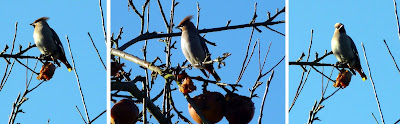
Come in Bombycilla garrulus, your time is up...
I've whined on about how, since my initial November burst of Waxwings, the little sods have eluded me. It got to the stage where my wife and daughters asked me, every time I came into the house, whether or not I'd seen a Waxwing. And each time they looked upon my crestfallen face, with my head shaking in shame and defeat, they felt a little of the hurt themselves.Saturday, 8 January 2011
Politically incorrect
This is Auricularia auricula-jadae. Its English name was once Jew's Ear, but the 'PC Police' paid it a visit and declared that in these more enlightened times it ought to be refered to as Jelly Ear. I can vouch from checking a number of peoples ears (from differing religions) that this fungus does not resemble the average Jewish persons ear. In fact, the closest that I can find to a match is that of a rugby-playing catholic. I took this picture this morning at Beddington Sewage Farm whilst on a grand sweep of the area with Tank/Smiler/Steve (everyone at Beddington now has at least three names). We also recorded a minimum of 14 Green Sandpipers (which included a flock of 7) and 5 Water Pipits. Even after the coldest December since the Earth's crust cooled, there is so much fresh Hemlock growth emerging that it beggars belief.
Friday, 7 January 2011
When the text alarm goes off...
Thursday, 6 January 2011
All-taxa list update
Flora: 1360
Moths: 675
Butterflies: 50
Birds: 370
Dragonflies: 33
Fungi: 23
Mammals: 32
Marine: 5
Other insects: 39
Amphibians: 5
Reptiles: 4
Fish: 17
Snails: 4
Mosses, lichens, liverworts: 6
Grasshoppers and Crickets: 1
Plenty of room for additions. Just a question of putting in the time to get up to 3000...
Tuesday, 4 January 2011
Failing
Sunday, 2 January 2011
Committing patch adultery
I can't help it. I take on a patch, get keen, visit on a regular basis, get to know it well and then, after a certain amount of time, find another area that tickles my fancy. I don't totally give up on a patch, I just adopt another and add it to my suite of places to visit. But, I find myself feeling guilty about doing so, as if I'm being unfaithful to my other sites.Saturday, 1 January 2011
Keep calm and carry on
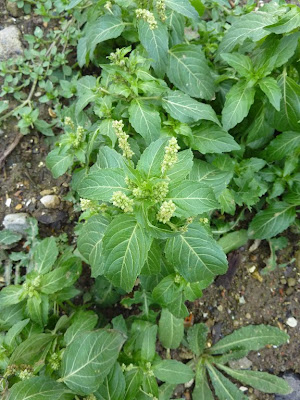
The first day of the year also saw my first day of undertaking the Beddington Sewage Farm botanical survey. It sounds rather grander than it really is - it's just me wandering all over the farm for the next twelve months making a list of the species present and commenting on their status and where they can be found. There is going to be one drawback however, and that is that when I am looking down at plants I cannot also be looking up at birds. Because of this, as I was photographing the Annual Mercury (pictured above) a skein of 25 White-fronted Geese flew over my head. A text alert had me frantically scanning the skies, but to no avail. It is just as well that with my new-found zen-like state of being I was able to accept this with calm and grace ...bollocks!!