Sunday, 27 February 2011
Odds and sods
I've added two links to this blog. Mark Telfer (he of pan-species fame) and Stewart Sexton's moths only blog. Both worth a look.
My latest addition to the North Downs and beyond library is 'The Advanced Bird ID Guide to the Western Palearctic' by Nils Van Duivenijk. This is an overdue purchase. There is no excuse to cock up any identification ever again with this tucked into the rucksack.
Saturday, 26 February 2011
Caspian Gull
A grey, wet morning at Beddington Sewage Farm was enlivened by this adult Caspian Gull and two Firecrests. The crests have been present since December, but have been elusive. I was pleased to finally catch up with them.
Thursday, 24 February 2011
A brief history of moths in the garden
As I am about to embark on another season of moth recording in the garden, I thought it might be worth mentioning what has gone before...
We moved into our current house in Banstead, (just outside of the Greater London boundary in north Surrey), in August 1987. The garden is 90 foot long and of a typical 1930s semi-detached house. There is a mature ash tree, a couple of large conifers and, to my shame, mostly non-native planting. I then owned an actinic moth trap which I ran on practically a nightly basis, with only snow, ice and winds above force 6 postponing the ceremonial switch on. I identified and counted everything - identified what I could, that is. Specimens that I struggled with were packed off to Graham Collins, the county moth recorder.
In January 1990 I took the plunge and acquired an MV trap. My counts and range of species subsequently rocketed. By 1996 (a spectacular moth year) I stopped counting everything and contented myself in sifting through the catch and noting what was irregular. In some ways I wish I'd carried on, as I had 10 years of complete, comparable data that would now be coming up to 25 years worth.
From the late 1990s the trap went out less frequently, maybe 2-3 times a week. In recent years I've experienced fits of enthusiasm and troughs of indifference. However, I've kept recording.
So far, the garden list stands on 385 species of macro moths. During those 24 years, I have seen the fluctuations of certain species first hand. The first Red-green Carpet that I trapped in 1990 was only the fourth Surrey record in 20 years - it is now hardly worth noting. Cypress Pug and Toadflax Brocade have also gone from being garden (and county) rarities to become expected trap visitors. The march northwards of Orange, Buff and Dingy Footmans can be seen first-hand. There are losses - I rarely see Garden Tigers, Eyed Hawk-moths and Red Underwings now, where as I used to. Sadly, there are plenty more that I could mention.
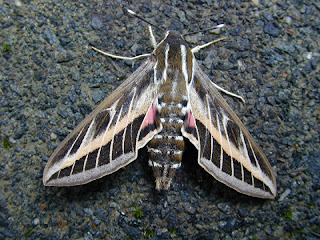
Migrants do crop up from time to time. Along with many Silver Y, lesser numbers of Dark-sword Grass and even fewer Pearly Underwing I have been graced with Bordered Straw (15), Scarce Bordered Straw (5), Hummingbird Hawk-moth (several), Gem, Vestal, Small Mottled Willow and, best of all, single Blair's Mocha and Striped Hawk-moth (pictured above - any excuse to show this beast again!).
The odd species turns up that has me scratching my head - where have the three Festoons come from? Or the handful of usually aquatic reliant Wainscots?
Being on chalk does mean that I am well off for a good selection of species. Best night catches usually number 500-800, but such numbers are rather rare. I might record 50-75 species of macro on such a night. One thing is a constant, and that is that no one year resembles another. It keeps me going!
Wednesday, 23 February 2011
Last night's haul
The MV gets a dust down
Monday, 21 February 2011
Common Jellyspot
After the rant of yesterday, here comes the calm.
Feast your eyes, if you will, on Common Jellyspot, a fungi that looks as if a woodland creature has just sneezed over a tree stump. This was taken at Pulborough Brooks (the heathland area) on Sunday.
North Downs and beyond - bringing you yet another easy to identify and bleedin' obvious fungus.
Sunday, 20 February 2011
Disgusted
Disgusted at the lack of concern for the residents.
Disgusted at the mean spirit of most those present (do the maths).
Ashamed to claim to be a part of the 'birding' fraternity.
If you can read the link and remain unconcerned, then I really do worry about our hobby - and a hobby is what it is, unless you are lucky enough to be paid to do it.
Why don't those who are guilty just bugger off and take up less disguised social crimes such as vandalism and theft. Pathetic.
Putting a face to a name
Back on the flood plain I was pleased to bump into Jon Winder, a visitor to this blog who has been kind enough to leave comments from time to time. After a good natter (and armed with some local knowledge for later in the year), I continued to do what I enjoy most - scope an open panorama and count what was before me. Most numerous were Lapwing (1400), Wigeon (850) and Teal (350), with lesser numbers of Shoveler, Pintail and Golden Plover. Six Little Egrets added a splash of exotica to the scene, and I was able to digiscope this Peregrine, sitting in a willow before it dashed across the brooks towards some unsuspecting prey. The reserve is well worth a visit, and forms, together with Greatham and Amberley Wild Brooks, a highly rich area for all sorts of wildlife, particularly plants and birds. Look out for Jon if you do go (identifiable by his RSPB volunteer badge), he's both knowledgable and approachable.
Friday, 18 February 2011
A confession
Something is stopping me. It's not the travelling (it's not far and I've driven to the corners of Britain for dragonflies, moths and plants before). It's not the fear of dipping (that's something I've experienced enough to become slightly numb to it). It's the crowds - and the sort of people that are in them.
I saw a newspaper clipping from The Metro, with a photograph of a line of several hundred birders queueing along a residential street waiting to be let into the garden that the dove was favouring. Most of them were dressed as if about to enter a jungle. Most of them were over 40. All looking slightly out of place, grown men appearing a little absurd. Don't get me wrong, I know that if I were there, I too would be dressed in the same manner and I am certainly over 40. I also know that I would be standing there highly embarrassed. Squirming in my boots if truth be told, averting my eyes from the (assumed) horrified gaze of the 'normal' people that live in the area.
"Mummy, what are all of those strange men doing?"
"Don't stare - they're most probably all on a register!"
There, I've said it. I would be feeling ridiculous. It's my problem, I know, but I cannot help feeling a complete prat in a public place with my binoculars on show, let alone also exhibiting a scope and a tripod. I become an apology of a man. A social misfit. I feel like shouting out "I'm married! I have normal interests too!" If, when I look around at my fellow birders, I think that they are all a bit odd, it's odds on that they're looking at me and thinking exactly the same thing. Maybe we could carry it off if there were plenty of George Cloony, Brad Pitt and Johnny Depp look-a-likes among us, but in reality we are more like a convention of Timothy Spalls. If for no other reason than this, the Oriental Turtle Dove in Oxfordshire is out of bounds to me. Unless it turns up somewhere that normal people don't go...
Thursday, 17 February 2011
Coral Spot...
... on a dead stem of Hogweed.Wednesday, 16 February 2011
Legacy
Many birders posting on the internet have been reflecting on the loss of Ray Turley. What is at once apparent is that he was liked, he was respected and that he left behind a legacy. That legacy was to pass on to others his burning passion for birding, not just the pure thrill and excitement of observation, but also the need to care for their welfare and habitats. How many of us will have been able to achieve that when our time finally comes?
I think that it is a good time to evaluate the way in which we go about our natural history study. Is it enough to blindly carry on observing without thinking about how we can put something back into it? One of Ray’s skills was to impart his enthusiasm onto others by sharing and showing what was on offer. This he did without thinking about it and he passed this on to total strangers as much as he did to those that he knew. He also did this without seeking out thanks or recognition – in fact I’m sure that he would have been bemused by the show of warmth that has been apparent over the past 24 hours. He was a modest man.
We now have one less birder to share their knowledge and show the way. All of us are in need of such kindness, particularly when we are finding our way in an interest or visiting an area for the first time. We ought to ask ourselves if we are in a position to be of help to others, to show them a bird, share the secrets of a patch or impart our joy of shared interests. It need only take a small act of kindness or giving up five minutes of our time to make a big difference to someone within our orbit. This is something that I will continue to reflect upon.
As Lou Reed says “You’re going to reap just what you sow”
Tuesday, 15 February 2011
Thanks for the memories Ray
Monday, 14 February 2011
It was forty years ago today...
..that we ditched the old ways of pounds, shillings and pence and adopted a decimal currency. I was in my first year at grammar school and found the whole thing a bit sad really. Although I was not yet a birder (see later in post) I was still a geek as I collected coins. Before decimalisation the coinage of the realm was a bewildering collection of all shapes and sizes, and coins in circulation still included stuff from Victorian times. Many was the time I squirreled away a penny from the 1800s. But I digress…
With the ‘forty year’ anniversary of our change in currency I also realised that it also the same anniversary for my taking a positive interest in the birdlife of Britain. Although I didn’t pick up a pair of bins in anger until 1974, I can identify the seeds of interest back to a 1971 Tawny Owl, that used to sit in a tree in our garden in Sutton, and did so as regular as clockwork, just as the light started to fade. It roosted in tall trees in a neighbouring garden, forsaking them to glide down to our more modest one. I got into the habit of waiting for it. When it appeared I would hold my breath and dare not to move in case I spooked it. After an all too brief stay it would silently move off. Magical.
Friday, 11 February 2011
Northumberland Moths
Thursday, 10 February 2011
Birding epiphanies
Wednesday, 9 February 2011
Sunday, 6 February 2011
Ladies and Gentlemen... Common Tamarisk-moss!
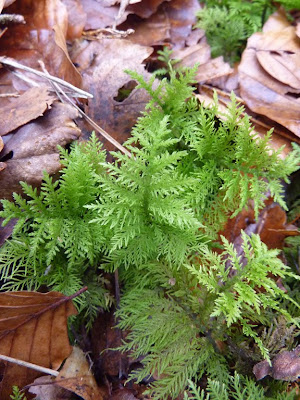
This is Thuidium tamariscinum, more easily remembered as Common Tamarisk-moss. I found it peaking through some leaf debris at Friday Street (Surrey) and it quickly became my favourite moss of the day. They are not all this easy! It is perhaps worth mentioning that even something as obvious as this species does have pitfalls for the unwary, as two similar species exist (Delicate and Philbert's Tamarisk-moss). To complicate matters even further, these two species integrate with each other and each of their more robust forms can only be told from the commoner Tamarisk-moss with the help of a microscope! It makes watching a reed-bed full of vagrant acrocephalus warblers during a gale seem terribly simple...
Saturday, 5 February 2011
Slowly going blind by moss
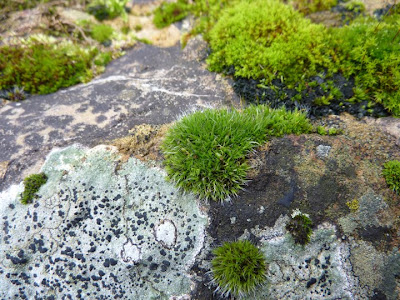
I have been spending far too long at the computer today, slowly working my way through the photos that I took yesterday on my moss/liverwort/lichen foray. My eyes and head do ache...Together with field guides, internet sites and a large dollop of faith, I have been trying to piece together what, exactly, is what. Needless to say, these organisms are not easy. There are thousands of the bloody things, many are similar, many need the deft eye of an expert and many need to be left well alone. I was quite pleased to identify a minimum of 15 species, with several pending and quite a few more destined to remain in a folder marked 'unknown'. I am seriously thinking about going on an organised bryological outing to get a bit of help. I enjoyed yesterday immensly - when you look at things from a different perspective it is astonishing just what there is to be seen. Moss was green and slimy to me not long ago. It is a thing of beauty in reality. I may well bore you with several images in the coming days. I bet you can't wait.
Friday, 4 February 2011
Of Hobbits and moss
I took a day's holiday today, and rather than look at empty fields at Canons Farm, drown in mud at Beddington or dodge the dog's mess at Holmethorpe, I thought that I'd try and bump my moss list up and took myself off to Friday Street in deepest Surrey. The area is on the Lower Greensand and is characterised by wooded heath with muddy mire valleys. The narrow lanes wind through steep banks which are festooned with ferns and mosses (see above). It's all quite dark and oppressive for an open downland boy like me, more like a scene from a Tolkien novel rather than that of a Hardy...