Posts

Showing posts with the label Banstead

"Kwowww"

On Tuesday evening, at 20.05hrs, I was taking out the rubbish, when I heard a call from south-west of the house. I froze, knowing what it was at once, but scarcely believing it. I had listened to this call on Xeno-Canto many times, getting ready for such a moment but not really considering it something that I would hear over the back garden. After 15 seconds the call came again from the blackness, now directly over head. Yes, there was no mistaking it! Another 20 seconds it called a third time - now further away to the north-east... "Kwowww" A lazy drawl, part bark, part yelp. A Bittern. Nocturnal flight-call. I went back inside and played the call on Xeno Canto just to make sure that I had remembered everything correctly. I had. Bloody hell, a Bittern over suburban Banstead! And only a week after an Arctic Skua had blessed me just a mile or so away. Sometimes the birding Gods do smile on you. To some birders these two species are just small fry, mere starters to the main cou...
More invert action

Image
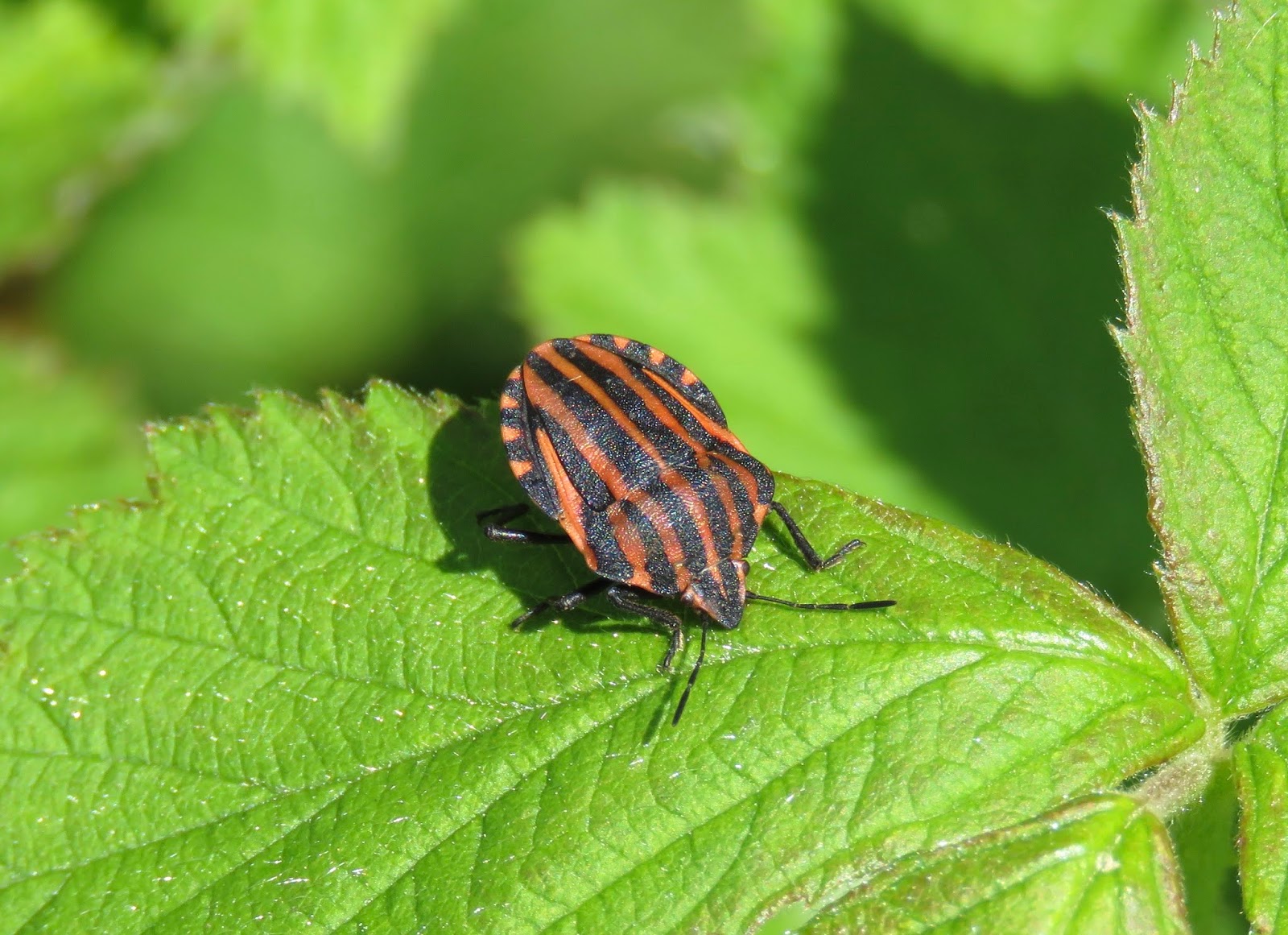
Sometimes, just a nose about locally is all it takes to produce the goods. After a morning of gardening I took myself off to check Banstead Downs for Striped Shieldbug (above). I didn't find them where I have had success before, but did come across three individuals within 3m of each other at a new site (TQ2664260543) some 500m south of the original Freedown Lane colony.  I also came across Lixus iridis (above) at four sites, all shown on the map below. Each of these areas are open in character with a heavy ground vegetation. The weevil seems to like Hogweed. Today, all three Striped Shieldbugs were on Bramble. Apart from the Striped I also recorded Brassica, Dock, Hairy and, best of all, Woundwort Shieldbug (below), my favourite - just like delicate precious jewels. The chances are, if you are in the Banstead, Wallington, Chipstead, Coulsden or Croydon areas, a check of any stand of Hogweed might provide you with either of these colonising inverts. That's my summer sorted out ...

Vegetated verges

Image
Roadside verges can be a rich source for recording wild flowers. Here in Banstead we are lucky enough to be in an area where the housing planners of the 1930s considered that green spaces were advantageous to residents - thus we have many grassy strips that are allowed to grow (largely) unchecked - mainly due to council cutbacks that do not stretch to frequent mowing. A ten-minute walk from home provided me with 60 species of wild flower utilising these areas. Although this morning's list was not populated by anything surprising, I have found Common Broomrape, Small Toadflax, Pignut, Blue Fleabane, Pyramidal Orchid and Bee Orchid on these Banstead verges in the past. The underlying ground is chalk, so it is quite usual to find plants that would usually be associated with calcareous grassland on these suburban havens.

Past few days

Image
My 'birding spring' seems to have already morphed into an 'insect summer'. I can't say I'm too bothered about it as the local birding has not been all that productive over the past few weeks (for me, anyway). Avian highlights this week have been a migrating Hobby along the scarp at Colley Hill (watched it arrive from a mile-away, dead straight line, east to west) and a singing Firecrest on Banstead Downs, where I have only seen wintering birds in the past. The image above may not appear to have any wildlife merit, yet it is here that both Striped Shieldbug and the giant weevil Lixus iridis is to be found here. I have failed to locate the former so far in 2021, but the latter are easy to find, double-figure counts achievable without the need of sweeping or beating the vegetation. A good selection of inverts are also present, and really bolster this flagging birder's mind. A few highlights below. I have found in the past that when I switch off from the birds t...

Buzzing with Kites

Image
We are now getting to the time of year when, here in Banstead, we see a marked increase in raptor movement, primarily Common Buzzards (with a few Red Kites thrown in for good measure). For a number of years now the Buzzards have been a feature of spring, with the local breeders sharing the skies with their congeners that are passing through. Last year saw plenty of time to keep an eye on the local sky thanks to lockdown, so I was in a good position to monitor this phenomenon.  Between March 21st - May 9th, 145 Common Buzzards and 45 Red Kites passed over the garden, mostly moving through in an easterly direction. The Buzzards tended to slowly drift through the air-space, with the Kites far more direct. I was careful not to count the local birds. I can see two resident pairs from the garden, or at least can see them when they indulge in a bit of extra-limital displaying. Any benign day in late-March to early May will provide a bit of movement, with the highest number of birds in one...

8 foot x 7 foot...

Image
... and covered in prickles and white hairs. This magnificent Cotton Thistle is dwarfing all around it in a Banstead farm field. A Triffid if ever there was one.

This isn't normal

Image
It is worth reminding ourselves that today's date is February 26th. The temperature in west Wales (Porthmadog) has been recorded at 20.8C (that's 69.4F in old money) - a new UK February record high. Closer to home it has been 20.7C in Teddington. In such warm temperatures and under clear blue skies and unbroken sunshine I have been wearing just a t-shirt and shorts. Comfortably. Because the number of Brimstone butterflies flying through and hanging about in our Banstead garden had been high, I thought I'd take a slow walk around the neighbouring streets - a vaguely circular walk of 90 minutes with no repetition of the route. I just strolled and counted butterflies. The results, for today's date, are staggering. FIVE species (I've seen two on the same date in February before, but never more). 38 individuals! They were: Brimstone (32), Comma (2), Small Tortoiseshell (2, one on winter flowering heather, above), Red Admiral (1) and Peacock (1). Needless t...

When Summer meets Winter

As I needed to be close to home today I embarked on a day-long 'on-off' sky watch. On the whole it was disappointing, with very few birds passing overhead, hirundines at barely a trickle, with the odd Chaffinch and Meadow Pipit thrown in to punctuate the quiet. However, the coming of winter was encapsulated by two Redwing (the autumn's first) that flew west early on and a further four landed in a neighbouring garden early in the evening. These are quite early, my 'firsts' are normally not until early October. It was interesting to see that there was a sprinkle of sightings of this fine thrush across the county today. Another intriguing aspect of today was a steady passage of Stock Doves, with at least 100 heading south. These are likely to be local birds moving between feeding sites rather than migrants, although the odd flock was quite high and purposeful. Over the past five years this species has become much commoner in 'my' part of Surrey, with Canons Far...

Call myself a birder?

Image
I thought I knew a bit about the birds in my immediate area - let's say within a three mile radius of home. There wouldn't be much that would get past me, at least as far as big obvious birds like Barn Owls were concerned. WRONG! I have just become aware that a pair of Barn Owls have successfully bred not 500m from my front door - not just this year but last year as well. My fraudulent claim to be some sort of 'local expert' has been shown up for the sham that it is. Let me give you a bit more detail... Katrina was speaking to a couple of her friends two days ago. Both of their husbands have plots on a local allotment, and the conversation turned to the nature present at the site, specifically the owls that breed there. Knowing that I'd be interested, Katrina asked what species of owl was present. When she later told me that, apparently, they were Barn Owls, I was terribly dismissive. "Oh no, they won't be Barn Owls, they wouldn't breed on a small all...

30 years of the back garden moth trap

Image
I recently mentioned that we have lived in our house for almost 30 years, and during that time have run a moth trap in the garden. It seems a good time to look back over those 'mothing years' and try and pick out any themes, trends, surprises, gains and losses. One post cannot do it justice, so thought I'd kick it all off with a look at the site itself. On August 14th 1987, Katrina and I moved into our three bedroomed house in Banstead, northern Surrey. It is an area that could best be described as 'leafy suburbia', positioned between Banstead Downs and Epsom Downs, relatively high on the chalk, and surrounded by 1930s housing. Most of the houses nearby had mature gardens, varying in sizes. Ours was well stocked with plants, had a 30ft front and 90ft back garden, which butted up to an area of 'wild' ground. A mature ash tree, a Lawson's Cypress and a small pond were further features. During the past thirty years there have been changes - the wild ...

A scarce micro

Image
The first peer into the garden MV this morning was rewarded with a single Bordered Straw sitting on top of an egg box - my first Banstead record since the 1996 invasion - but things got better... This is Phtheochroa sodaliana , a scarce and very local resident of chalk downland. In the 'Smaller Moths of Surrey' (published in 2012) there are only four recent records, the latest being in 2005. A brief search on other county websites suggest that this species really is hard to come across. Luckily for me it is a distinctive moth, as my micro identification abilities are not the best.

The garden chronicles

Image
It's one of those lists that all birders keep, even if they do not consider themselves to be listers - I would go as far to say that if any of them say that they do not keep this particular list, then they are fibbing. I'm talking about the 'garden list'. There is one great big crumb of comfort in keeping one, and that is, unless you live with another birder, you cannot be gripped off. Whether you live on a coastal headland or in a city centre, there are many hours of enjoyment to be had in its collation. I have lived at my current address since August 1987. That means I have spent many thousands of hours looking out over the 90ft back garden and 25ft front. There is a mature ash tree, there was a Lawson's Cypress (felled in 2014) and the planting is a mixture of wildlife friendly and easy to maintain species. A small pond has been a fixture over the years. The area is mature residential with a recent trend for developers to buy up larger gardens and build on th...

Toadflax Brocade in Banstead - a short history

Image
It is not all that long ago that the Toadflax Brocade was considered anything but a very local species. First recorded in the UK in 1939 and as breeding in 1952, colonisation then started in earnest. In the mid-1980s, Skinner considered it 'Well established at Dungeness, Kent and found locally along the coast eastwards to Sandwich and westwards towards Angmering, West Sussex'. Even in the 1998 revision of his book he mentions only 11 other records away from this heartland. Graham Collins 'Larger Moths of Surrey' - published in 1997 - can only lay claim to a single Surrey record, from Bookham Common on 7 July 1970. By the turn of this century moths had started to appear further west along the south coast, and since then they have been recorded as far north as Yorkshire. Of more interest than these isolated wanderers has been the colonisation of London and the Home Counties. Which leads me on to Banstead... It was in the back garden on 17 August 2009 that I came acro...

Banstead Bosphorus

With work being done on the house, I had need to be at home these past two days. When the fog burnt off on each morning, I took advantage of the clear skies and warm temperature and sat in the garden with my binoculars. Yesterday a flock of 4 Common Buzzards moved through, all spiralling directly above me before picking up an airflow to their liking and purposefully heading eastwards, as if on a conveyor belt. Today I had three Common Buzzards for company for most of the middle part of the day, with much displaying and calling. What wasn't hanging around however was a superb Red Kite, that seemed to pick up the same air flow as yesterday's Buzzards, heading off eastwards with little ceremony. Not that many years ago such sightings in the south-east of England, let alone my garden, would have seemed highly fanciful.

A moth miscellany

Image
Rosy Rustic - signs that autumn is on the way... Alliteration - don't you just love it? I could have gone further - 'A massive moth miscellany' or 'My meagre marvellous moth miscellany' but then that would be over-egging the pudding, wouldn't it? Back to the reality of the MV trap haul this morning. Numbers were depressed and by far the best species recorded was the autumn's first Rosy Rustic (I don't trap that many to be honest). It is shaping up to be a good time for Straw Dot - I recorded eight yesterday which is my highest single night count in Banstead, and another couple this morning. There are certain moths that evoke the passing seasons. When those cold winter mornings start to give up Brindled Beauties and Twin-spotted Quakers, I know that spring is on the way. When late April catches start to include prominents and Lime Hawk-moths, then summer is just around the corner. For me, it's high summer when Scalloped Oaks and Marbled Beaut...