Posts

Showing posts with the label Charmouth

Stormy Charmouth

Image
Do you remember the days when a sober suited gentleman from the Met Office would casually say that we were in for a "bit of wet and windy weather"? It seems as if the 2018 version is to personify the approaching weather system (Storm Boris, Storm Satan) and give it an historical context (lowest low pressure system since Storm Vlad the Impaler back in March 2018!!). Well, we recently enjoyed a bit of wet and wind, which coincided with Katrina and I spending a few days at Charmouth in Dorset. As compensation, yesterday was sunny and ridiculously mild, which meant that we were able to survey the aftermath - a dead adult Gannet (below), flocks of Rock (bottom) and Meadow Pipits feeding on the beach detritus and plenty of waves crashing into the soft cliffs adding to coastal erosion (above). There's no denying it, an angry sea is a spectacular sight (and, safely on land, a thing of joy). Although not a birding trip I did manage to have a good look around that provide...

The land of the dinosaurs

Image
The image above was taken from a hill to the west of Charmouth, looking eastwards along the Dorset coast. The highest point is Golden Cap, with the distant cliffs beyond that being east of West Bay. You can walk this stretch of coastline on a footpath that, give and take the odd cliff slump, allows you to tip-toe along the edge of hair-raising precipices and stunning scenery. For the birder it is an overload of senses. On the one hand you marvel at the habitat set before you - miles and miles of hedgerows, cliff top scrub, meadows untouched by fertilisers, small pools and streams - but on the other hand there is so much of it (and it extends way inland) that coverage cannot be anything other than poor. A team of a thousand birders working together would just scratch the surface, so the handful of locals that are present have a hard task of it. My short stay was exhilarating and frustrating in equal measure, there being so much promise which is made hard by a testing landscape. There...

Sort of sea-watching

Image
Charmouth could not be any more tucked into Lyme Bay. It's not the sort of place that anybody would pick as a place to sea watch from - you can see Portland Bill to your left and a number of Devon headlands off to your right. Maybe the best time to scan seawards is during stormy weather, when the odd bird may seek shelter. It was debatable as to if today could claim to be 'stormy', more like 'windy', but the optimist in me thought it was worth a go. The result was so-so, with 98 Gannet and 3 Fulmar west. On the beach, a first-winter Common Tern and two Mediterranean Gull (adult and 2nd winter) brightened up what was fast becoming a dreary day. This afternoon I wandered Stonebarrow Hill and the slopes barely seeing a bird. I saw nor heard a warbler all day... A low moth trap total did include this Clancy's Rustic, named after my old mate Sean.

A wild egret chase

Image
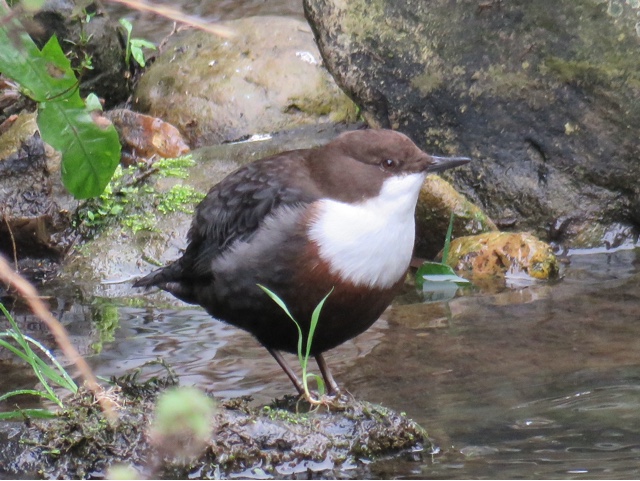
Even in the sleepy backwater that is Charmouth it is still possible to be gripped off. I was watching a Dipper (above) in nearby Lyme Regis when Richard Phillips kindly texted me (while on his way to Tresco) to inform me that there was a Cattle Egret in Charmouth. I may have only been down here for two days but now (ridiculously) think of myself as a local - I was gripped off! I had walked to Lyme so faced a lengthy journey back along the not easy to traverse beach. To cut a long story short I duly arrived at the Egrets last reported site (a field with cattle as to be expected) but of the bird there was no sign, although three Yellow Wagtails dodging the hooves were some compensation But fear not! My new found local knowledge had me walking up Old Lyme Hill to gain a panoramic view across the surrounding farmland, and BINGO, there it was, strutting its stuff some half-mile further east. I wonder if it will gather some mates? The garden MV supplied me with a Box Moth (they ...

Getting to know you

Image
Part of the joy of getting to know an unfamiliar patch is stumbling across areas that look promising. This evening I found myself wandering across a farmland footpath that took me up to the top of the under cliff to the east of the golf course. The rough grassy area had it all - isolated trees, low hedgerow, patches of scrub - with the added bonus of elevation and almost 360 degree views. A place to return to. I also found a number of spots to the east of Charmouth, at the top of the under cliff, where hedge lines and streams meet before seeping over the edge. In each place were birds, with a small pool acting as a bathing place. Again, places to return to. It wasn't heaving today, but persistence payed off to a point, with Sparrowhawk, Hobby, Peregrine, Swallow (50), House Martin (30), Stonechat (5), Whitethroat (2), Blackcap (2), Chiffchaff (13), Raven (3). A grassy cliff top held at least 50 Autumn Lady's Tresses (pictured). It is hard to complain about the lack of birds...

And now for something completely different

Image
Charmouth, in west Dorset, is most probably best known as a site for geology - cliff slumps, fossils and part of the World Heritage Jurrasic Coast. It is not, however, considered to be a birding hotspot, although local birder's, such as Richard Phillips, have found such goodies as Pallid Harrier, Glossy Ibis, White Stork and Yellow-browed Warbler in the past couple of years. I have been an infrequent visitor here during family holidays, and have always longed after spending a bit of 'proper' birding time on the cliff-tops, river valley and coastal scrub - well now I am. A brief wander during the middle of the day revealed a few migrants, such as a Spotted Flycatcher, 10 Blackcap and 2 Chiffchaff. A Cetti's Warbler was most probably a resident. A modest start, but why use up all your luck on day one? Mad gamble or inspired choice? The next week (or two) will tell.

News on the Polish Med Gull

Image
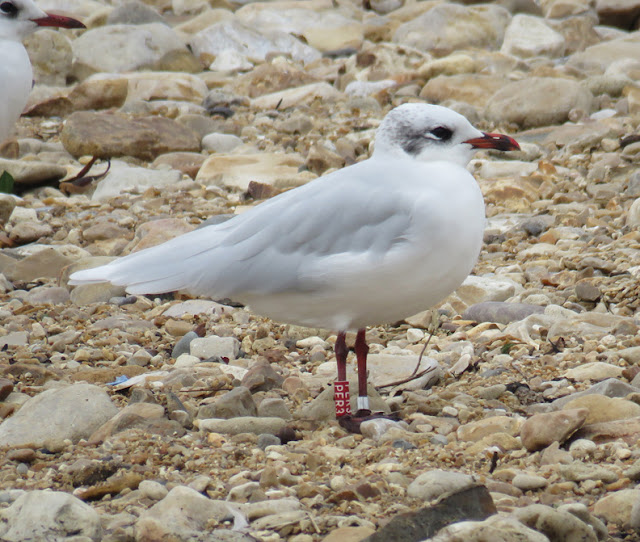
Last week I mentioned an adult Mediterranean Gull that I saw on Charmouth beach, sporting a red plastic ring (PER3). Through the excellent Colour Ring Birding website, I reported the details and received the following information from the Polish scheme behind the ringing of this particular bird: Ringed on 13/05/2007 as a 3rd calendar year female, nesting at Polder Bukow, Krzyzanowice, Slaskie, POLAND, by Jakub Szymczak So the bird was two years old when ringed, which makes it 12 years old. This colour ring reading can become addictive!

A Pole in Dorset and a moan

Image
Just back from a short break in Dorset, and although the optics and camera came along, they played second fiddle to everything else... highlights were up to three Mediterranean Gulls on Charmouth beach, including this adult (above) sporting a red plastic ring (PER3) which suggests that it was ringed as part of a Polish study. Also seen were at least two Dippers (at Lyme Regis (below) and Charmouth). There has been a bit on social media recently about some people's dislike of the shortening of bird's names into an attempt at creating a 'cool birding patois'. I couldn't agree more - you can stick your Spot Shank, Pink Stink, Grot Finch, Yank Start and Spot Flit up your... People also still seem to be congratulating each other on having the ability to spend lots of money, drive hundreds of miles and look at other birder's finds; they still refer to seeing said bird as 'scoring', 'bagging' and 'nailing'; also continue to take selfie...

Of Purps, Dippers and patches

Image
My short stay at Charmouth is over, and once more I was able to sneak out and get quite a bit of birding under the belt - even 'shopping' excursions to Lyme Regis had 'smash-and-grab' raids carried out on Purple Sandpipers and Dippers. A minimum of four Purple Sandpipers frequented the rocks at the end of the Cobb, and a walk along the river at the edge of town produced a Dipper. It was my good fortune to meet up with Charmouth-based birder and blogger Richard Phillips (you can read all about his finds here).  He kindly gave me a tour of a part of his impressive patch, an area where the river meets the beach, fringed by copse and reeds. It screams out rarity! We spent a most pleasant hour casually birding whilst chatting, the sun warm enough to encourage a good few butterflies onto the wing. Charmouth is blessed with clifftop paths that take you into stunning scenery like this: This is the cliff slump due east of the town. Standing up here I coul...

Chiffchaff fall

I'm spending a few days down in Charmouth, on the Dorset coast. It's a small, but busy town, the beach not ideal for birding, although local eyes have pulled the odd goody out of the ornithological hat in recent months (Glossy Ibis, Yellow-browed Warbler). The coastal path running east of here runs above an enormous cliff slump, then tops out on Stonebarrow Hill, a mosaic of meadows, scrub and hedgerows. It looks stunning and I can well imagine that frequent observation would be re-payed. In a few weeks time the lower slopes will be full of orchids. I went up there this morning, after overnight rain, and it was leaping - 60+ Chiffchaff, 12 Blackcap, 2 Willow Warbler and a Tree Pipit, most of the warblers in song that made for a wonderful aural treat. If I lived in Charmouth, this would be my patch. You cannot get any more tucked-up in Lyme Bay, and Portland Bill shows-off nearby sticking way out to sea, but this unspoilt bit of coast, all the way to West Bay, has bags of birdin...

The most diffcult patch in England?

Image
I recently spent some time on the Dorset coast at Charmouth. As is my want, I wandered the coastal paths close by to try and winkle out those natural history gems. This whole area is part of the 'Jurassic Coast' and the cliffs here are very unstable. The picture above was taken east of Charmouth looking down from the clifftop into an area of slippage that has since stabilised and allowed woodland to establish. Beyond the woods is another cliff that drops straight into the sea. The picture below illustrates the site perfectly (thankyou Google Earth). Whilst I stared into this green abyss, I wondered how on earth you could successfully bird it. There must be plenty of migrants that have come over from France and dropped in. Some of them must be rare! How many Golden Os, Melodious Warblers and Bee-eaters enliven a late spring day? And what about those rare autumn phylloscs? But, you cannot approach the wood from the top (crumbling descent, wickedly steep incline, deeply rutted) or...