Posts

Showing posts with the label Nottingham Catchfly

Touchstones - from Portland Bill to Denbies

Image
Time, its passing and the effects that it has upon us is something that readily colours my birding. Apart from being a handy hook to hang a rare bird or spectacular movement on, a date can also bring to memory a place, people, a conversation, a feeling. A bit of a Proust's madeleine cake moment. I was idly daydreaming about birding places recently and my mental rolodex randomly settled upon Portland Bill. September 1977 sprang immediately to mind. Why then and not the date that I saw a Yellow-billed Cuckoo (September 1979) or Ivory Gull (February 1980) on that fair island? I then recalled that September 1977 visit - not blessed with loads of birds, certainly no rarity - but blessed with a calming, restful, place defining moment. Us young birders (for we were young back then) were crammed into a smallish car, parked on the road that heads downhill towards the car park and obelisk. The observatory was full, so no bed was to be had there. Our student pockets would not stretch to a hot...
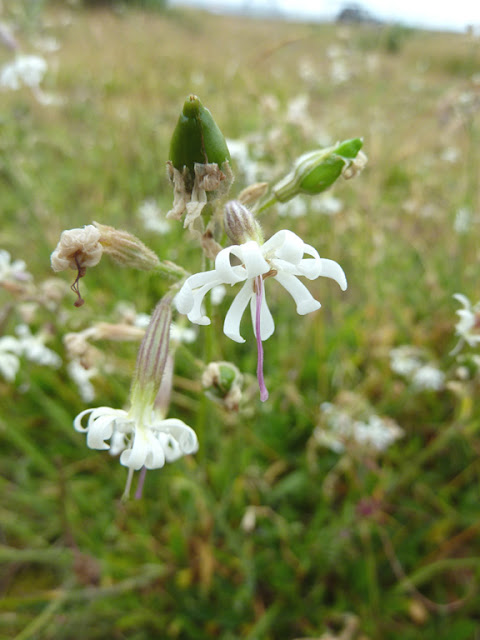
The evening perfume

Image
8. Nottingham Catchfly (Silene nutans) Back in the mid-seventies, when we all wore long hair and flared trousers, my first visits to Dungeness were all about birds. Birds, birds and more birds. But a couple of plants crept into my subconsciousness, by dint of having some more enlightened birders close by who also looked at other life forms that did not necessarily possess feathers. One of these species was Nottingham Catchfly. I was told that it was rare and that Dungeness most probably held more of it than anywhere else in the UK, and that is all I needed to know to embrace it as a 'worthy' flower. In time I got to know it well, knew where the best populations were and it slowly became an iconic part of my 'Dungeness experience'. - the shingle would have felt bereft without it. I spent the summer of 1979 at the Bird Observatory. Back then, during late June and July the peninsula used to be vacated by birders, so there were many days when it was just me at the ...

Annus mirablis

Dungeness Early summer 1979 One warm, sunny evening, Alan Heaven and I leave the bird observatory, cross the road near the entrance to the power station and go through the small gate that leads onto the RSPB reserve. Between here and the Oppen pits is a vast expanse of shingle that has hardly ever been walked upon, let alone birded. It is private, owned by the RSPB but Tony Pickup, the reserve warden, is keen for those staying at the observatory to have access to his kingdom at all times. His thinking behind this charity is that we will collect data for him and also deter egg collectors at certain times of the year – it is still a problem for him. In one summer alone two egg collectors have drowned in the depths of Burrowes Pit as they swim for the islands in persuit of Mediterranean Gull or Roseate Tern eggs. Part of the warden’s job on those black days will be to fish bodies out of the water. The shingle in this largely unexplored area is different from elsewhere. It lacks ste...

Fennel after rain - and smells

Image
Sometimes (actually, very rarely), I take a photograph that I'm really pleased with. This is one of them. The species is Fennel and I was taken by the raindrops that had hung on to the linear structure of the plant. Every time that I come across Fennel I have to pick a bit and rub it between my fingers. If you've never done so I urge you to try it. It smells of aniseed or licquorice depending on your olofactory set-up. This is one attribute of botany that a lot of people miss - smell. And by that I don't necessarily mean sniffing a fragarant bloom. Plenty of species have aromatic leaves although try snorting those of Black Horehound and you'll wish you hadn't. Various labiates are full of minty, lemony and herby sniffs (they are herbs after all!). Other families smell of curry, mice (no, really) and fish (yes, really!). One of my favourites is borne out of being (a) rare and (b) Dungeness based. Nottingham Catchfly is a modest white-flowered species that is ver...

The Great Flowering

Image
The resident botanists are refering to it as a once in a lifetime event. I am just grateful that I was able to witness it. Due to the wet, cool spring and early summer, Dungeness was blessed by a late and profuse flowering of many species, the quantity of which was only surpassed by the vigour of the blooms. When I arrived the Nottingham Catchfly was peaking, the subtle scent charging the evening air. Cat's-ear, Sheep's-bit, Viper's Bugloss, Mouse-ear Hawkweed and even the normally shy Dodder were putting on a spectacular show. After a week went by the modest Wood Sage burst into life, millions (literally) of plants carpeting the shingle with great rafts of off-white flowers. But, nothing lasts for ever... when I left Dungeness the Catchfly was all dried seed head, the Sheep's-bit looking sad, the Wood Sage browning at the edges. The following images cannot capture the event, but apart from my memories it's all that I can offer. Wood Sage - dominated the vegetat...