Posts

Showing posts with the label Winter Heliotrope

To Ewell and back

Image
Another session spent winter botanising, and once again a plentiful supply of plants to identify - mostly actually in flower or bud - which proves that there really isn't a dead season to be had when searching for flowers. I walked from home, along the Reigate Road and stopped off at Priest Hill SWT Reserve. At first glance the open fields of lifeless grass didn't seem to suggest that there would be any joy here, but if you look hard enough... Just like yesterday, most of the highlights were of alien/escaped species, but that is fine by me: Lesser Periwinkle, Sowbread, Asian Firethorn, Silver Lime, Balkan Spurge ( Euphorbia tomentosa ), Vibernum, Pampass-grass ( Cortaderia selloana ) and Mediterranean Spurge ( E characias ) were the pick of the bunch. Asian Firethorn ( Pyracantha rogersiana ) Identified by the hairless leaf stalks. Silver Lime ( Tilia tomentosa ) And before you think my skill levels on identifying obscure winter trees has improved, I was shown this tr...
A bit of spring in winter

Image
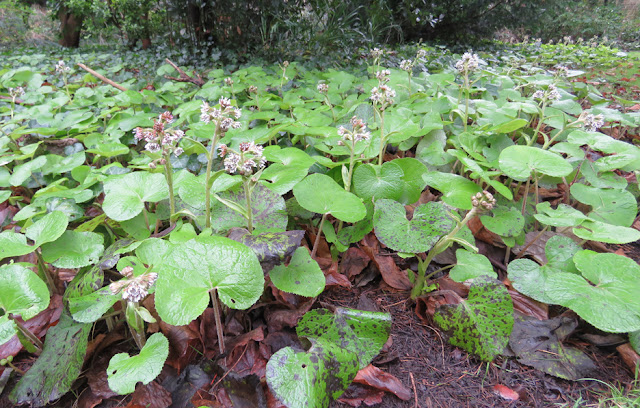
It was Bourne Hall, Ewell once again, plus a wander along the River Hogsmill all the way to Ewell Court. It was very quiet, with only a single (and tame) Little Egret, a flushed Common Snipe, but no sign of any Kingfishers. I reckon that the wintering Water Rail may have moved on. It was an iron cold day, the chill in the south-easterly breeze enough to make it uncomfortable, and the drizzle that fell in the early afternoon turned into the finest snow that I've ever seen. Amid all of this mid-winteryness was a sight to stir the soul - a fine display of Winter Heliotrope (above and below), together with a smattering of  Ramularia purpurascens across some of the leaves (thanks Seth!) Now, I know I keep on posting photographs of Stonechats, Reed Buntings and Little Egrets, but when these birds just pose for you, why not? I never tire of them.

On a roadside near you!

Image
I would put money on the fact that, unless you live in the wilds of Scotland, there will be a patch of Winter Heliotrope (Petasites fragrans) not far from where you are currently sitting - and it will most probably be found on a roadside verge. It is one of the few true winter flowerers, as opposed to the many, many species that are currently in bloom due to the ridiculously mild winter temperatures that we are experiencing. It acts as a good source of nectar for those hardy insects that are currently on the wing and, although not exhibiting a particularly showy flower, it is a most welcome sight in the middle of winter. But not everybody agrees… It is considered an invasive pest in some quarters. The Guardian newspaper says it "has attractive, fragrant, mauve flowers early in the year, but later in spring turns into a large-leaved monster, forming colonies along waysides.” Blimey! The species was first recorded ‘in the wild’ in 1835, having no doubt escaped from some ga...

What do you see?

Image
This is Walton Downs, looking south-westward towards Headley. It is a mixture of copse and farmland on chalk. As a birder, looking across this shallow valley, what do you see? I bet that, like me, you are weighing up the chance of seeing a good raptor, maybe a Short-eared Owl or even a Great Grey Shrike. I have walked the footpaths that cross this area many times and can only claim a handful of commoner migrants over the years, but each time I make the journey I still think that I'm going to get rewarded with a notable sighting - it just feels like a place that will harbour something of note. And this approach sums up the lot of a birder working any patch of habitat, wherever that habitat may be. Regardless of our experience telling us that we will fill our notebook with counts of commoner species, there is a big part of us that still maintains that something good will come along, and it might just be on our current visit. It's what drives us on and keeps us focused. It'...

Culture at the Hogsmill

Image
My venue of choice this morning was the River Hogsmill at Ewell, walking along its modest flow from Bourne Hall to the Open Space Park. Apparently, this particular stretch of the river was used by the artist John Everett Millais as inspiration and a backdrop to one of his most famous paintings - Ophelia . It depicts the grief stricken Ophelia drowning herself in a stream - but what a beautiful end! I've seen it in The Tate and it is one of my favourite works of art. Wandering around sans gloves, it could have been spring! Mild and sunny, catkins hanging from Alder and Hazel, mating Coal Tits and plenty of Winter Heliotrope in flower (top, right image). A couple of Kingfishers were showing off and they were joined by a Grey Wagtail. Altogether most agreeable.

Winter Heliotrope

Image
Nothing gladdens the heart on a winters day more than a bank of flowering Winter Heliotrope (OK, I can think of several things that do, but for grammatic effect I will choose to ignore them). These plants were cascading over a bank of dumped topsoil close to Reigate Hill. Flowering was not in profusion, but plenty of the tassel-like flower heads were present. This species is naturalised in Britain and can often be found on roadsides, the large rounded leaves giving the plant away long before the flowers do.