Posts

Showing posts with the label fungi

A stink in the woods

Image
It's late autumn, it's been raining, therefore logic suggested that there would be a lot of fungi sending fruiting bodies up above ground. My morning visit to the beech woodland close to Mickleham was a partial success - yes, there was fungi, but not in the numbers that I was expecting. Maybe it will be better in the next couple of weeks. I'm not anything other than a mycological dabbler, so I was quite pleased to identify (within reason) twenty species: Orange Bonnet, Lumpy Bracket, Porcelain Fungus, Southern Bracket, Turkeytail (below), Beech Woodwart, Candlesnuff Fungus, Green Elfcup, Oak Pin, Toothed Crust, Marasmius cohaerrens, Fairy Inkcap, Lemon Disco, Flat Oystering, Burgundydrop Bonnet, Lilac Bonnet, Stinkhorn, Ivory Woodwax, Inky Mushroom and Cabbage Parachute. Haven't they got fantastic names? The Stinkhorn is always a highlight - foul smelling and covered in flies (but which species?) Today's three individuals all lacked the black goo (spore mass) that n...

Bloody mushrooms!

Image
A few years ago I had but the one guide to the fungi of the UK. I knew very little about fungi, but this book was well laid out and even broke the species up into habitat, so that if my fungi was growing in broad-leaved woodland then all I had to do was turn to that particular section and match up my specimen. Simple. Er, no... The more I got 'into' them the more books I bought. With each subsequent purchase the more detailed was the publication. More detailed meant more species. More species meant that what I thought was a straightforward identification became anything but. It seemed to me that for every 'easy-to-do' mushroom there were, in fact, several look-a-likes. And these might need spore prints, chemical testing, sniffing and/or tasting to be absolutely sure. And then the taxonomists starting splitting. And splitting. And splitting. My original 250 species to be concerned about now numbers in the thousands. What did I learn? Well, the more I looked at the...

A pervert in the woods?

I received an email yesterday from someone who gave me precise directions to an area in the New Forest where there are currently many Devil's Fingers fungi on show. This was a case of 'reaping what you sow', as the gent involved had asked for, and received, directions to some Bog Orchids from your's truly several years ago. But I digress... I have a couple of days off work at the end of the week and am considering going to look for these exotic fungi. But hold on - I wouldn't be doing this if it was a rare bird and not a mushroom, would I? And why not? Well, I think I know the reason why, and that is people. If I do go to look for the 'fingers' I will most probably be the only other person there - possibly one or two others if I were present all day. If it were a rare bird then there would be a gaggle of green-clad middle-aged men already present when I arrived, a procession of others throughout the day and I would be uncomfortable. Now, this use of the ...

A starfish miles from the sea

Image
If you go down to the woods near Oxshott today, you're in for a big surprise... No teddy bear's picnic, I'm afraid, but something even more bizarre - Starfish Fungus (Aseroe rubra). After having seen Red Cage during the week I'm positively overdosing on exotic fungi. A big thanks to Seth Gibson for the precise grid reference that led me to a fine cluster of these beauties in several states of development. Fully 'out', with a slick of foul smelling gunk on top An egg, awaiting to give birth to an alien like the one above This one's gone over, looking like a tideline corpse - more marine than mycological

Red Cage (Clathrus ruber)

Image
Just before I left the office this evening I checked my emails to find one from Banstead's very own botanical guru, John Peacock. He was alerting me to the appearance of Clathrus ruber , a sessile stinkhorn that rarely appears in the UK. It has an English name - Red Cage. I have longed after seeing this species, and had looked in vain for it before, when John discovered it growing under a yew tree in Banstead two years ago. Last year was a no show, so his message had me detouring from home. The light was fading and I only had my camera phone with which to record this striking fungus. I could see two fruiting bodies from some way off, one much larger than the other. There are several coral-red species, all with an exotic and startling appearance that, I believe, come from Australasia. Their appearances may be increasing, particularly on municipal wood mulch. The irony of rushing off to twitch a fungus is not lost on me. I expect cries of 'hypocrite' to come from sever...

They've arrived!

Image
Two new publications that have just been added to the North Downs and beyond library were not only eagerly anticipated but will both, without doubt, aid identification of their species greatly. Collins Fungi Guide and British Wildlife's Micro Moths of Great Britain and Ireland are going to encourage an awful lot more naturalists to take on these 'difficult' groups. Both tackle a vast fauna that have identification challenges within them. Neither publications claim to be the definitive word, and in the case of the micro book clearly state the need to leave certain families of moths alone unless you want to use a microscope and have a penchant for examining their nether regions. The illustrations in both are superb, the layouts well designed and a joy to browse through. I haven't used either in anger yet, but with the teams behind them they cannot be anything other than 'must have' books.

Scarce Umber

Image
To prove that I haven't given up looking at anything that isn't a fungus, here is a Scarce Umber that I put up whilst at Ebernoe Common last Saturday. I followed its weak flight for maybe thirty seconds until it alighted on the leaf litter. Trawling of photographs has yielded further new species of fungi, but this has its limitations as I cannot possibly check all the salient details to clinch certain identification on many. 2995 now....

Back to Ebernoe

Image
The dry spell for much of southern of England has ended, and I have been seeing quite a bit of fungi springing up. Mindful of the possibility of night frosts killing off what fungi are currently on show I thought I would make a return trip to Ebernoe Common in West Sussex. Any regular visitor to this blog will know that I have adopted fungi as my 'new passion' this autumn and have managed to progress from a complete mushroom novice to a partial mushroom novice. I'm slowly getting to the point where I can find a place in the field guide where the mushroom that I am looking at will be found (at least to a family - but not all the time!). I can appreciate the need to note cap, gill and stipe colour, texture, and form, plus to take in what the fungi is growing on and the habitat that I'm in (that last point is the easiest to answer...) I was lucky to bump into a knowledgable mycologist in the middle of the afternoon who was helpful in helping...

Back garden ticking

Image
This is an earthtongue, that I reckon is Geoglossum cookeanum , based on the fact that it hasn't got a hairy, tapered stem. Just in case a knowledgable mycologist has stumbled across this humble twaddle, and they think that I'm incorrect, please let me know. This is a new species of fungi for me, and was found growing out of the soil in a pot where a Viburnum tinus is planted, only yards from the back door. This handily demonstrates one of the positives of pan-listing - you can always find something that you haven't identified before even where you live. You needn't go outside!! This week I've found a spider and three species of fungi in the back garden that I've not knowingly seen before, although all are common and no doubt previously ignored/overlooked. I was too busy (couldn't be bothered) to look critically at a few snails and slugs that came out during the recent wet weather, but I suspect a few of them might be new. With the total creeping up to ...

Dryad's Saddle

Image
The Dryad's Saddle (above), was found in Nonsuch Park, Cheam, this afternoon. It's a much better specimen than the one I saw yesterday in Banstead Woods. A small child could easily sit on it (although I wouldn't recommend it as they would fall straight through it). I'm getting quite excited by fungiat the moment and seem to spend far more time looking on the ground for them than anything else natural history related at the moment.

Yellow Cobweb

Image
An early start at Canons Farm on Saturday was rewarded with two flyover Waxwings but little else. I resorted to poking around the rotten wood in the nearby woodland where I discovered some Yellow Cobweb (a fungi), an addition to the all-powerful pan-species list. This unassuming fungus is pictured above.

Coral Spot...

Image
... on a dead stem of Hogweed. ... at Beddington Sewage Farm. ... with a Water Pipit circling overhead, calling (subscribers only).

Committing patch adultery

Image
I can't help it. I take on a patch, get keen, visit on a regular basis, get to know it well and then, after a certain amount of time, find another area that tickles my fancy. I don't totally give up on a patch, I just adopt another and add it to my suite of places to visit. But, I find myself feeling guilty about doing so, as if I'm being unfaithful to my other sites. I've posted about my return to Beddington SF before. It was my original patch. I have campaign medals for for active service at this sewage farm between 1974 - 1986; 1993-1994 and am currently on a mission there right now. Today I went to Canons Farm and felt ashamed. I really felt as if I ought to apologise to the farm for having neglected it and admit to two-timing with that great bully of a patch up the road. I feel the same when I go back to Holmethorpe. I feel that I ought to beg forgiveness from Gordon and Graham and beat myself with birch twigs for being so unoriginal as taking my binoculars and tel...

My Yellow Brain

Image
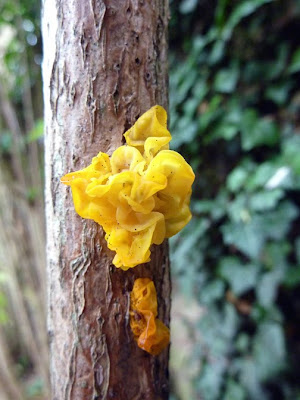
Meet Yellow Brain Fungus - one of two additions to my 'UK All Taxa' list today. The other was also a species of fungi, Split Porecrust. I did take the latter's photograph, but the results were not up to much. The Yellow Brain Fungus was found in my back garden on the branch of a Himalayan Nutmeg. This species is meant to be parasitic on other species of fungi, although I couldn't see its host. Of local note were a flock of Waxwings that took up residency only a mile from where I live. I wandered along yesterday morning to pay my respects. A few of the human residents who live in the houses around where the Waxwings have chosen to raid the rowans were keen to find out what all of the middle-aged men with binoculars were looking at, and seemed pleased to be shown the tufty trillers. Most had heard of this species from Autumnwatch and one even asked me if Lee Evans would be turning up, as he had watched the infamous BBC4 Twitchers programme.

Going local

Image
The weather stymied my biding at either end of the day (fog in the morning, then persistant rain from mid-afternoon), but Holmethorpe Sand Pits did produce a Water Rail, 2 Common Sandpipers, a Green Sandpiper and a Brambling, while Canons Farm also yielded a Brambling. I spent a good hour on Nutfield Ridge looking at fungi. They are not easy. I believe the picture above to be a Pestle Puffball, but please tell me if I'm wrong. Meadow Waxcaps were more straightforward and I have pictures of several more species that I need to look at more closely. This all-taxa listing lark is enjoyable but highly challenging.