Posts

Showing posts with the label gulls

Better late than never!
Image
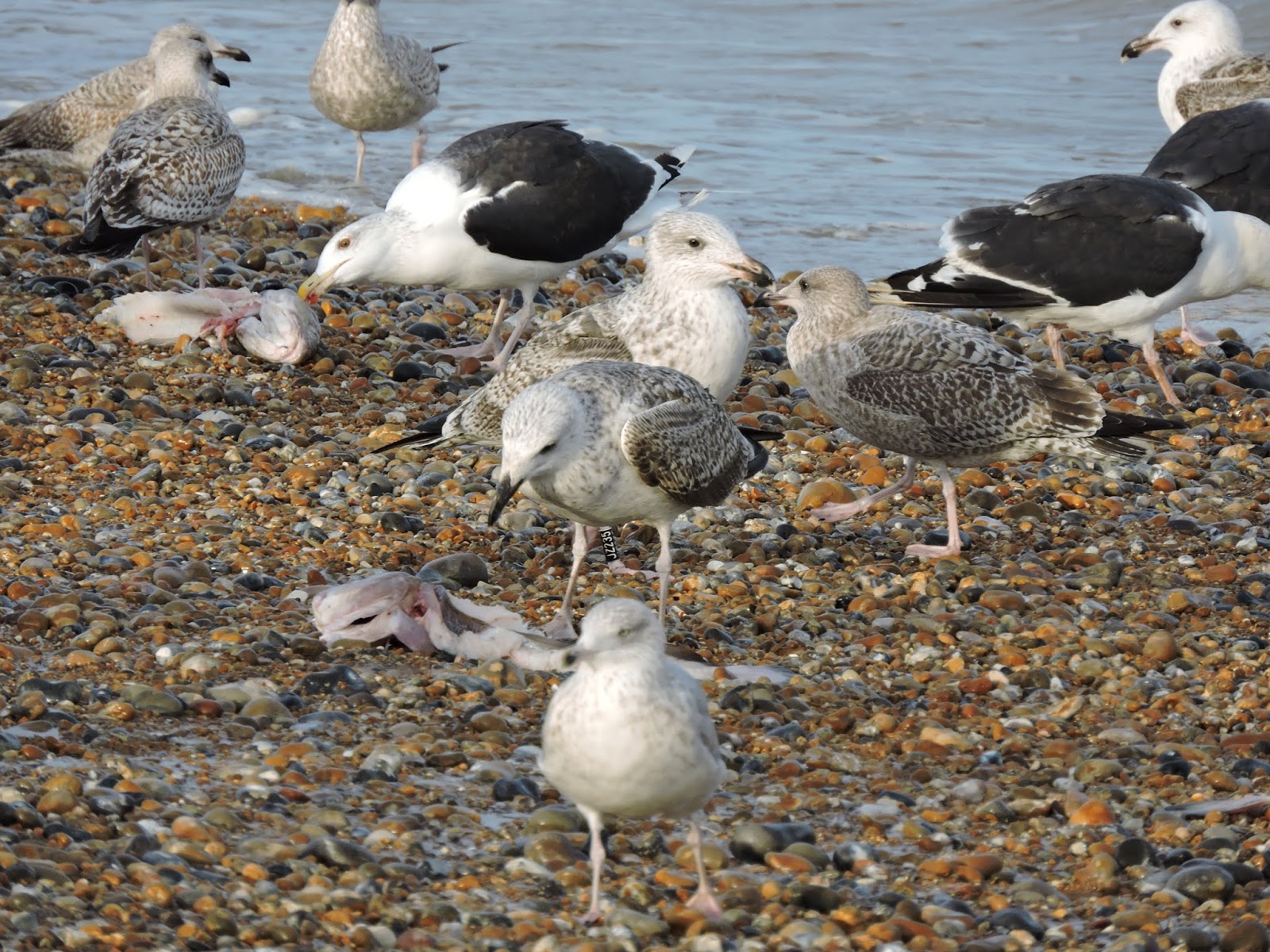
I have tens of thousands of images that I have saved over the past 20 years, some of them dating back to the infancy of affordable digital cameras. I discard most of what I take, keeping just the few that can be thought of as being 'passable'. There are folders within folders on the computer desk top (all backed up, of course, on a removable hard disk) and most of these are of identified species, numbered and dated. Sometimes, especially if I have been away on holiday, or staying at Dungeness Bird Observatory, I will keep everything taken during that trip in its own folder. I have recently been looking through such a folder - this one was titled 'Dungeness, October 2015' - when I came across a series of images taken on the beach while observing Caspian Gulls on the 25th. It was of a group of gulls that had been coming in for fishermen's discards. You can see it above. I've obviously not looked that hard at it before, because as I worked my way through the g...

The gull lines

Part 7: October 1975  As the light started to fade they came over in silent, plodding lines, with no deviation or hesitancy. I stood at an Epsom town centre bus stop and counted them. The counting was a means to an end, with me falling into their rhythm and entering a vaguely hypnotic state. My waiting for a bus coincided with the end-of-day gull procession, from the open Surrey fields to the west London reservoirs that offered them a safe, deep-water roost. My journey home from art college was, for a brief few days, aligning itself with that of the gulls. I found comfort in their appearance, a sign that the day had progressed as it should, that all was well with the world. They were silhouetted, and specific identification was beyond me, although I could safely assume that the smaller birds – quicker wing beats, narrower wings – were Black-headed, and that the bow-winged beasts were Herring, Lesser and Great Black-backed. My excitement rose if a great snaking line appeared above ...

Caspian See?

Image
Am I one of the gull people? No, not really. I do look at them. Sometimes even actively seek them out. But to truly belong to that specialist group of birders you need to study them. And then study them again. Over. And over. And over. It isn't so much a passion, or an obsession, but more a disease. Gullitis? Larusgytis? There isn't really a name for it yet. Just to prove that I do dip my toe into this rarified world I present a few bridge camera images from Dungeness this autumn. The top three pictures are of a first-winter Caspian Gull and the bottom of an adult Caspian Gull, all on the beach. Even I can 'do' these individuals, but there are other birds that even the aficionados will screw their faces up at and proclaim that "there might be a bit of Herring Gull" in them. If you want professional quality images of gulls (especially Caspian) the net is swamped with them, but I can recommend Dungeness Bird Observatory , Ploddingbirder , Richard Smith a...

The rise of the gull people

Image
There was a time when gulls were largely ignored. They were regarded as pure ornithological filler, something to be tolerated in-between 'proper' birds coming along. Admittedly, a Sabine's, Glaucous or Iceland Gull might have raised an eyebrow, and something like a Ross's would have caused a stampede, but otherwise it was a case of stifling a yawn and looking the other way. Oh how times have changed... Early pioneers of advanced gull identification (such as Peter Grant) really were breaking new ground. Up until the 1970s most birders baulked at the idea of trying to identify any large immature gull. It was a challenge enough to be able to separate Common and Ring-billed Gulls. Some people still struggled with immature Kittiwakes and Little Gulls. But when it was pointed out that, with a bit of patience and a keen eye, even the most uninspiring of gulls could not only be identified to a species but accurately aged as well, a few birders sat up and took notice - but ...

How to bluff at bird photography

Image
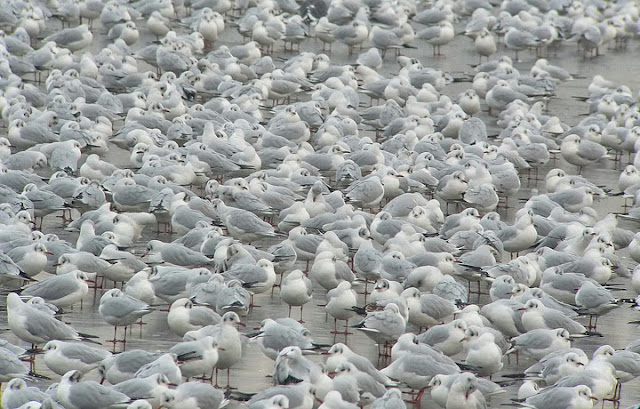
So, you own a camera. It might be a small compact camera, or maybe you've got a SLR with a standard lens on it. You know that you can get OK results by taking pictures of things that keep still and that allow you to get close to them - such as plants, fungi and moths at rest - but as for birds... well, the bloody things won't keep still and, when you do get close enough, the results are, quite frankly, disappointing. There are many blogs out there that are full of stunning images of birds. I could name a few but I'm not going to as they make me feel impotent. But, there is a way out for the naturalist/birder whose photographic equipment is modest or who doesn't have the patience to keep still for ten hours to get a picture of a Kingfisher sitting on a stick. Sheer number. A single Black-headed Gull at this range would be a very poor shot indeed, but when it is in the company of hundreds of others, it takes on an altogether more arresting image. Like one of those...

More crows and gulls

Image
After dismissing crows and gulls in my last post I found myself at Holmethorpe Sand Pits this afternoon watching mostly... crows and gulls - I can't keep away from them. Or is it just that they form the largest components of bird biomass in my area? Anyhow, a good 3,000 gulls were loafing around the landfill and water bodies with at least 2,000 being Herring Gulls. I reckon the gull above is a first-winter Yellow-legged Gull, present on the Water Colour lagoons, but if any of you larophiles out there think I've made a schoolboy error then please let me know. The crow part of the day was by courtesy of 1,500 Jackdaws gathering to roost. This many Jackdaws cackling away at once is an inspiring experience when you are in the middle of them. This year has already lost it's lustre - that's not to say that I'm disenchanted, just that the newness has rubbed off, the resolutions are in tatters and reality has set in. 2013 is well and truly here - let the games begi...

The G word

Gulls. Can't get away from the buggers at the moment. Every other blog seems to parade the latest images of Iceland Gulls, Med Gulls, Caspian Gulls, even humble Herring Gulls. Of all ages. And races. A grey, white and buff celebration of all things larid. Why don't I sound so keen? Well, I do like gulls. I even scope flocks of them and pit my knowledge of them against what is before me. I reckon I'm OK on gulls but not up to scratch compared to the true larophiles that seem to lurk in every harbour, landfill site and reservoir the length and breadth of Britain. Gulls seem to attract a certain sort of birder. They are pioneers (there is still so much to learn about them). They are purists (the need of critical examination, note taking and good old fashioned fieldcraft is required). They are confident (if you don't have birding self-belief you wouldn't tackle them). I can understand why some birders look the other way where gulls are concerned. Not everybody...

How many?

Image
A post-Christmas birdwatch was enjoyed at Beddington Sewage Farm today, myself already warm with the glow of enough calories on board to fuel the running of Dungeness 'C' reactor and happy with the England cricket teams continued demolition of Australia. On arrival it was obvious that the landfill site was operational, as thousands of gulls were present. After settling down, having had an hour or more scanning and also having walked across to the enclosed lagoons, the time came to estimate those numbers present. My gut reaction was to plump for a total larid mass of, lets say, seven or eight thousand individuals, based on nothing more than educated guesswork. However, when I tried to add a little bit of common sense to the process, it only helped to prove that my initial estimate was woefully short. I was quite happy to claim a fairly positive count of 375 Lesser Black-backed Gulls. So I used this as a starting point - a number not estimated but actually counted out, one gull a...

If you don't like gulls, look away now

Image
The cold weather had frozen both of the lakes at Beddington this morning, but this state of affairs did mean that plenty of the gulls that were scavenging on the landfill came and stood on the ice for us to scan at leisure. Among them was this 4th winter Caspian Gull (not an adult as its bill is still showing some trace of immaturity.) The picture below shows how much darker the mantle colour is from the nearby Herring Gulls (the Caspian is to the right, facing away from us). The most numerous species was Black-headed, with at least 7,500 present, along with 350 Common and 50 Lesser Black-backed. Neither of the two Med Gulls seen during the week gave themselves up. Go on, even if you don't like gulls all that much, they do make a spectacle, and on a day like today when nothing much is moving, it is something to look through with the added bonus of a good chance of picking up the uncommon. I did miss 2 Waxwing that flew through south-eastwards. I was off checking a stream for Lit...

Gull time

Image
It's not everybody's cup of tea to spend a few relaxing hours sifting through gulls. The scene above was taken this morning at the northern lake, Beddington Sewage Farm. If you are really keen and want to play the larid version of 'Where's Wally', then click on the image for a bigger picture. If you find a Med Gull then let me know, because I didn't. I did find an adult Yellow-legged, but could not refind the Caspian Gull that I saw two weeks ago and has been seen on and off since. Today's counts included 2,500 Black-headed and 2,000 Herring. The numbers will only increase...

Yesterday's gulls today

When I began birding, gulls were practically ignored by most birders - unless it was something easily identifiable, such as an Iceland or Glaucous Gull... or a nice adult Mediterranean. Meds were still rare then, and non-adult plumages were a real challenge for most. Any large gull that was not in adult plumage was shunned. It was an unwritten rule that they were, on the whole, unidentifiable. A few birders came along who changed that perception. One of them was Peter Grant. Because we were both Dungeness regulars I got to know him well, and can remember him critically analysing the few gull skins that were housed in a cabinet in the observatory. He made sketches, spent a long time at the power station water outflow where gulls gathered and similarly at the RSPB reserve where a significant roost assembled. We both sat in a hide overlooking this roost and he asked me to go through the motley collection of larids that had gathered, and to make my best attempt at ageing and identifying th...