Posts

Showing posts with the label visible migration

UMA26 September report

Image
September has positively flown by. My 'Uberpatch Meteorological Autumn' project (a rather pompous construct to spur me on to cover the local patches throughout September - November) is a third of the way complete. I can say that it has, so far, not totally lived up to expectations. Looking back over the last four weeks has certainly had its moments but these have been heavily outweighed by periods of disappointment. It was always likely to be this way, no dry inland birding patches are going to compete with what the coast - or local sewage farms or reservoirs - will be able to serve up, but the purpose of my efforts are to highlight what is possible across areas that are largely shunned and neglected by the avid birder. There were times when I berated myself for yet again treading this 'path less taken' but then something - invariably something quite modest - delighted me and I was once again fully engaged. I can truthfully say that I have got out of bed each morning wi...

Fly lines

Image
I'm now well into week four of the 'Uberpatch Meteorological Autumn' project and will wait until the end of September before going through the highs and lows that have been experienced. I have been doing a lot of sky-watching, or vis-migging if you prefer that description, and this has opened up avenues of pleasure, frustration and bewilderment, especially in trying to understand what weather conditions are best to witness a decent movement and where I'm best to position myself to do so. It isn't straight forward! I have a number of 'go-to' places to practice this dark art and all can produce the goods. In rough order of prominence they are: Denbies Hillside; Colley Hill; Box Hill; Epsom Downs; my Banstead garden; Canons Farm; and Priest Hill. Apart from my garden all have great viewing conditions (open sky, long horizons) although Box and Colley Hill lack decent northward views. This post is a distillation of what I think I know about autumn bird movements...

The 'always learning' curve

Image
We are almost at the end of the autumn visible-migration season, and, so far, it has been pretty decent. Following on from a massive Redwing day, and a more than passable Fieldfare-fest, I have spent the past two mornings at Colley Hill, on the North Downs just above the town of Reigate. Here are the two watches in detail, taken from my postings on Trektellen: Friday's session was four-and-a-half hours of birding that had its rewards, although the bird stream didn't really get going. Of the thrushes, it was three flocks of Blackbird (50, 27 and 25) that were the most interesting, as I cannot recall watching this species visibly migrate through the county before, certainly not beyond the odd one or two. The four Hawfinches were in a flock and briefly alighted. Watching many of the birds as they moved westward was instructive. Most arrived from the east, flying parallel with the scarp slope, maybe 100-200m out (to the south). Plenty just carried on through towards the Mole Gap, b...

Fieldfare frenzy

Image
It's happened again! Another back-garden thrush rush, but this time, instead of the slim silhouettes of several thousand Redwings I was watching the chunkier, more stately shapes of Fieldfare, that most regal of thrushes. I was stood outside at 06.45hrs, wrapped up against a keen NNW wind. At first, just a few Redwing flew over westwards, but as their flock sizes increased so did the odd cameo appearance from Fieldfares, until they took over as the main thrush component (at about 09.00hrs). I was able to latch onto a few tremendous flocks - 300, 100, 90 - and ended up with a grand total of 1,684, backed up by 747 Redwings. Just checking on my previous best Surrey vis-mig counts, this is just higher than my 1,658 (north) at Box Hill on 29 October 2019 and 1,558 (west) at Banstead on 13 October 2020. Needless to say, Wes Attridge eclipsed my Fieldfare count today by recording a new county record of 10,390 from Leith Hill Tower, although he was virtually frozen to the spot at the end ...

The day of the Redwing

Image
Sometimes you are in the right place, at the right time. And sometimes you are only in the right place at the right time because you have stood there for days on end, waiting for it to happen. Today it happened. It has become a bit of an 'October thing' over my garden, here in Banstead - a day (or two) of concentrated diurnal Redwing passage, so much so that I stand outside the house, at dawn from October 1st, waiting for it to commence. My previous back garden successes have included: 7,724 west at on 12 October 2020 5,334 west on 15 October 2020 4,145 west on 8 October 2018  3,203 west on 13 October 2020 The Surrey record, up until this morning, stood at 15,000 west at Beddington SF on 12 October 1997. I had no expectation of ever reaching that figure, and thought that my 7,724 from last autumn was a bit of a one-off. How wrong was I... It started to look good yesterday afternoon/evening, with the Flysafe/BirdTAM website offering up graphs and charts that predicted the follow...

Vis-mig and an Ouzel

Image
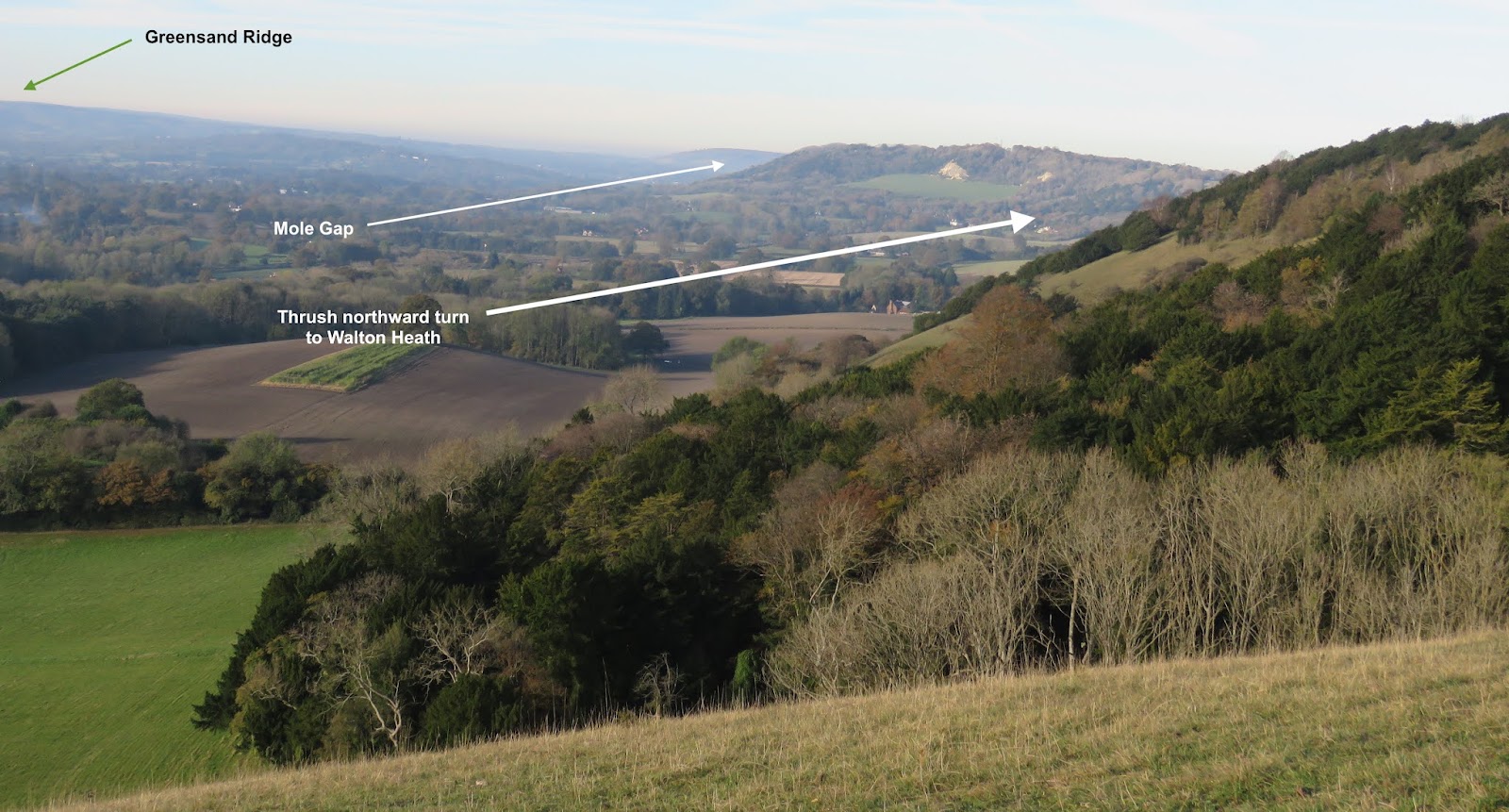
With lockdown partially eased, I felt confident enough to visit Box Hill for my first 'visible-migration' watch of the year. I took up position at my normal spot, below and to the west of the public viewpoint. This allows clear sight of birds arriving along the scarp, and also those a that are coming out of, or going into, the Mole Gap. The image above is what can be seen if you look straight ahead from my 'vis-mig' spot - the town of Dorking, with the Greensand Ridge in the far background. A small knoll, 'The Nower', is on the left-hand side (in the middle-ground), with the Mole Gap on the far right, in front of the rising hills that go up to Denbies and Ranmore. It was not a seismic migration session, as can be seen. For those of you not familiar with the migration site Trektellen, an asterisk against a species name denotes a differing direction of travel other than that which is specified. Most of my birds were, in fact, going north up the Mole Gap. Afterwar...

Flight-lines

The past three Octobers has seen my birding effort dedicated to finding decent visible migration spots in Surrey. My search has been deliberately confined to within ten miles from home. So far, and largely with good return, I have tried Box Hill, Colley Hill, Denbies Hillside, Epsom Downs, Canons Farm, Priest Hill and last, but not least, my back garden in Banstead. It is the latter that I will expand upon for this post. I am on (for Surrey) fairly high ground, a northerly spur of the North Downs. The garden is of moderate size and is north-westerly facing, looking up and along a slope. Neighbouring roof tops and a mature Ash tree cuts down visibility somewhat, but I can position myself to be able to see most of the sky, with the southwards views quite good and, looking across to a slightly higher ridge some 600m away, far-reaching in places. Back-garden vis-migging was born out of convenience, but it soon became apparent that it would repay my efforts. Big hirundine and thrush movemen...

More thoughts on North Downs autumn vis-mig

Image
The photograph above was taken from the eastern end of Colley Hill, from a place where I have conducted several migration watches. As much as this particular spot has proved to be good, it is limited in seeing birds that are incoming from the east (unless they are south of the scarp) and very poor looking northwards. Yesterday I stood on a knoll at the western-end end of the hill (marked above as 'Colley Hill watchpoint') and was pleased to find that all-round visibility is much better, including a much improved northerly view. In the distance you can clearly see Ranmore/Denbies and beyond that the Greensand Ridge. Between Colley Hill and Ranmore/Denbies is the Mole Gap, a place where the modest River Mole breaks through the North Downs. It is here that Box Hill will be found, another site that I have 'vis-migged' from, with some success. Some thoughts on Box Hill: it is tucked in from the leading edge of the downs - will this mean that a number of birds coasting...

Trial run

Image
Last autumn I spent some time trying out various spots along the North Downs to test their suitability as sites from which to watch migrating birds. Colley Hill, Box Hill and Denbies Hillside were all given a go, along with a few places further north, on spurs of higher ground (Mogador, Banstead and Canons Farm included). All of them provided some good birding, with sessions at Colley Hill and Box Hill being particularly noteworthy. Those latter two sites are both a minimum of a 20-25 minute car journey. What I would really like is for a regular vis-mig spot to be within walking distance from home. There are two sites that have produced some memorable visible-migration within minutes from the front door. The first is my Banstead, Surrey  back garden , where I have, in the past, recorded such numbers as 4,145 Redwings flying west (8th October 2018), and 1,175 House Martins moving south-west (24th September 2019). Finch passage can be obvious, mainly Chaffinches, but they do includ...

I spy...

Image
The picture above was taken yesterday morning by Mark Davis, looking northwards from the parapet of Leith Hill Tower. It is an arresting image. In the middle ground is Box Hill, and you can clearly make out the viewpoint where a combination of the feet of thousands of visitors, and the driest May on record, have worn down the grass to a pale creamy buff. The wooded ridge behind that, all smoky blue and mysterious, is where the bulk of the 2017-18 Hawfinch irruption took up temporary residence. And looming up in the distance is the London skyline, one that, even ten years ago, would have looked very different. The tallest, needle-like structure on the right-hand side is The Shard. It is 26.5 miles - as the Hawfinch flies - from Leith Hill Tower. And beyond the structures of London you can make out the Chilterns as they run through Hertfordshire. If you do not know the area you could be forgiven for thinking that those of us who live on the capital’s fringes are looked down upon by ...

Colley or Box?

Image
Looking back eastwards from White Downs earlier this week and already this autumn's birding was on my mind. Set out before us are the three 'peaks' on the North Downs that are within my uber patch. I have vis-migged from all three, but not often enough to be able to have a firm idea as to where is best. Obviously the time of year and the weather conditions play a part in which one demands my attention. Last autumn I spent more time at Box Hill and had some success (with thrushes) whereas Colley Hill fared better for finches. Ranmore didn't perform well at all. I plotted the main flight lines at the time and repeat them below. October 2019 - Box Hill migrant flight lines (mainly thrushes) October 2019 - Colley Hill migrant flight lines  The questions that are really taxing me at the moment are these. Colley Hill is further east than Box Hill. Have all (or at least most) of the birds that pass Box Hill westwards along the scarp passed Colley Hill on the way? ...

Charmed

Image
My most enjoyable natural history events of the past five years continues: 9. A swarm of Goldfinches  It dawned overcast, dry and mild at Dungeness on 19th October 2017. The wind was a gentle south-easterly and, on stepping out from the observatory back door and into the half-light, there were already birds calling high overhead. It seemed to me a morning to be watching the skies for visible migration! I took myself off towards the point, away from the background noise of the power station. Watching diurnal passerine movement at Dungeness is an imprecise art, although most birds during the autumn appear to hug the beach (either heading east or west) or straight down (or up) the peninsula. Any vantage point between the observatory and the fishing boats will normally do. I initially stood close to the old lighthouse to get a feel for where the birds were moving - it was soon obvious that Goldfinches were on the move, and coming down the west side of the promontory. After ten min...

Mind the gap

Image
To the west of Box Hill you will find a narrow river valley, formed tens of thousands of years ago by the River Mole. It must have once been a mighty river, not the shallow, sluggish water course that it is today. In recent posts you will find maps of the Box Hill area with identified flight lines of migrating birds. I have marked such flight lines along the Mole Gap, but in recent weeks the birds had not been using them - until today. I arrived at my favoured Box Hill vantage point at 06.30 hrs. It is a small area of flat ground on the scarp slope with views eastwards and, most crucially today, westwards, across the Mole Gap and on towards Ranmore. Thrushes were on the move quickly afterwards, a mixture of Redwings and Fieldfares. After approximately 75 minutes I had recorded at least a thousand of both species. By 09.00hrs the Fieldfares had tailed off, with the stream of Redwings more or less coming to a halt by 10.30hrs. An hour later I called it a day. The final totals were:...

Thrush-bearing cloud

Image
When I stepped out of the house at 07.00hrs the air was laden with moisture. The weather forecast was that of a nagging band of rain stretched across the south-east of England, and unlikely to clear until the afternoon - but it's proposed edge was tantalisingly close to Dorking (according to one satellite image that I had looked at.) So, instead of heading to Colley Hill as intended, I made my way to Box Hill, hoping that the extra few miles west might make a difference in the weather. Arriving at Box Hill made clear that it hadn't. The roads were awash with standing water, although the headlights did pick out a few Song Thrushes having a bathe. The hill top was shrouded in mist, but walking a third of the way down the scarp allowed some semblance of visibility across Dorking and on towards the Greensand Ridge. Looking south-east I could also just about see aircraft taking off and landing at Gatwick Airport, so I was ready for action. The only problem was the persistence in t...

Marsh Harrier topping

Image
Colley Hill can be found on the North Downs just west of Reigate. It is quite a spectacular site, with a steep scarp slope that has, along its length, a couple of natural bowls. These are not accessible to most people, so the partially scrubby slopes remain largely undisturbed. I have a longstanding affection for the place, but my birding victories here have been quite meagre, even though my effort has been reasonable over the years - a Ring Ouzel here and a Common Redstart there is not quite reward enough! To the north (and just over the M25, that bisects the area like some poisoned serpent) you will find open farm and grassland close to the village of Mogador. Both of these places have been lumped together as a single site for the purposes of recording any visible migration on Trektellen. This morning I took up position at 'Watchpoint 2' (map above) that has a good uninterrupted view northwards across the farmland. It was very misty to start with, but after an hour th...

Box Hill flight lines

Image
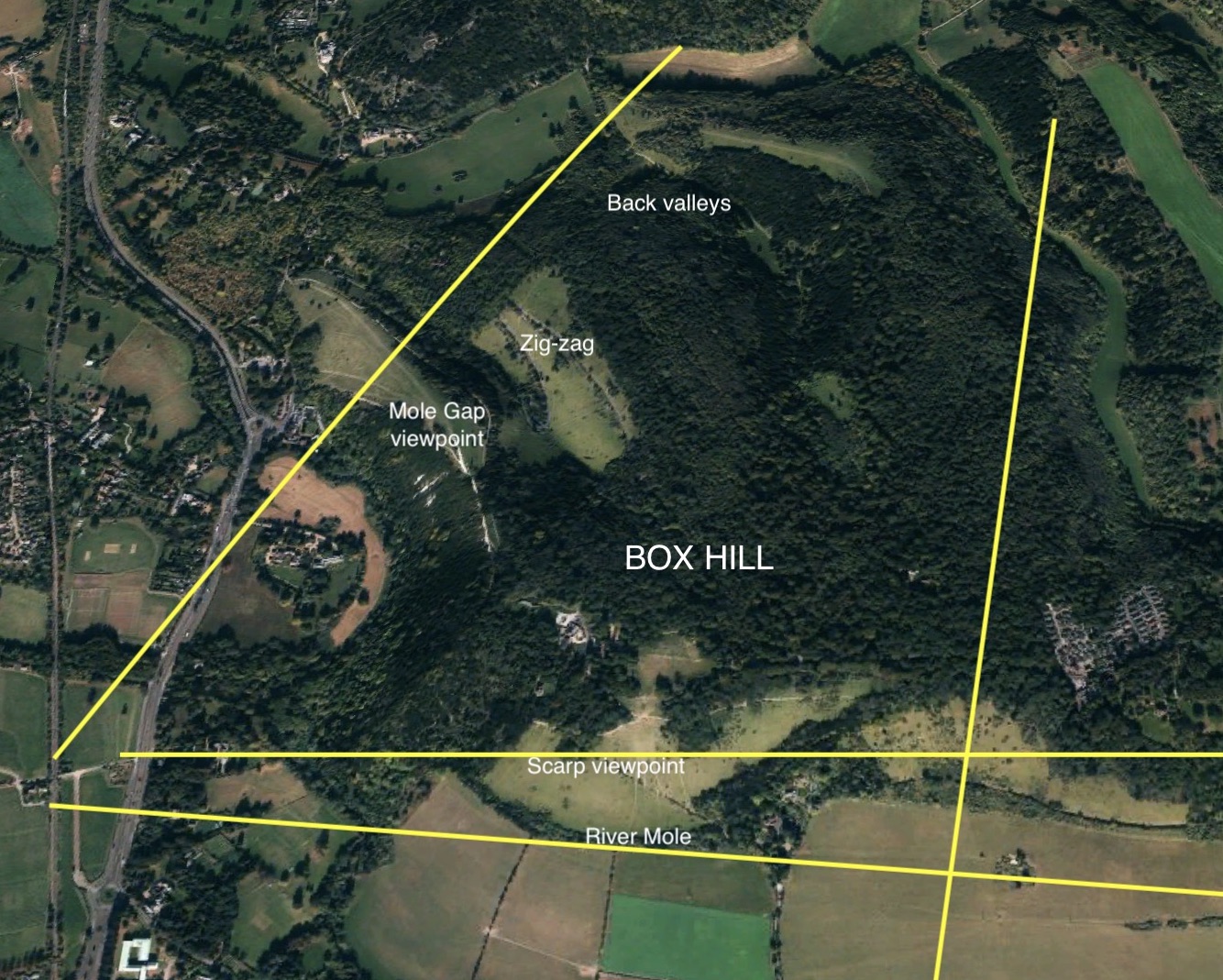
I knew I wouldn't be away too long... We are at the height of the visible migration season, or vis-mig if you prefer. Ed Stubbs, over at Thorncombe Street, is having a storming time this week and, apart from basking in the glory of finding a Red-throated Pipit, has written a bit about the recent history of this form of skywatching in Surrey. You can read it here. I have been having a far more modest time, but enjoyable all the same. This morning I went over to Box Hill, and stood on the slopes between 07.15 - 10.45 hrs. My reward was a steady, if unspectacular watch, with Woodpigeons on the move (1,927 south-west), my first three Brambling of the autumn, and back-up from an assortment of thrushes, finches, Starlings, and buntings. It was time well spent. What was educational were the flight-lines that the birds took. They are crudely marked out, in yellow, above. Firstly were the birds that flew from the north and headed south / south-west over and away from the scarp....

Where to stand?

I love migration. Birds, butterflies or moths, the privilege of being able to observe it happening is never lost on me. Every session out in the field that coincides with a movement of birds overhead is a treasured session. We are now in the middle of the best time to witness such movements. So, pick your site, go and stand there, look up, and count the birds. Simple. Well, to a point it’s simple, but finding somewhere to stand where you have a good chance of seeing numbers of birds flying through - that isn’t as easy as it might seem. Anywhere can turn up a good bird. Anywhere can provide you with a bit of visible migration. But those sites that regularly host such avian spectacles are fewer. Logic suggests hills and river valleys are the likeliest spots, but even they can be hit or miss. My own search for a North Downs hot spot, on the scarp slope, has been one of failure. Reigate Hill, Colley Hill, Box Hill and Denbigh’s Hillside have all been given the once, twice and thrice-over...

"I've got binoculars, on top of Box Hill"*

Image
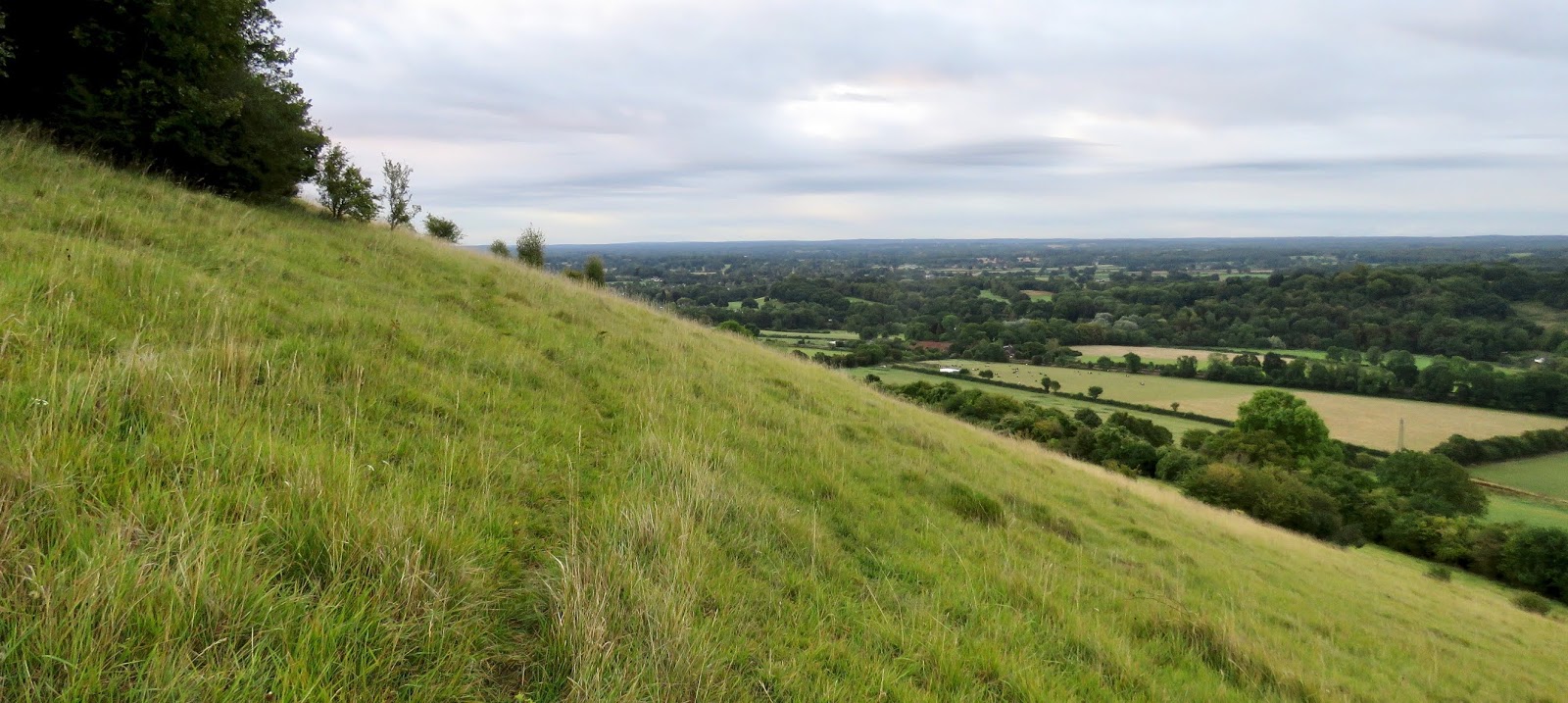
* hat doffed to one J. Lydon Esq, Flowers of Romance, PiL And that is exactly how I found myself at 06.20hrs this morning, ready for a morning of scintillating visible migration watching. By 08.20hrs I came to the belated conclusion that the birds had not read the script. A force two westerly wind, with 7/8 cloud cover, was never going to be the recipe for a memorable movement, and this was not helped by a 0/8 sky just to the north. Four House Martins heading south and two Swallows west was it as far as 'true' movement went, a pitiful return. And here are the views that were on offer from my vantage point, a third of the way down from the peak, just west of the viewpoint. Looking east, along the line of the North Downs. Gatwick Airport is out on that flat bit somewhere. Looking due south across Dorking (cue guffaws from our American friends). The River Mole is just before the closest housing. The Greensand ridge is in the distance - and here be dragons the Le...

Earthstars and Apps

Image
Our neighbours asked me to look at some fungi that they had growing in a flower bed. There were several of them that I tentatively identified as a species of Earthstar and, after looking in a few field guides believe is most probably Collared Earthstar (Geastrum triplex). It is apparently the commonest Earthstar but I could be wrong. Those of you that read yesterday's post may recall that I was pontificating on creating a WhatsApp group for Surrey birders who like a spot of visible migration. Well, the deed is done and we already have 20+ members. I need to acknowledge the help of younger daughter Jessica in showing me how to do so. My limitations with computers, software and Apps grows by the day...

A modest wader passage

The morning was spent at Mogador, the hamlet of which, at 200m, is apparently one of the highest settlements in south-east England. I was scanning the skies just as it was getting light, and for the next two hours was able to watch a modest southerly passage, which included 365 Redwing, 91 Fieldfare, 6 Lapwing and a Common Snipe. From keeping an eye on my Twitter feed, a number of other 'north downs' and associated higher ground sites also recorded waders on the move, albeit in modest numbers - Lapwing, Common Snipe, Golden Plover and Dunlin were the recorded species. What we lack in the county is a place where such observations can be seen, compared and studied. The only news gathering vehicle is a county page on the 'Going birding' website, which with all due respect is not being populated with much data. Maybe the vismiggers amongst us should set up a 'WhatsApp' group? Apart from an interest in what others are recording it would also act as an alert just in...