Posts

A gift that keeps on giving

Just two days into a week at Dungeness and already the shingle is providing me with natural history of the highest order. I won't post in any detail until my return home, but in just 48 hours I've been treated to a rare colony of Tree Crickets, spent a couple of hours botanising in completely 'new' Dungeness habitat and have had incredible views of a low-flying Honey Buzzard. Whatever happens during the rest of the week, the old place has proved itself - as it always does - yet again.
Rarity or spectacle?

What is that you remember most about your birding? What gives you the biggest kick when you are out in the field? What do you hope for more than anything else when you are looking?  For me, all three questions are not fulfilled by rarity, but by sheer spectacle. I've seen my fair share of rare birds, and some of them were firsts for Britain at the time. I may have travelled miles to see them. But, apart from a very few, they are but a tick on a list. If I were to compile my Top 10 'greatest birding hits' then it would be mostly populated by sheer spectacle. Off the top of my head I can vividly recall sea watches where skuas, terns, wildfowl and waders streamed past on a conveyor belt of awe; clouds of thrushes tumbling out of pre-dawn skies, calling in the half light; vast finch flocks wheeling over farmland; coastal bushes heaving with warblers and chats; hirundines arrowing by in a controlled frenzy of migration. Such events cannot be twitched. By and large you have...

The shingle is calling...

Image
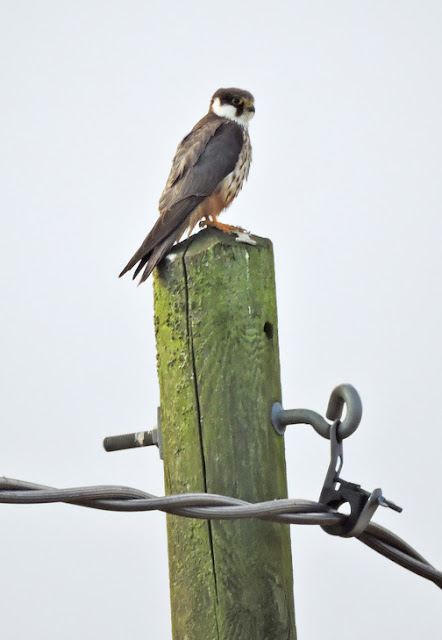
There's only so much an inland birder (and waterless at that!) can take. When coastal stations are awash with migrants and the birders present are busily picking out the scarce and the rare, those of us foolish enough to try and stay local are on a hiding to nothing. Another trip to Canons Farm, another few hours of quiet despair. This Hobby tried to cheer me up, and did succeed - for a few seconds. It's no good, I need a spell on the shingle...

Both sides of the argument

There are times when I wonder about my commitment to our birdlife. What do I actually do to help it? Going out and looking at them is just passive support. Identifying, counting and sending in the results to bodies such as the local bird clubs or the BTO goes a little way towards helping collate a database on which greater deeds can be planned and carried out. As much as we need foot soldiers to carry out the grinding work in all walks of life, some of us might have experience, spare time and a profile that can be used to great effect in the struggle to better the lot of our birds. I have plenty of the first two - experience and time - but do I use it? No, if I'm being honest, I don't... I don't do work parties. I don't volunteer. I tend to get turned off by campaigns. Is it just me, or am I the only birder that is fed-up with hearing about Hen Harriers and driven grouse moors? I shouldn't admit to that, for fear of having Mark Avery and his giant stuffed harrier ...

Globe theatre

Image
No, I haven't gone all Shakespearean on you... After walking the footpaths that cross Epsom and Walton Downs, and failing to tickle a single ornithological taste bud, it was a relief to come across this stand of Blue Globe-thistle, at the foot of the race course. I have known it here for several years, and it was a sturdy patch back then, no doubt the result of a dumping of earth. Some botanists dislike aliens with a passion, whereas I am quite fond of them. There is a very good second brood of Holly Blue here in Surrey. Wherever I wander I am coming across them, even over the past couple of days, which have been dark and dismal. To see one flitting along a hedgerow in a heavy drizzle can lift the moment instantly.

A Thursley interlude

Image
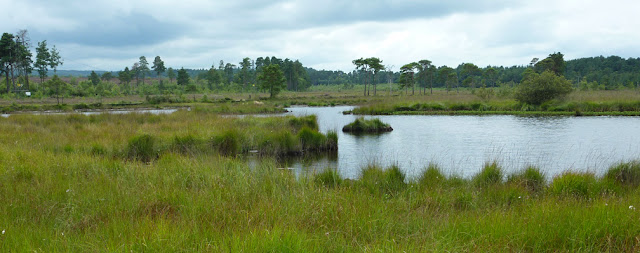
Today saw a rare outing to Thursley Common. This is one of those places that I have struggled with over the years. Being a specialist habitat it is always going to produce a small, but notable, suite of birds, but this is only half of (my) story - it seldom manages to excite me and I am without doubt the loser in not visiting the site very often. In spring/early summer you are more or less guaranteed the summering/breeding stars, with Woodlark, Common Redstart, Dartford Warbler, Hobby and Nightjar. You can sometimes jam in, as I did, with a first-summer Common Crane (6 May 1987) that rose up from the bog before giving a fly past. Winter is an altogether harder proposition. Birdlife can all but disappear and on one occasion my notebook recorded but 18 species in a five hour visit, but did include a Great Grey Shrike and a Hen Harrier! Having mentioned those two highlights, I have to admit to blanking out more often than not. But Thursley is far more than just birds. It is one...

Pants birding

On Monday I spent a few hours grilling the fields and hedgerows at Canons Farm. It was eerily quiet, not even a 'hweet' or 'hoo-eet' from a Chiffchaff or Willow Warbler to be heard. I almost cheered when a Whitethroat broke cover. My skywatching revealed nothing, apart from the fact that a few corvids and gulls were bothering to move, and even they were doing so half-heartedly. I returned home with the thought that at least I had made the effort. This afternoon I returned, hopeful that the odd migrant would be lurking - after all, Tree Pipit, Reed Bunting and Curlew had all been recorded there mid-week, and are all good local birds. But a steady drizzle greeted me and the fields and hedgerows did a repeat performance from Monday (although to be honest a single Chiffchaff did call). I wandered lonely as a very damp cloud, my enthusiasm waning with every passing minute. I don't mind birding without highlights, I just like to have something to look at! I was desperat...