Posts

Silver Lime

Image
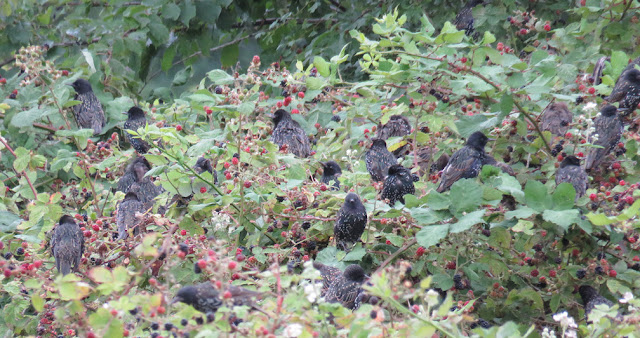
I'm feeling quite sorry for the hundreds of thousands of families currently on their British holidays. No doubt when they booked up their hotel/B&B/cottage/caravan/tent earlier in the year they imagined themselves splashing in the sea, eating ice cream and luxuriating under a blazing sun. The past couple of weeks have seen nothing but unsettled weather, punctuated by heavy rain and unseasonable strong westerly winds. Having had some of the holidays of my youth blighted by bad weather, I know how much it can affect what should be 'happy times', but there again, I do recall our flooded tent (at both Bude and the New Forest) with a certain amount of nostalgia... My recent trips to Priest Hill have been a question of 'dodging the showers' and any passage migrants have been largely missing. Bird numbers are quite woeful, bar a roving flock of Starlings, that number between 150-250 strong. They spend much of their time feasting on blackberries (top) and wheeling ...
Back to Priest Hill

Image
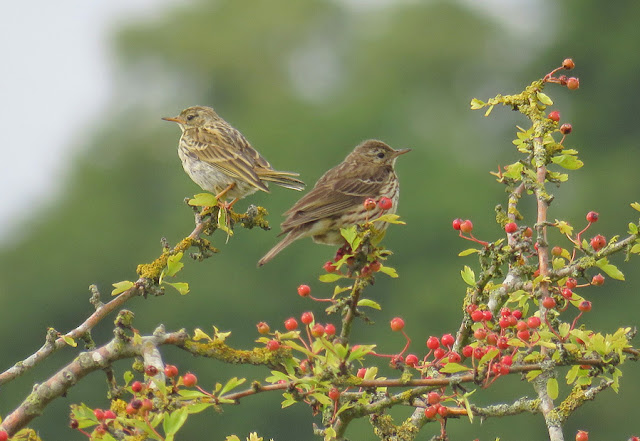
The UK autumn may really have started several weeks ago (with failed or non-breeding adult waders moving through), but in ND&B land we have only just declared the season open! To be honest, once I start to see Harebells, Clustered Bellflowers and Common Toadflax flowering, and Copper Underwings and Flounced Rustics in the MV, then I know that the summer is starting to think about ushering in the autumn. In all reality, this seasonal thing is not straightforward, as they overlap, merge and share many aspects. Serves our right for trying to label and pigeon-hole everything. Anyway, my sudden acceptance of all things 'autumn' has mainly been driven by my return to Priest Hill SWT Reserve. You may remember that I adopted it as a patch at the end of last autumn, and my time there has been gratefully rewarded, with such highlights as Cattle Egret, Woodcock, Jack Snipe, Common Snipe, many Red Kites, Peregrine, a good passage of Wheatear, Stonechat and Common Redstart, Ring Ou...

Long hot summer

Part 12 - April - July 1976 On returning to Beddington SF, the spring passage was well underway. On April 18 th the scratchy, agitated song of a Sedge Warbler greeted me, along with a pair of displaying Redshank, vying for attention with several pairs of tumbling Lapwings – these birds dominated the soundtrack to my sewage farm days during this period. Two days later, both a Little Ringed Plover and a Corn Bunting were newly arrived. Three visits were made to Pagham Harbour, the lure of the coast and its avian promise too much to resist. Garganey, Spotted Redshank, Whimbrel, Greenshank and Common Redstart were all seen, but it was a single Little Tern that stole the show. Up to twenty were present, flying like clockwork toys along the beach, this being accentuated by their ‘cartoon-like’ chattering, but one tern in particular had taken a liking to a ditch parallel to the shoreline at Church Norton. It patrolled this thin ribbon of water as I sat on an earth bank, just f...

Sunshine on a cloudy day

Image
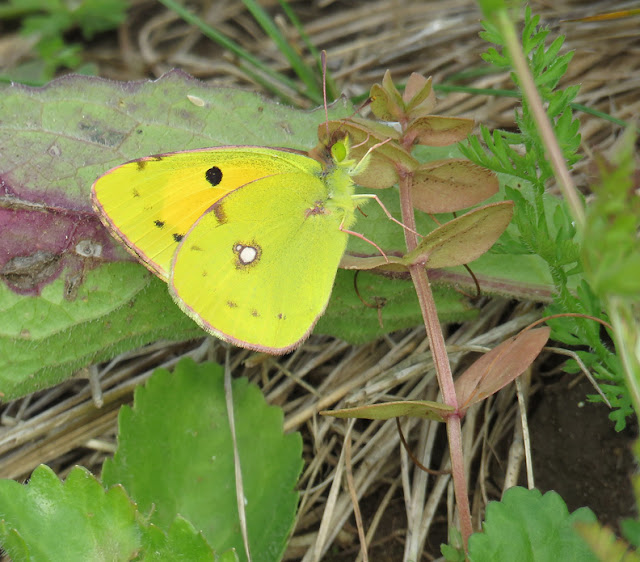
It has hardly got light here in Banstead today, a stygian gloom more reminiscent of mid-winter. But, after an almost full day spent decorating (well 'full' as far as I'm concerned), I hot-footed it up onto Langley Vale Farm for a spot of botanising. I chose to check the fields at the base of the slope close to Nohome Farm. It was all quite pleasant. The Wild Carrot was wonderful, as the two images above show. This field has been chosen by the Woodland Trust as a 'wildflower' meadow, and what pops up here is a mixture of species that were here before and those courtesy of seeding. I'm sure the Wild Carrot is a mixture of both sources. Although cloudy, it was muggy, so a few butterflies were on the wing. Highlight - by a country mile - was a single Clouded Yellow (top image), my first this year. I was also pleased to find a robust Round-leaved Fluellen (above and below), a brute of a plant, nothing like the weedy stems I usually find. Last but...

Red, gold and green...

Last night Katrina and I joined a few thousand other souls up on Epsom Downs racecourse to (a) watch a few horse races and (b) attend a Culture Club concert (I don't like using the word 'gig' - we never called them that 'back in the day'). In fact, come to think of it, I don't like using the term 'back in the day'... I must admit to two things. Firstly, I don't like horse racing. And secondly, I've never been a big fan of Culture Club. But when an opportunity comes along it seems churlish to turn it down just because you're not that keen on it! I could have stayed at home and cleaned the moth trap, or daydreamed about what rare birds I am going to miss this autumn, but no, Mrs ND&B has a soft spot for Boy George, so off we went. We only caught the last couple of races. Neither of us bet, so we just both chose a horse from each race and stood to gain nothing but bragging rights if either of them won. My two horses were chosen on name a...

Big hoverflies

Image
We were in the garden a couple of days ago when Katrina suddenly backed away from me (I cannot blame her) and exclaimed "I don't like the look of that!" She had just seen this... I was able to immediately put her at rest by telling her that it didn't sting, although it was very big and looked like a hornet - it was, in fact a hoverfly - Volucella zonaria , a hornet mimic. They are magnificent insects and illustrate how varied the hoverflies are, with some in comparison being tiny wisps of things. I've recorded two other Volucella in the garden, both large, arresting and most probably responsible for many a sudden panic in back gardens up and down the country.. Volucella pellucens Volucella inanis

Phasing

Image
Both the Not Quite Scilly and Wanstead Birder blogs have touched on this subject recently, and I'm not one to pass over the opportunity to nick a good idea... Phasing -  the lessening (or even dropping) of time spent bird watching. Most long-time birders have gone through spells of it. I certainly have. In fact, because of my other natural history interests, birding has sometimes taken a back seat for months on end. I don't quite accept that as phasing however, as I'm still out in the field, still looking at and identifying living things, but instead of birds they are plants, butterflies, moths or dragonflies. No, to phase is to completely close down. I've certainly lessened birding time in the past, but have I ever 'retired' from it? I'm not so sure. Whenever I go on a long birding trip (a fortnight on Scilly, a month at Dungeness) I cannot bird at full throttle throughout. I slow down, I need a change, my mind demands it. That can mean just potter...