Posts

The hidden world on Hogweed
Image
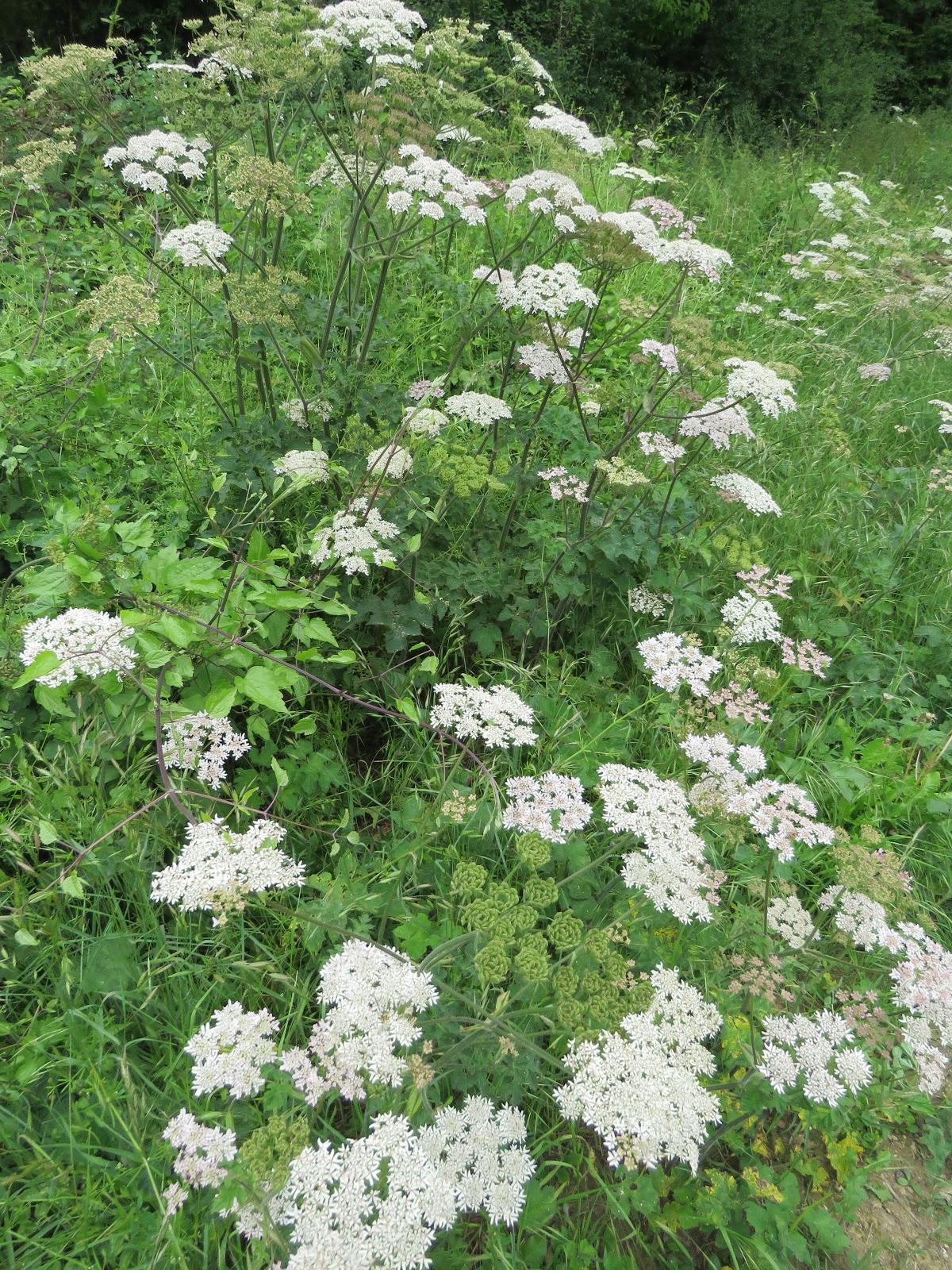
By mid-June I shed my birding skin and grow another, one that is confused by invertebrates and flowers. My current favourite place, Park Downs - just a couple of miles from home - has several stands of Hogweed (above), a common plant that deserves close scrutiny. Just look at a flowerhead and be amazed! This is fairly typical of what you can find - a chaos of feeding invertebrates, some so small that they can be easily overlooked. And now zoom in... This is where I get confused. What are they? The 'black' bugs with the red side-patches (cuneus) I believe to be Closterotomus trivialis , which has only been recorded in England since 2009, but appears to be very common at Park Downs! The smaller, dull beetles are (I think), Bruchus rufipes . The beetle on the far right is a Varied Carpet Beetle (fairly confident about this one). But what of the black beetle with the long antennae at the top left? Martin F - help please!! As you can tell, my knowledge of bugs and beetles is rudimen...

Dark Green Fritillary

 Up to three of these butterflies this afternoon at Park Downs. A little taster...

Sigma men

Are you a Sigma male? This relatively new 'character type' has been put forward by Ric (see comments section for last post) as an explanation as to why I (and people like us) think and behave as we do. So how do you know if you are one? A quick online search suggests that you (we, I) are if: You love being alone but value other people. You are a silent leader. You can adapt to different situations. Treat everybody around you the same way. Doesn't need a social circle to be yourself. Understands the importance of silence. Morally grey (or worse) Hates living life safely. Social skills could use some work. Incredibly self-aware. Master of own fate. Could be an alpha male if wanted. Hmmm... I started off thinking that, yes, I must be one, but as the 12 points continued found that I disagreed that they were describing me at all. I have highlighted those that I identify with strongly in bold and those that I do not in italic. Those in blue I do not feel strongly one way or anoth...

Staying put

Image
Two weeks ago I was in West Sussex, on a beautiful sunny day in which I met up with a couple of friendly faces from my birding past ( you can read about it here ). I took a detour on my way home, to Shoreham, to see plant that I have long lusted after, Starry Clover (pictured above). The drive was a lengthy one considering the short distance, and the traffic seemed to be back to pre-Covid levels, with plenty of queues, hold-ups and busy junctions. I crawled into Shoreham - the clover's home - and parked up by the fort, to be greeted by hundreds of people flopping about the beach, strolling the paths and enjoying ice-creams, drinks and the sun. My clover quest was a rushed affair, due to the species being by a busy footpath, with my self-conscious attempts to photograph the flowers drawing plenty of bemused attention. I then, rather reluctantly, walked some 500m to check on a site for Childing Pink, at a small cordoned off area of sandy ground, along the harbour's edge. It was h...

Look what’s popped up...

Image
When I took the lawn mower out to tidy up the front lawn I was staggered to see this Pyramidal Orchid standing proud. It was a bit the worse for wear, having had the leaves nibbled - most probably slugs - but the flower head was present and just starting to flower. The garden is on chalk with just a shallow depth of earth. The closest Pyramidal Orchids are maybe 3/4 of a mile away. Our front lawn has a good natural flora, with species such as Blue Fleabane and Small Toadflax cropping up, plus common calcareous grassland plants. I mowed around the orchid and am proudly watching it open up.

First moths origins

Image
Since 1987 I have recorded 409 species of macro moth in the garden. I thought it would be interesting to see what new species I have recorded over the past 15 years and a breakdown of their possible origins. 2006   Striped Hawk-moth (01/09), Pinion-streaked Snout (22/09), Pine Carpet (14/10), Blair's Mocha (28/10) 2008   Buff Footman (01/06) 2009 Dingy Footman (02/06) 2010 Toadflax Brocade (23/05), Orange Footman (04/06), Hoary Footman (25/07) 2011 Rannoch Looper (03/06), Tree-lichen Beauty (02/08) 2012 Jersey Tiger (17/08), Gypsy Moth (18/08) 2013 Royal Mantle (16/07), White-point (04/09) 2014 Grass Rivulet (07/06), Dark Spectacle (03/09) 2015 Cypress Carpet (26/06) 2017 Yellow-legged Clearwing (13/06), Orange-tailed Clearwing (18/06), Scarlet Tiger (19/06), Scallop Shell (08/07), Clifton Nonpareil (23/08), Delicate (25/09) 2018 Great Oak Beauty (09/06), Kent Black Arches (06/07), The Mocha (07/07), Oak Processionary (19/07), Gold Spot (06/08) 201...

Moth bothering

Image
The garden moth trap has started to produce decent numbers and species diversity, although that headline moth has still yet to appear. My highlights over the past week have been Alder Moth (above) and Figure of Eighty (below). A few migrants have also started to show, but limited to low numbers of Silver Y and the micro xylostella . My garden is at its 'mothing' best during the months of June and July, when wanderers infiltrate the catch - not just migrants but also habitat specific residents that go wandering. An exciting time of year here in Banstead.