Posts

Showing posts with the label Starling

A long walk in the Surrey Hills
Image
On May 3rd I put on my walking boots, opened the front door, and ventured out into the (almost) dawn. It was 03.45hrs and the start of a carefully planned circuitous birding walk. The aims were simple really, to see what could be found across a large swathe of the Uberpatch. I wasn't expecting much, as the 'properly' birdy areas of my extended patch (Beddington and Holmethorpe) were not being visited, as these areas are well covered by others, and I have perversely taken it upon myself to travel on 'those roads less birded'. It would be fair for others to question why any sane birder would remove themselves from such proven honeypots, and I'd largely agree, but we all get our ornithological kicks in different ways, and the older I get the more left-field they have become. Call it self-denial, self-harming or just plain stupid, but to me these 'forgotten' patches can - an do - spring surprises. Just not all that regularly. To cut a long story short - a 34...

Postcards from Cornwall

Image
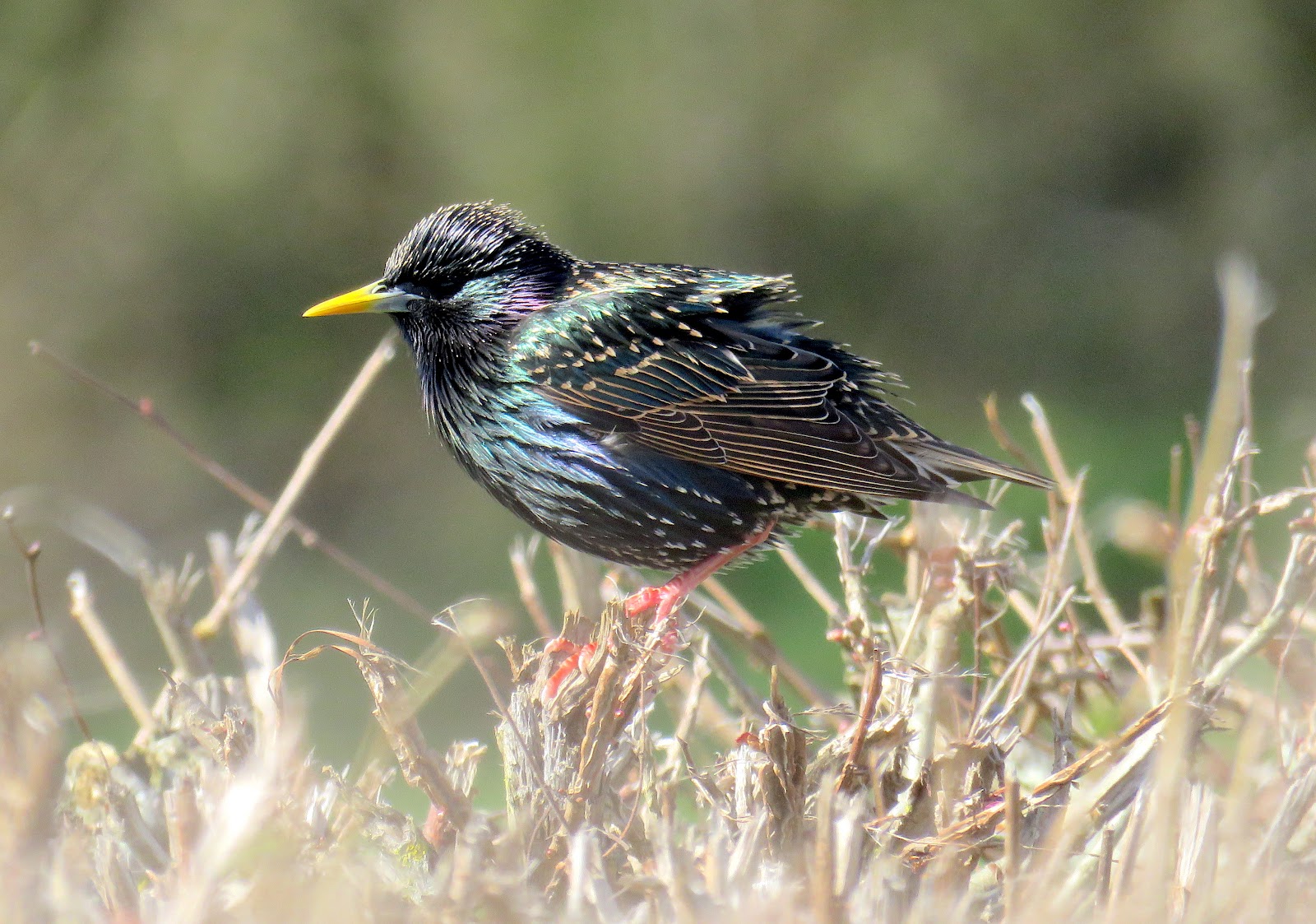
Common Starling, basking in the predominant weather of our Cornish holiday - hot, dry and sunny Wall  - still extremely scarce in Surrey but easy enough to find north of Bude I was pleased to stumble across several plants of the declining 'arable weed' Field Woundwort Olearia solandri (Coastal daisy-bush), established in the sand dunes at Bude Never need an excuse to take a picture of a Wheatear - they presumably breed on the clifftops close to Bude It was good to see Bude birder Harvey Kendall (here on the right), who on this particular occasion joined me to watch a juvenile Marsh Harrier that was hunting over the lake and farmland behind the bungalow in which we were staying. I first met Harvey (and his son Ian) back in 1979 at Dungeness. We were able to reminisce and catch up over several cups of tea throughout our stay. The harrier was a Maer Lake tick for him, and one gripped back on his son!

Shape-shifters

6,000 Starlings in a flock is small beer when watching certain roosts. Yes, they may sweep and wheel, coalesce and break apart, seemingly playing around as much as choosing exactly where to roost and share in the day's news via their chortling - but a flock of 6,000 Starlings coming in off the sea is a different proposition all together. They are direct. They have urgency. They are arrows. They have dispensed with grace to act upon a primal urge to move on, move forward, survive. We picked them up maybe a mile offshore, a shifting smoke, shape-shifting until we could start to appreciate what we had before us. A leading mass that seemingly sped up as they closed in on us, then revealed a tail of birds that went on and on. They breached the beach and gained height, the tail of the flock panicked into catching up. More followed, and within half-an-hour we had counted 15,000 birds - early morning in France, breakfast in Blighty. The Starlings took the feathered plaudits but moths s...

Silver Lime

Image
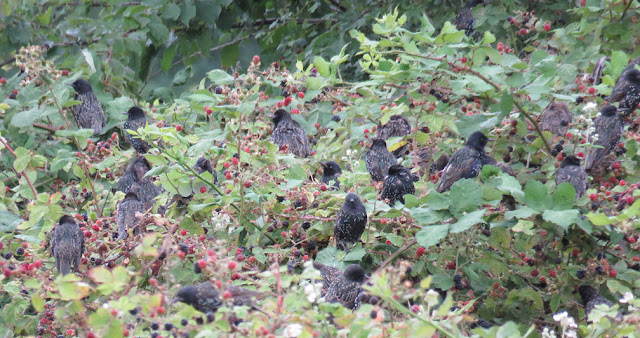
I'm feeling quite sorry for the hundreds of thousands of families currently on their British holidays. No doubt when they booked up their hotel/B&B/cottage/caravan/tent earlier in the year they imagined themselves splashing in the sea, eating ice cream and luxuriating under a blazing sun. The past couple of weeks have seen nothing but unsettled weather, punctuated by heavy rain and unseasonable strong westerly winds. Having had some of the holidays of my youth blighted by bad weather, I know how much it can affect what should be 'happy times', but there again, I do recall our flooded tent (at both Bude and the New Forest) with a certain amount of nostalgia... My recent trips to Priest Hill have been a question of 'dodging the showers' and any passage migrants have been largely missing. Bird numbers are quite woeful, bar a roving flock of Starlings, that number between 150-250 strong. They spend much of their time feasting on blackberries (top) and wheeling ...

Starlings

They came in off the sea on a broad front, some flocks in tight balls, others strung out like stretched elastic and even more in small congregations, seemingly detached from the masses. They flew directly, with purpose and urgency. The larger flocks could be seen even at distance, dark smudges against a light grey sky, thickening and thinning as parts of the flock overtook others, an ornithological Etch-a-Sketch. They started to arrive shortly after first light, peaked between 08.00 - 10.00hrs and carried on in ever decreasing numbers until mid-afternoon. How many? At least 10,000, all heading NW to N, and now roosting many miles away, many of them for the first time in this country. Welcome!

Remembering Starlings

Image
It started with a short film-clip that was shot sometime the 1950s. Trafalgar Square. Looking up at the statue of Nelson, motionless on top of his column, surveying all before him, in grainy black and white. Atmospheric and redolent of faded Empire, rationing, post-war gloom.... and Starlings. Thousands of Starlings. Swirling around our fabled Admiral, clouds of chattering, screeching birds, getting ready to roost in one of London's most famous squares. In 1950 over 100,000 Starlings were recorded roosting there. And it got me thinking of the roosts of my youth and how we all took this most humble of birds for granted, even dismissed it from our list of what were considered to be birds 'worth bothering about'. It got lumped in with House Sparrows and Feral Pigeons. Not worth looking at. This was, of course, before their numbers plummeted. During the 1970s I grew accustomed to seeing the pre-roost gatherings of Starlings over Sutton. Black vortexes that morphed in shape...

Vis mig

Image
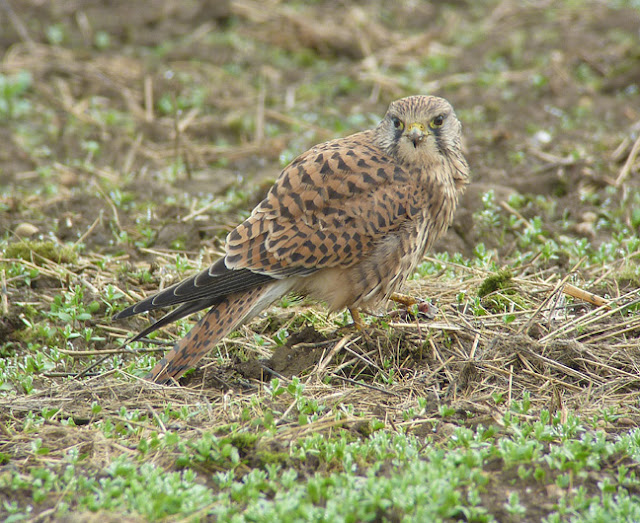
I like nothing better than a good passage of diurnal migrants passing overhead - migration and movement in all its glory. This morning at Canons Farm there was, for the first three hours of daylight, a good passage of Redwing (700), Starling (3,000) and Chaffinch (300) in a westerly/south-westerly direction. The odd Redpoll, Siskin and Brambling was thrown in for good measure. One of last weeks Ring Ouzels was still haunting the hedgerows. The Kestrel pictured above decided to pounce on an earthworm and consume it only yards away. Even I had to digiscope it.