Posts

Beddington Sewage Farm

I've added a page to this blog, called 'Beddington birds'. Not surprisingly this is a list of the bird species recorded at the world famous sewage farm, with my own personal list highlighted in red. There are four birders who have seen over 200 species there, which is no mean feat for a London sewage farm. You will find some top class rarities among them - Glaucous-winged Gull and Killdeer being the stand-outs. However, there is still no record of Slavonian Grebe or Nightjar. One or two others, that were easily seen when I first trod the paths, are now gone - Grey Partridge and Willow Tit - maybe to never return. Patch watching is, of course, more than a list. Blogger pages become too difficult to manipulate if they have too much data loaded onto them, otherwise I would bombard you with further Beddington info.

Bewildered

With a self-imposed target of my pan-species list reaching 3000 by the end of the year, and currently falling a little bit short, I decided to target mosses. I've got the book to help me and a fine book it is to (Atherton, Bosanquet and Lawley). The trouble is, there are so many of the pesky things and a lot of them look the same. With a brave face and after giving myself a good speaking to (to inject enthusiasm and conviction into my doubting self) I entered the field yesterday to give them (another) go. Well. After time spent at Beddington and Walton Heath, I added the grand total of....none. I tried. I really did. But I couldn't in all honesty confidently name anything. My mosses and liverworts list will remain low for some time to come I'm afraid. I did add a few fungi to the list (which now stands at 2951). It's touch and go if I get to the magic figure before the year's end. I've also got the Dobson lichen guide. There are thousands of possibilities ...

The public and 'our' reserves

I recently visited Rye Harbour Nature Reserve on the East Sussex coast, within a couple of gull's wing flaps from the Kent border. There have been great things happening at Rye. What used to be Rye Harbour Farm is slowly being turned into saltmarsh , capable of supporting breeding and roosting birds. This is part of a grand 50-year plan called the 'Romney Marshes Living Landscape Partnership'. What is being constructed is an almost unbroken mosaic of wetland habitat stretching from Hastings in the west through to New Romney in the east, taking in Pett, Icklesham, Rye, Walland and Romney Marshes, Dungeness and Lade. Really exciting times. When I was staying at Sandwich Bay back in June, I was similarly impressed by local plans for turning a large area of Worth Marshes back into exactly that - marshes. This would created a similar run of habitat all the way back westwards along the Stour Valley to Canterbury. When I was wandering around the newly created paths at Rye, whi...

Entering the Lyon's Den

Image
I couldn't resist it any longer - after having read so much about the delights of Ebernoe Common on Graeme Lyon's excellent blog  I decided to go along and take a look for myself. I persuaded my old mate Gordon Hay to come along for the experience. Neither of us are fungi experts, but on arrival headed straight for the churchyard where I knew an easy to identify species should be present. It was, but just the one... Pink Waxcap! I was pleased with that. We wandered around for a couple of hours and saw, amongst others, Dead Moll's Fingers, Brown Birch Bolete, Tawny Funnel, Field Blewit, Chanterelle, Powdery Brittlegill and Poisonpie. The more familiar Fly Agaric, Lilac Bonnet and yellow Stagshorn were also on show. A number of fungi photographers were also combing the area, on of whom reckoned that the numbers present were very poor due to the dry weather. We were not disappointed with what we had seen however. After this we went onto Pulborough Brooks (2 Ruff) and ...

Seawatching in Surrey

Image
The thin slither of silver that you can see in the centre of the picture above is the sea. No big deal to you, maybe, but to me this was one of those golden moments. I was standing in Surrey and I could see the sea! There was something about that which was rather special. Squint as I might, but I couldn't make out any seabird passage, although it was a bit hazy. Also the 30 mile distance may not have helped. I think the gap in the South Downs that allows us Surreyites to get a salty sea view is where the River Adur empties itself into the Channel at Shoreham. But I maybe wrong. Where was I? Leith Hill.

The Surrey Alps

Image
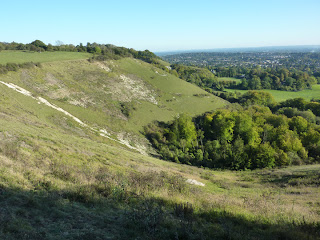
This is Colley Hill, on the North Downs. We are facing eastwards and that's Reigate nestling down like the sleepy little leafy town that it is. The scarp and bowl look far more dramatic in real life than it does in a photograph - the perspective and vertiginous slopes have the life squeezed out of them. The North Downs is a different beast to the South Downs. The latter appear wilder, more remote and grander. Both are of similar height, although because the adjacent land is already pretty high, the North Downs does not give the impression of being as lofty as that southern bit of chalk. Having plenty of cloaking woodland also adds a softness to the north. Back to Colley Hill. I have spent a lot of time here over the years. It is a place of family walks and picnics and also one that I do venture onto for plants (Meadow Clary!), butterflies (good numbers of Silver-spotted Skippers) and birds... well, when I say birds I really mean in expectation of them. To me it...

If you're easily offended, look away now...

Image
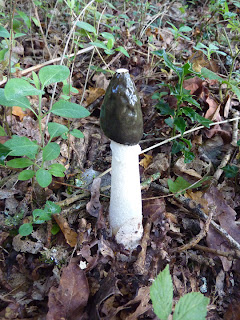
This is a Stinkhorn, one of the more phallic looking fungi. No doubt this sort of species was covered up by Victorian naturalists to save the honour of any passing women. Mind you, if it does remind you of a penis, and you are a man, I suggest that you make an appointment with your doctor urgently and get yours checked out. They are supposed to smell to such an extent that you can detect their whereabouts with your nostrils before your eyes have a chance to do so. I bent down to sniff the tip of this particular specimen (I did feel a bit perverted doing so) and can reveal that it was sickly sweet. All this eroticism was taking place at Thundry Meadows, a Surrey Wildlife Trust reserve close to Elstead. It is an interesting reserve of Alder Carr, grassland and mixed woodland along a stretch of the River Wey. The picture below is looking across the river away from the reserve. Pretty... I carried on afterwards to Thursley Common. In glorious weather and with a mere breeze, ...