Posts

The jewel of the mountain top

Image
4. Rock Speedwell (Veronica fruticans) Early July, 2008. A vile day, with swirling force 6-8 winds thrashing heavy rain about with violent abandon. Not a day for botanising, and certainly not a day to be at the top of Ben Lawers, the most famous of the Scottish botanical mountains, with a feast of alpine plants not equalled elsewhere. But here I was, soaked to the skin, barely able to see further than 100m in front of me, and at times that view was down to 10m. Fortunately the path is well marked and worn, and as long as I kept to it and did not wander from it, I was safe. I had been sheltered somewhat from the elements by Ben Ghlass's shoulder, but, as I ventured towards the final stretch of the summit path the weather got at me unimpeded. What part of me that was dry now became very wet indeed. Every so often the fog-like cloud parted for a few seconds to reveal the way ahead. A boulder strewn grassy rise led up to the cliff base but it was not until I was close to this wall ...

More green stuff

Image
Two delicate plants for you this morning, both being quite local around here. On the left is Common Valerian . I found a few tall specimens growing on a chalky slope above Chipstead Bottom, and even though I have walked past this spot many times before, have not previously seen it here. And on the right is Pale Toadflax , a modest but rather fine species, which is found sparingly on Park Downs. A quick check at Fames Rough revealed a flowering Ground Pine (looking sickly) and the few Cut-leaved Germander plants that are present are now heavily in bud. There were modest numbers of Marbled Whites and Meadow Browns on the wing, a scattering of Large Skippers, but butterfly numbers still seem depressed to me.

Ribena and red wine

Image
5. Marsh Cinquefoil (Comarum palustre) This is a very local species in the SE of England, and I have only seen it in two places - Thundry Meadows (Surrey) and - yes, you've guessed it - Dungeness (Kent). In fact, the latter site is the only place in Kent that it is found. It is having a very good 2016 on the shingle, with clearance work across the northern part of the bird observatory recording area having opened up habitat enabling it to flower for the first time since 1984. There are other sites nearby, such as the Oppen Pits on the RSPB reserve, where a discrete population has endured. I was entranced by the flower long before I saw it. Not many have such a colouring - a cross between Ribena and red wine. And not many look as if they were the product of someone skilled in the art of soft furnishing. My first encounter with Marsh Cinquefoil was on a misty June dawn at Thundry Meadows, and I was not disappointed. Even in the half light it shimmered at me, an exotic flower i...

"I'm going to pick up my binoculars and walk out the front door - I may be some time"

Image
I tweeted that at 09.00hrs, a few hours after coming to terms with the fact that this country had decided to vote to leave the EU. I can honestly say that I have never been so angry, confused and felt so impotent over a political decision. It was a referendum that did not need to happen, but did so because of petty party political infighting. I took myself off to Denbigh's Hillside, close to Dorking, to clear my head. I sat down and started to put all of what had happened into some sort of order. The bare facts are that 51.9% of those who voted opted to Leave, and 48.1% opted to Remain. For such a far reaching decision, it seems almost too narrow a margin to allow any progress to continue. This isn't just a case of the UK coming out of the EU. It has opened up massive chasms between the generations; a deeper fracturing of a fragile United Kingdom; a widening class divide; Northern Ireland and Gibraltar now facing up to being on closed borders; enormous worry for UK passp...

Warm air perfumed

Image
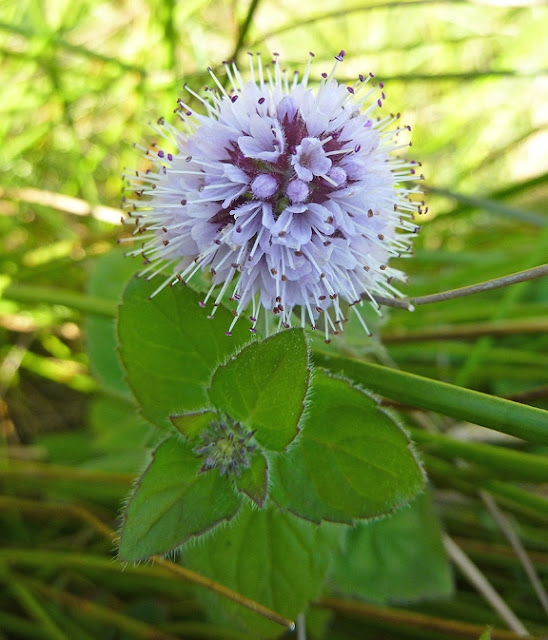
6. Water Mint (Mentha aquatica) This species is really the twin of my last selection (Ragged Robin). As with that species, it came to my notice by being one of the plants that populated the wet flushes on the shingle at Dungeness. I often smelt it before seeing it, at times in subtle wafts, and at others it could be overpowering, depending on whether or not I had just crushed some leaves underfoot. The flower cannot be described as anything but modest, but is recognisable from a distance, as each neat 'ball' tops another, discretely strewn amidst the vegetation. You can find it where there is water, whether a damp flush, a village pond or a stream-side bank. I have it growing in my small garden pond, where it is a great attractant to a wide range of bees, flies, wasps and moths. Just sit for an hour and watch the winged procession come and visit. It is easy to plant and will spread across the pond by creeping rhizomes. I look for the spikes each summer and am delighted w...

Torn ribbons

Image
7. Ragged Robin (Silene flos-cuculi) This is another species that buried itself deep into my subconsciousness by being a plant that was with me at the start of my 'Dungeness time'. Back in the mid-70s I could be found regularly helping out with the bird ringing, and as such trudged across the shingle and through the sallow bushes from net-site to net-site day-in, day-out. The wet flushes that were found out on the shingle had their own community of flowers, many not found away from them. These, even to my bird-obsessed mind became little icons, friendly markers appearing by the damp edges. The coral-pink, deeply-indented petals had got my attention, made me take notice, and encouraged me to find out what it was called. It looked like torn ribbons to me. "Ragged Robin," I was told. I liked that name. And it is a species that still brings a smile to my face whenever I stumble across it. It is not a plant that I see much locally, more's the pity.

The evening perfume

Image
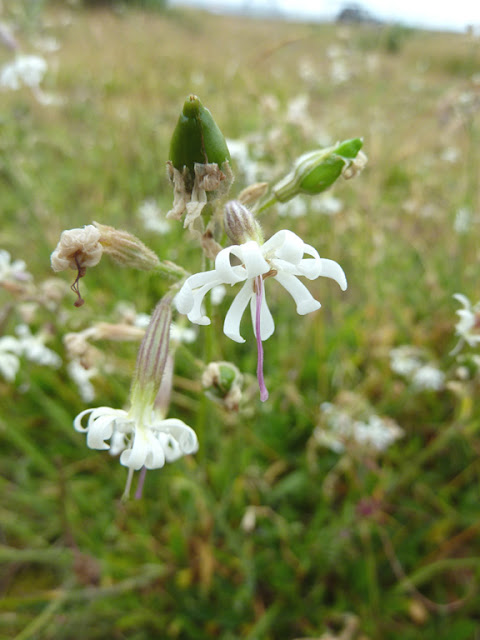
8. Nottingham Catchfly (Silene nutans) Back in the mid-seventies, when we all wore long hair and flared trousers, my first visits to Dungeness were all about birds. Birds, birds and more birds. But a couple of plants crept into my subconsciousness, by dint of having some more enlightened birders close by who also looked at other life forms that did not necessarily possess feathers. One of these species was Nottingham Catchfly. I was told that it was rare and that Dungeness most probably held more of it than anywhere else in the UK, and that is all I needed to know to embrace it as a 'worthy' flower. In time I got to know it well, knew where the best populations were and it slowly became an iconic part of my 'Dungeness experience'. - the shingle would have felt bereft without it. I spent the summer of 1979 at the Bird Observatory. Back then, during late June and July the peninsula used to be vacated by birders, so there were many days when it was just me at the ...