Posts

Lose glasses, find iridis

Image
It was a pleasure to once again meet up with Sussex-based freelance ecologist and all-round good bloke Graeme Lyons ( you can visit his highly instructive and entertaining blog here ). He has been conducting an invertebrate survey at Chipstead Bottom over the summer, and invited me to accompany him on his latest session yesterday. I jumped at the chance. Graeme's natural history knowledge is exceptional and his desire to encourage and inspire others to look at all the natural orders is infectious. We met at 09.00hrs. It had been over six years since we last met, but immediately struck up the easy going relationship that we had previously enjoyed, chatting non-stop during the following seven hours as I followed him around, watching the master at work. Graeme was armed with a sweep net, suction sampler and beating tray, utilising all this equipment (plus more) to entice the myriad of hiding invertebrates out into the open, ready to be catalogued and identified. There were five s...
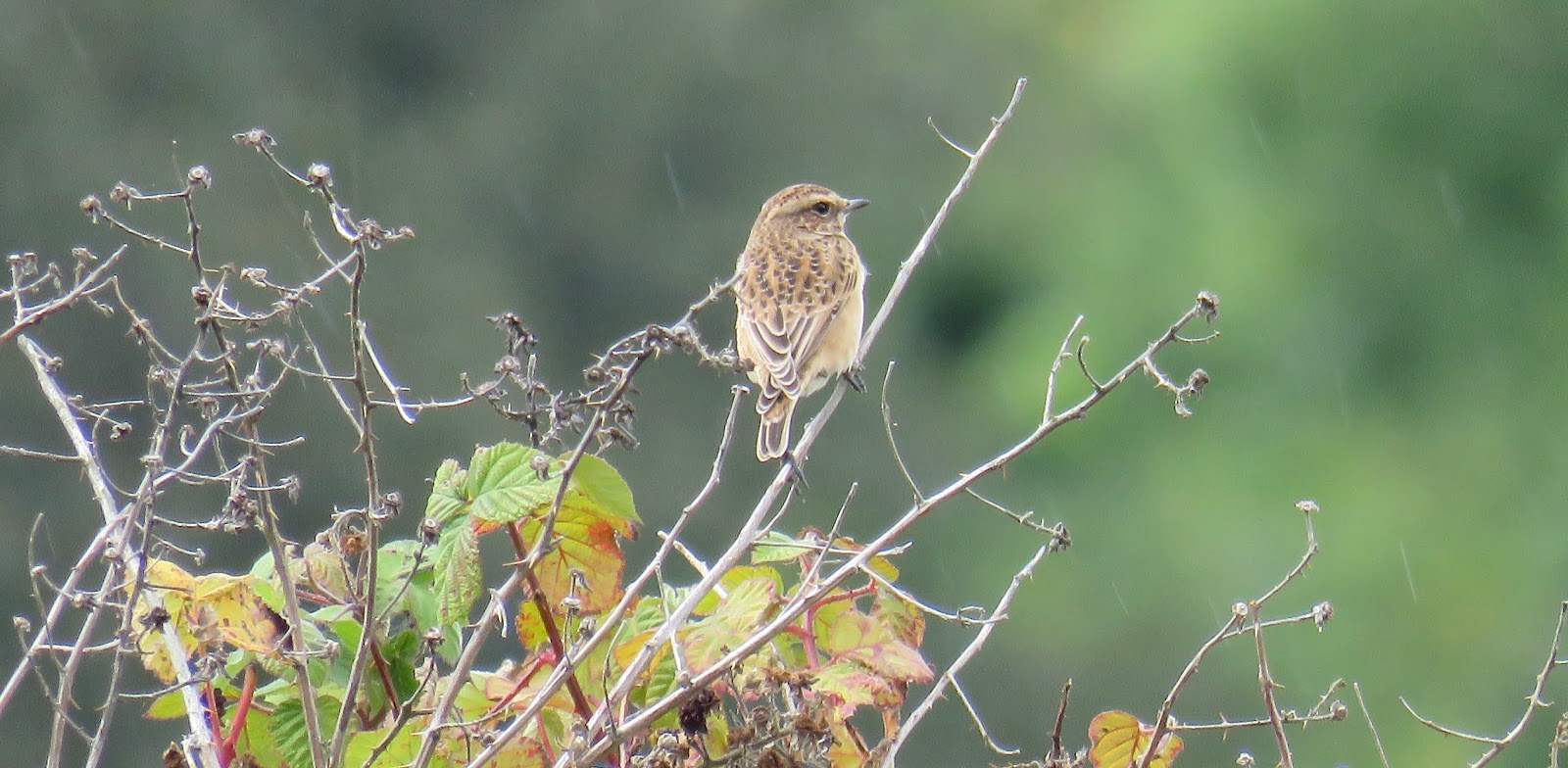
Whinchats

Image
Whinchats. One of my favourite birds. Luckily for me they are a frequent passage migrant on the neighbouring downland. This afternoon a minimum of five were found at Priest Hill, with at least two of them being 'new' individuals. I would love to know the true numbers passing through. Counts from here of five (24th), three (27th) and five (today) could, purely on paper, be taken as five birds hanging around or 13 different individuals. Fortunately some of these birds have been quite striking - one exhibited a bright orange upper breast (only seen on 24th), while new in today was a grey-plumaged bird plus another that had a strongly spangled mantle. So, a minimum of seven.

Going local

Image
Any regular visitor to this blog will know that I extoll the virtues of local birding, yet on the other hand moan about it in equal measure. This is a post of positivity. Yesterday saw me at Canons Farm, where a swarm of 220+ Swallows were feeding over the large bean field. They eventually headed off south-westward, with two Hobby, a Swift and a House Martin in tow. A juvenile male Peregrine was also present, trying its luck with some of the 850+ Wood Pigeon on site. This morning I met up with Steve Thomas, he of Ewell 'nog-mig' fame. Before we retired to the Wheatsheaf in Ewell for an afternoon snifter, we strolled around Priest Hill and uncovered a Wheatear, three Whinchat and three grounded Yellow Wagtails. A tidy return.

Whinchats in the rain

Image
A day's birding (on and off) all on foot from home. Was it worth it? Well yes, it had its moments... First off was a couple of hours vis-migging from Nork Park. This was the first such session and will most probably be the last. Until you actually try these things for real, the problems are not always apparent. As a site it has a great view, but the best position is alongside a noisy A road. I have enough of a problem picking up the calls of distant Tree Pipits and Redwings as it is, so the backdrop of vehicle noise will not be helpful. The park is also home to hundreds of dog-walkers and their canine companions. I was met with a mixture of suspicion and curiosity and felt quite uncomfortable. If the park returned Spurn-like numbers of migrants I would roll with it, but this is obviously not the case. I returned home and sat in the garden, which was almost silent in comparison. My close-to-home skywatches will be a lot closer to home than I envisaged. This afternoon I dodged...

Trial run

Image
Last autumn I spent some time trying out various spots along the North Downs to test their suitability as sites from which to watch migrating birds. Colley Hill, Box Hill and Denbies Hillside were all given a go, along with a few places further north, on spurs of higher ground (Mogador, Banstead and Canons Farm included). All of them provided some good birding, with sessions at Colley Hill and Box Hill being particularly noteworthy. Those latter two sites are both a minimum of a 20-25 minute car journey. What I would really like is for a regular vis-mig spot to be within walking distance from home. There are two sites that have produced some memorable visible-migration within minutes from the front door. The first is my Banstead, Surrey  back garden , where I have, in the past, recorded such numbers as 4,145 Redwings flying west (8th October 2018), and 1,175 House Martins moving south-west (24th September 2019). Finch passage can be obvious, mainly Chaffinches, but they do includ...

Wet but rewarded

Image
Dawn at Box Hill was characterised by low, misty cloud. I descended through the murk, and walked the tree-lined banks of the River Mole, eastwards as far as the garden centre bridge. There were pockets of birds to work through, best being a mixed tit and Chiffchaff flock that also held a couple of Spotted Flycatchers. Two Crossbill moved eastwards and up to four Kingfishers were noisily obvious. By 08.00hrs it started to rain in earnest and by the time I returned to the hill top I was very wet indeed. Back home a check of the moth trap revealed two of the migrant pyralid Palpita vitrealis (pictured). My first for the site was only last week.

Treading water

Image
Sometimes, birding locally can get to you. Today is such a day. It is a given that my bit of dry, northern Surrey is not going to measure up against Spurn or Dungeness (or Beddington or Holmethorpe for that matter), but when every other London park and Surrey heath is recording multiples of Pied Flycatcher - and I'm not - it starts to get personal. The last five days has seen me visit Canons Farm, working all the copses, hedge-lines and weedy field corners. The last five days has seen low numbers of migrants. A few passing Chiffchaffs, a flock of four (and a one) Whinchat, a Stonechat, a single Willow Warbler, that's about it. I strongly suspect that all of the Whitethroats and Blackcaps are locally-bred loafers. My effort has been full on, my patience freely given. But each day I've left the farm with a sense of knowing that, even if I had stayed out in the field for an extra hour or two, nothing would have happened. Sometimes it goes like that. After a barren three...