Posts

A different kind of 'Richard's' at the sewage farm...

Image
When news broke of Peter Alfrey having found a Richard's Pipit at Beddington yesterday I was unable to visit, but, via the kindness of Roger B, access was granted earlier this morning. After a rather poor 90 minutes skywatching from the northern lakeside we then scaled the slope of the mound (with Glenn and Christian) and walked onto the weedy top to search for the pipit. After 45 minutes of a no-show Glenn returned to the underwhelming sky-watch whilst Christian and I doubled-up our efforts and started all over again. Within a couple of minutes a large, wagtail-like pipit leapt from the vegetation and flew in a tight circle around us, then hovered for a good 10 seconds before alighting once more into the vegetation. It couldn't have performed any better, with the clear supercillium, pale lores, stout bill and unmarked flanks at once obvious. The next time in flight it called three times, the classic raspy "shreee". We were then able to stalk the bird as it stro...
Vismig

Visible migration is but one of the joys of birding. To be able to watch flocks of birds moving overhead, with intent and purpose, is exhilarating - it's as simple as that. And, to make things even better, you can take part in these observations anywhere you can see some sky. A balcony on a city-centre block of flats; a hilltop; a coastal headland or a suburban back garden, they will all do, admittedly some will produce more birds and a wider spread of species than others. Our Banstead back garden would most probably come two-thirds of the way down a 'Visible migration' league table. It has clear sky, although mature trees and houses get in the way in certain directions; it is at elevation (in Surrey terms): it is close to open downland. Even though I've lived here for over 30 years, attempts at visible migration from the garden have been patchy, even though successes are sometimes forthcoming and some big movements have been witnessed. This autumn a bit more effort h...

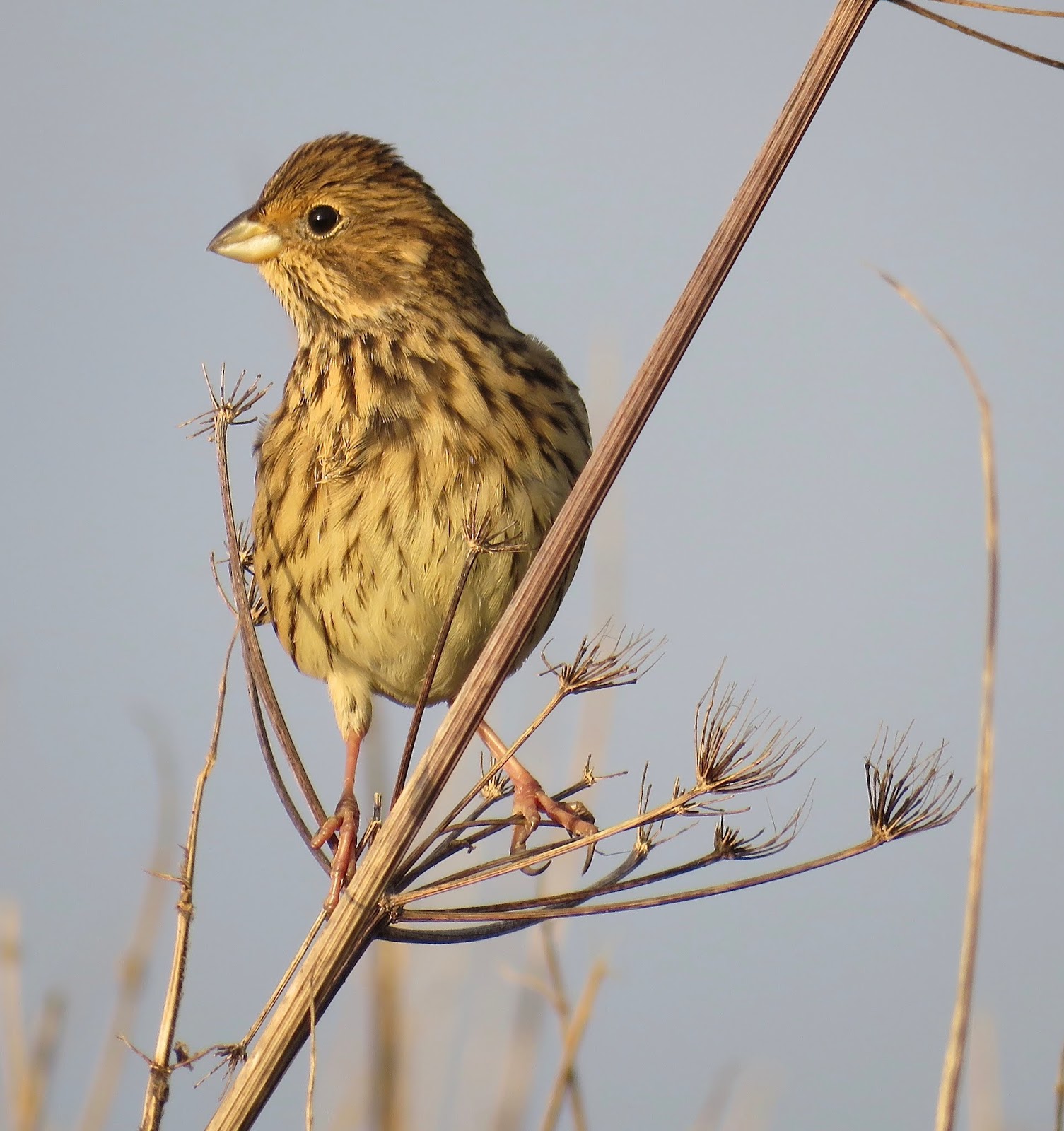
Corn Buntings at Whipsiderry

Image
I was very pleased with managing to capture these images of Corn Buntings in the set-aside fields at Whipsiderry near Porth, Cornwall. No enlargement needed, just a bit of sideways crop.

Tolcarne stranding

Image
It was sad to come across this stranded and deceased Leatherback Turtle this morning on Tolcarne Beach just east of Newquay. The Cornish Marine Strandings team had already arrived and tagged the corpse in case the tide took it away before it could be removed. A large beast, it cut a sorry sight, motionless on the sand, surrounded by sombre holidaymakers.

Set aside success

Along the cliff top, just above Whipsiderry Beach, is a stretch of 'set aside' fields some 800m in length. Signs alert you to this being 'Bunting habitat' and in particular that of the Corn Bunting. Like elsewhere in the south, this species has become a lot more uncommon, so it was good to see such measures having been undertaken to safeguard its future. The fields held plenty of birds, with Linnets, Goldfinches, Skylarks, Meadow and Rock Pipits utilising the long grass and wildflower seed (I did see some Corn Marigold still in bloom). And Corn Bunting? Yes, five of these chunky passerines, one in song and an obliging individual that allowed me to obtain some quite good (for me) pictures. I will post them soon.

Well Choughed

Katrina and I are down in Porth, a small Cornish town due east of Newquay. Some friends of ours have just moved down here and we are availing ourselves of their hospitality. They insisted that I bring my optics along and have a bird watch and I am happy enough to oblige! An Internet search revealed little about the general area for birding. It is easy to assume that any part of the British coast, particularly one this far down in Cornwall, will have a rich ornithological history. My arrival was one of not knowing what to expect. It certainly has potential, with a rocky coast punctuated by sandy bays, cliff tops with discrete areas of Tamarisk scrub and ribbons of hedgerow. Today saw two highlights in my couple of hours of birding - a low-flying and vocal Chough plus a second calendar year Mediterranean Gull. A modest but pleasing start.

Azores day one

After the crew mopped up on Shetland earlier in the month (with seven selfies, 28 likes and a retweet from none other than Captain Wank) we decided to hit the Azores to hoover up all of the Yank vagrants. But before we did there was the small matter of the Cornish Catbird, so the crew got back together at Big Dick's House - that's me, Pipit Shagger and our new member Spunkwit. What a birding possee!! After a fraught drive through the night we were relieved that the bird was still there, pointed out to us by a passing cyclist who reassured us that it didn't have a tail - we must have been looking at the wrong field guide... anyway, we all uploaded a load of images via Spunkwit's big lens - I'm sure that there haven't been many pictures taken of this particular bird. Our's were shite to be honest, but you could easily make out the tell tale whiskers. Anyhow, back to the Azores. It took us three days to get to Corvo where we were met by one of the top Western...