Posts

Showing posts with the label George Monbiot

In a world of wounds

In George Monbiot's latest post (click here) , he writes: To understand what is happening to the living planet, the great conservationist Aldo Leopold remarked, is to live “in a world of wounds … An ecologist must either harden his shell and make believe that the consequences of science are none of his business, or he must be the doctor who sees the marks of death in a community that believes itself well and does not want to be told otherwise.” In my ignorance, I have only vaguely heard of Aldo Leopold. I was intrigued to see from where this quote was taken. It comes from his book 'A Sand County Almanac' and was published in 1949.  I had to read that date of publication again. 1949. The quote seems so fresh, so now . It only goes to prove that the realisation that our planet is not well because of the hand of man is not a modern phenomena. It's just that, in the intervening years since Mr. Leopold's observation, very few of those in a position to do so have d...
Please read this

If you click on this post you will be taken to George Monbiot's thoughts on funding and flooding. Please take a few moments to read it. Maybe Owen Paterson should do so...

Worthy blogs

I've added a couple of extra 'worthy blogs' to my list (on the right there). The first is A new nature blog by Miles King. The second is from George Monbiot . Both are thoughful (and thought-provoking), taking blogging to very high levels indeed. If you want to look deeper into our natural world, the movers and shakers (and destroyers) then take a bit of time and have a look. You won't be disappointed. They both show my stuff up for the fluff that it truly is.

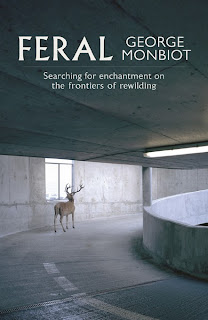
Feral

Image
A couple of posts ago I mentioned that I was reading Feral by George Monbiot. Last week I finished it and can not recommend it highly enough. In simple terms, the author puts forward his case for the 'rewilding' of large tracts of Britain. Most of upland Britain is, in his words, 'sheep wrecked' - over grazed. This results in a barren landscape where the naturally occurring plants are reduced to a mere handful of species. The survivors are the few that are unpalatable to sheep, with only the very steepest slopes safe ground for vegetation to take any hold. Needless to say, such a habitat breakdown has a knock-on effect across all wildlife, affecting species numbers and composition. I have witnessed the destruction caused by sheep and deer at Ben Lawers in Scotland. By the visitor centre there is a burn that comes down from the hillside, meandering through a shallow depression. This has been fenced off to allow the vegetation to regenerate. You are allowed to wand...

A few literary recommendations

Image
I wandered into a second-hand book shop at Lyme Regis (near to the Cobb) and came across a gem of a book - The Oxford Book of Flowerless Plants by Nicholson and Brightman - first published in 1966. It concentrates on ferns, mosses, lichens and fungi and, although it could never be used as a field guide, the plates are simply charming. Here are three examples. The artist has grouped these lichens and mosses into 'habitat' groupings which is a good aid to helping such a novice as myself get close to making an identification. The species illustrated are the common and most likely to be found, so further reference from the 'big boys field guides' should help confirmation. I used the word 'charming' to describe the artwork - it is used as a compliment as these illustrations give off a real warmth and obvious love of the subject matter. Barbara Nicholson is the talented artist. Whilst on holiday I read The Fossil Hunter by Shelley Emling . It is, for all in...