Posts

Showing posts with the label Marsh Tit

Comeback tit - 3km (Day 4)

The two inches of snow that fell in the Banstead area yesterday was still in place, with sub-zero temperatures overnight giving it all a hard crust, the roads and pavements being slippery as a further result. After the big influx of Skylarks at Canons Farm as a result of the weather, I returned to monitor their number - still 120 present, but down from yesterday’s 200. They were feeding on a couple of the western-most fields along with 150+ Linnets. When they all took to flight, the flurry of clean whites and buffs in such dazzling light, under lit by the reflecting snow, was dazzling. Adjacent to the farm, on the eastern flank, is Banstead Woods. I spent an hour trying to kick up a Woodcock (in which I failed), but a great success was locating a single Marsh Tit, my first here for several years. When I used to visit these woods from the late-70s this species was ‘a given’, 2-3 individuals easily picked up within just a few minutes. Alas, over the last 10-15 years it has been a difficu...
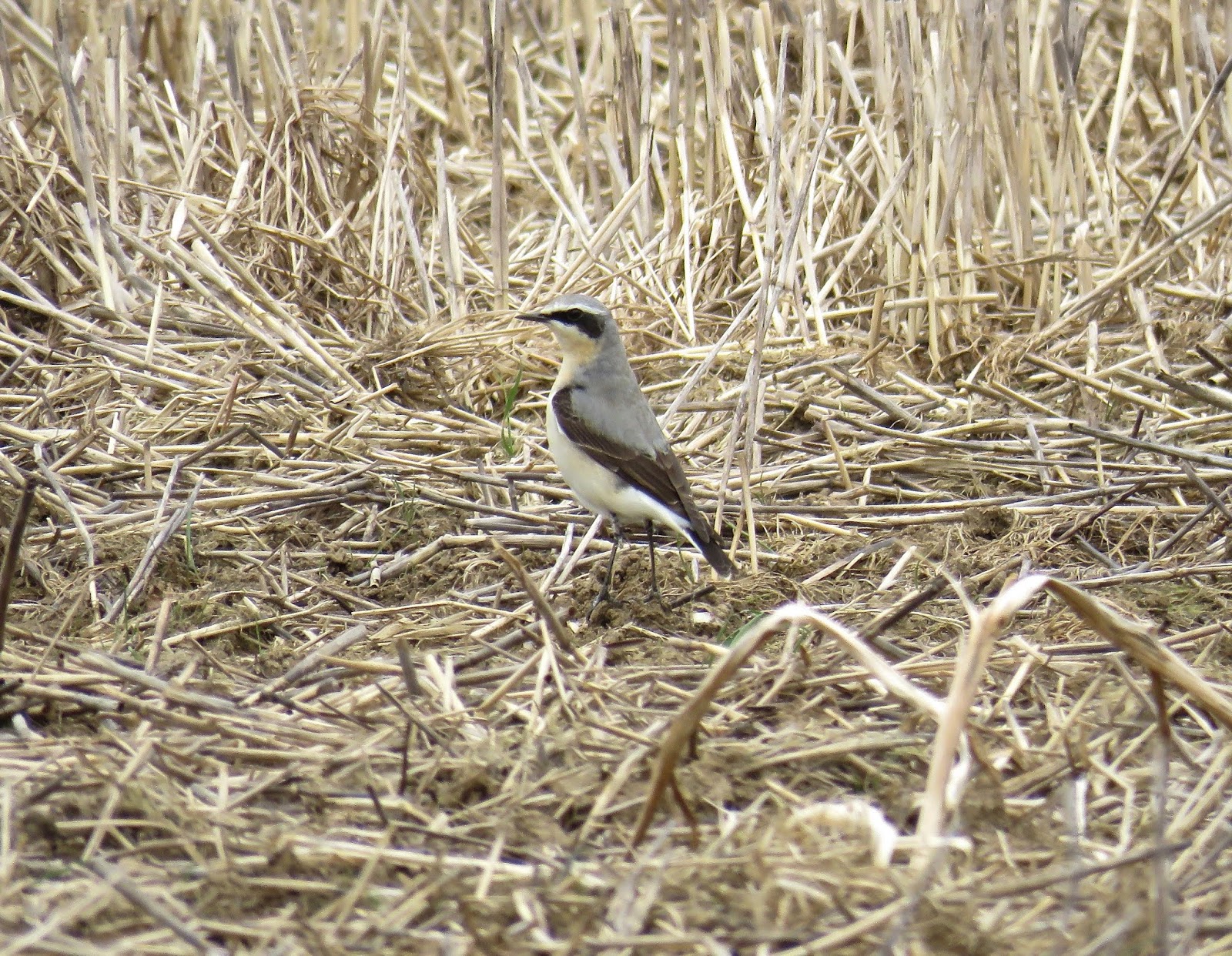
It's white-arse time!

Image
The past couple of days has seen a large influx of Wheatears into southern England. I have been checking on the high, open ground of Epsom Downs and Canons Farm with some regularity, but with no success - until this afternoon. Standing by Reeds Rest Cottages (at Canons Farm) I was talking to Gordon Hay on the phone, moaning about the lack of Wheatears, when a smart male flew into view. The spell of taking in this most wonderful of birding moments - the year's first white-arse - was broken only by the appearance of another male alongside, and then a third. All flew off, over the green barn, before then alighting on Broad Field, where they were joined by a female Stonechat. I moved on to Mogador, just north of Colley Hill, where the open ground has been a magnet to chats in the past, but not this afternoon. There was some compensation with a pair of Marsh Tits being extremely vocal in Margery Wood, where I haven't recorded the species for a number of years. One more ...

Hawfinch social

Image
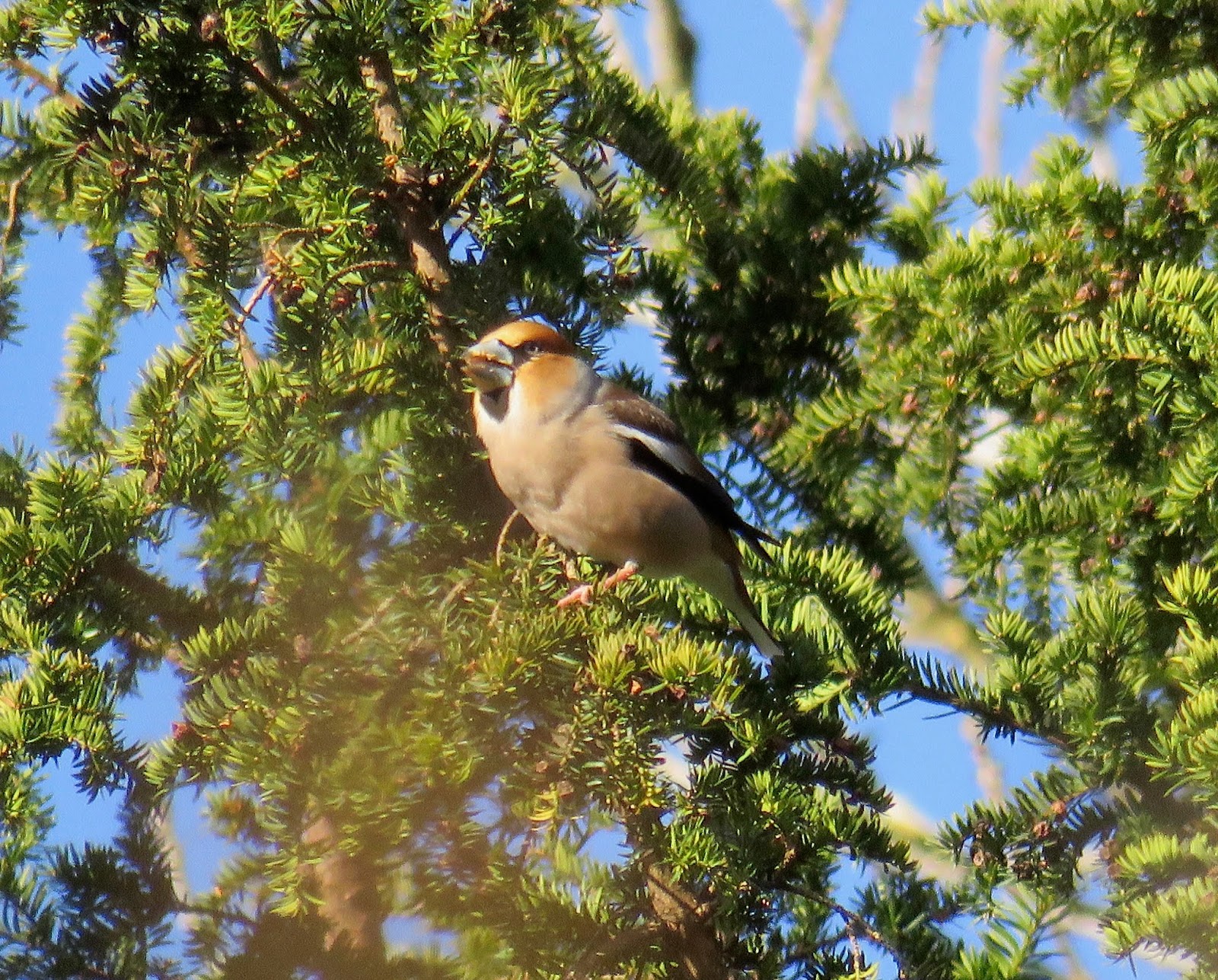
Bramblehall Wood was bathed in glorious sunshine, which no doubt helped swell the number of birders who joined me on the muddy footpaths to witness yet more Hawfinch action. It was a pleasure to watch these birds along with John, Lindy, Jan, Graham, Piers, Paul and Lee - it made the morning all the more memorable. It was not so pleasurable to be told that two birders (even though they had been asked not to) entered the wood which is clearly private. This brings up three things - (a) they lack fieldcraft (b) they have no consideration for others (c) they are showing a lack of respect to the landowner. Once they have left the area and returned home it is us local birders who suffer any consequences. No wonder the suppression of birds is making a comeback... Anyhow, back to the fun stuff. I recorded a minimum of 250 Hawfinches which were on show as early as 07.10hrs when I arrived on site. There were two episodes that I would like to share with you. The first occurred at the southe...

A lack of Marsh Tits

This morning I spent at least three hours roaming the woodland that is draped across Gatton Park, Reigate Hill and Colley Hill. It was exceedingly quiet, save for a flock of 75 Redwings. There were times when I could stand still and fail to see or hear a single bird. Most worrying was the lack of Marsh Tits. It is close on five years since I have recorded one in this general area. Come to think of it, my last few visits to nearby Walton Heath has failed to turn up this tit either. Maybe its local range is contracting - seemingly lost from Banstead Woods, possibly going that way in the Reigate area, hard to come by at Walton Heath... but it's not all doom and gloom. The small populations in Great Hurst and Little Hurst Wood are hanging on (albeit becoming quite isolated) and it remains quite common at Headley Heath, Mickleham and Box Hill. I have to remind myself that when I first started birding in these places back in the mid 1970s, Willow Tits were quite easy to come by. It wou...

Klimt at Headley

Image
Headley Heath is a special place for me - some of my earliest birding took place here, with warm summer evenings in the company of churring Nightjars and roding Woodcocks. In recent years I have twice come across Hawfinch flocks, but my efforts to do so again have been unsuccessful. I went back again this morning for another try. The western side of Headley Heath is divided by several steep-sided, shallow valleys. The ground here is wet and the eroded sides spew forth flints. Most of the ground is heavily vegetated, with the scrub becoming wood, most of the mature trees being at the top of the ridge on the western most boundary. And it is here where I have seen those near-mythical Hawfinches before. But not today. I did, however, record 15+ Bullfinch and 5 Marsh Tit, amongst few other birds - it was very quiet. Away from the valleys, Silver Birch is the predominant tree. There are a few places where they dominate an area, young trees packed tight and growing with thin, straig...

The fruits of late autumn

Image
The hedgerows on Walton Downs were splendid this morning - plenty of leaf still intact and of various colour - plus an abundance of fruit, in particular Spindle, Rosehips, Buckthorn, Black Bryony, Wild Privet and Hawthorn. I don't think that I've seen such a show so late in the year. Spindle - an abundance of this gaudy pink fruit... ... which when split reveals an orange seed - colour co-ordination gone AWOL!! Plenty of Hawthorn still decked with haws and only a few thrushes taking advantage There were moderate numbers of thrushes around, with 50+ Redwing, 25 Blackbird, 15 Fieldfare and a smattering of Song Thrush. The fields harboured 50+ Skylark. I was pleased to find a couple of Marsh Tits still being faithful to Little Hurst Wood. Very poor picture follows...

Present at the birth

Image
Last Thursday I attended a meeting held by the Woodland Trust in which they presented their vision of how they see the development of Langley Vale (Bottom) Farm. Their plans are subject to an Environmental Impact Assessment, which is to be carried out imminently. There was a cross-section of interested parties present, both from a local and national level, including the Surrey Botanical Society and the Surrey Bird Club. What was heartening was that there was clear recognition on the part of the WT that the area is nationally important for its arable flora and locally of significance for the nesting Lapwings. Initial impressions were that there is to be a plan in place to protect them. A balancing act needs to be mastered however as there is much to be done alongside 'conflicting' arenas: the creation of new woodland; the need to protect existing habitat for the rare plants and birds; the installation of car park, interpretation centre and footpaths; sympathetic management of...

Return to Langley Vale Farm

Image
It was a novelty to be treading on soft mud and looking up into trees after a few weeks on the shingle. I returned to Langley Vale Farm this morning mainly to undertake a bird survey, although I was heartened to see some of the field edges had been 'ploughed' (above). Whether this has been done for the benefit of the 'arable weeds' I do not know. Today's big news (on a local level) was the presence of a Marsh Tit in Little Hurst Wood, one of several small woods to be found on the farm. I watched (and heard) it for maybe ten minutes and can honestly say that I derived as much pleasure from this bird as I did from kicking up a Dusky Warbler on the beach at Dungeness last month. Other highlights included 150+ Fieldfare, 50+ Redwing, 3 Little Owl, 20+ Skylark, 5 Pheasant, 2 Sparrowhawk and 2 Common Buzzard. I have come across good flocks of finches here in previous winters, so hope that regular observation will pay off.

Mud and pheremones

Saturday found me wandering along a muddy footpath in woodland close to Polesden Lacey, which produced a couple of Marsh Tits. The tea and flapjacks afterwards ran them a close second. Mud was the overriding theme on Sunday, as I paid a visit to Beddington SF. This site is squelchy at the best of times, but after one of the wettest Decembers of recent years it was worse than normal. Bird wise it was fairly quiet, although a Water Pipit and several Tree Sparrows were just two of the highlights. The moth trap has been decidedly poor. Mild nights have not resulted in moths caught. The current clement spell is about to end, so I would imagine this window of opportunity is about to be closed. Planning for the summer, I have just ordered a bumper pack of pheromone lures from Anglian Lepidopterist Supplies which I hope will help me to record several species of clearwing in the summer.