Posts

Showing posts with the label Goshawk

Adventures on the High Weald

Image
On Monday morning I left Horsham town centre clutching an OS map of the area and headed out eastwards to explore. There was no agenda and no firm plan other than to follow my instincts and try to end up on the high ground west of Handcross. All the footpaths that I walked were unknown to me and so the habitat that I came across and the views that opened up before me were, by and large, surprises - a lucky dip kind of day. It is a wonderful way to get to know an area and any expectations that I might have harboured were exceeded! This ‘blind tasting’ is something that I will do more of. The habitat was characterised by wet woodland criss-crossed by many streams with accompanying pools and ponds. There were also several large medieval hammer ponds, the streams having been dammed to create the right conditions for the water to power huge hammers (which were built alongside accompanying furnaces) that pounded the iron-rich clay to extract the metal for the production of armaments. The sign...

The rise of the Goshawk

Image
Last Saturday morning I had four encounters with Goshawks within an hour's birding along the Mickleham Valley (above). The first was a loud, robust and piercing call from an unseen bird; the second an enormous female, flying along a hillside of yew and box showing off its muscular athletic build, long neck, long wings and rounded tail, with a dark mask beneath a thick white supercillium; next a distant displaying bird big-dippering; and lastly a streaked juvenile, just at tree top height, circling the hillside giving fine views (but for the thin tree canopy great photographs could have been obtained). It would take a highly inattentive birder to wander across my part of the Surrey North Downs and not realise that Goshawks are doing rather well here. For the past three years I've been able to expect to see them in the late-winter/spring with some regularity and so far this year if I don't see at least one when I'm out and about then I am rather surprised. It wasn't a...

ND&B return

Image
It has been 10 months since I last posted, a post which I suggested might be the last made on 'North Downs & Beyond' - I have never known when best to stop... How are you? What have you been up to? Me? Well, when I left you I was still knee-deep in Hawfinches along the Surrey North Downs. Mickleham Downs was the epi-centre of the action, with several counts of 300-400 being made. These most charismatic of finches were still to be found well into April, although I couldn't claim to have found any breeding pairs. Having said that, there was plenty of courtship behaviour to be witnessed earlier in the spring, with the photograph above showing a female (left-hand lower bird) accepting a tree bud that the male, neck outstretched, had tenderly offered her. This took place on 18th February 2025 and I was most privileged to have witnessed it, let alone caught it on camera. The Mickleham - Box Hill - Colley Hill area was also excellent for Goshawk (below), with several pairs bei...

Southbound Gos

Image
A return to my first patch, Beddington Sewage Farm, turned out to be a fortuitous move. It was a lazy start to the day, not turning up until 09.00hrs, entering the site via Hackbridge. This meant I was abandoning the 'signing-in' process and sticking to the public footpath and hides. This has its pluses, as wandering across a working site, dodging large machinery and trying to avoid debris and holes in the ground does not make for laid-back birding. The public footpaths are pleasant to work, with a ribbon of easily workable vegetation between the railway line and water bodies, plus three hides that gives pretty good views over the lakes and newly created - or rather, in the making - wet grassland. Highlight was undoubtably a juvenile Goshawk, my attention only being drawn to it by the calls of a couple of Carrion Crows. It was overhead and quite low, the muscle-bound, streaky-breasted raptor making the crows look weak and puny. This is where I made a mistake. I was roughly leve...

The Holly and the Firecrest

Image
What with the wind reducing to a manageable force 3-4, and the rain promising to keep away, I thought it was time to go and check the high ground between Dorking and Abinger. I say high ground, but those of you used to more northern latitudes it’s not very high at all - we are talking 734 feet (or 224m in new money) at the most. I spent the majority of my time zig-zagging up and down across Ranmore Common. It was quiet. This time two years ago I was knee-deep in Hawfinches on these footpaths, and only last February it was easy to locate singing (breeding?) Crossbills. Today I had to make do with c10 Marsh Tits, none of them yet in song which was surprising given the clement weather. The lack of finches this winter is most noticeable, with just a handful of Goldfinch, Chaffinch and even fewer Siskin. A Redpoll or Brambling would be treated like a star prize at the moment. After a while I came across some decent stands of mature Holly, just like this: On this part of the downs, ...

Looking down, looking up

Image
Denbigh's Hillside on a warm and sunny morning is a delightful place to be. It has the lot - scenery, plants, butterflies and birds. The main purpose of my visit was to monitor the butterflies that were still on the wing. We are coming to the end of many of their flight times, and, for some species, today may well have been my last chance to observe them in 2019. Numbers were quite low considering how good the weather conditions were, with the commonest 'blue' being Adonis (although they still didn't reach double figures and were by and large tatty) but in contrast the only two Silver-spotted Skippers seen were still very fresh. It was a good morning for raptors. At least 15 Common Buzzards were in the area, and among them, for a good 10-15 minutes, was a female Goshawk, loafing around before coming in directly over my head and off towards Ranmore Common. This was 'top-trumped' by a Honey-buzzard that appeared with a Common, but then peeled away an...

Wooden butterflies and some Hawfinches

Image
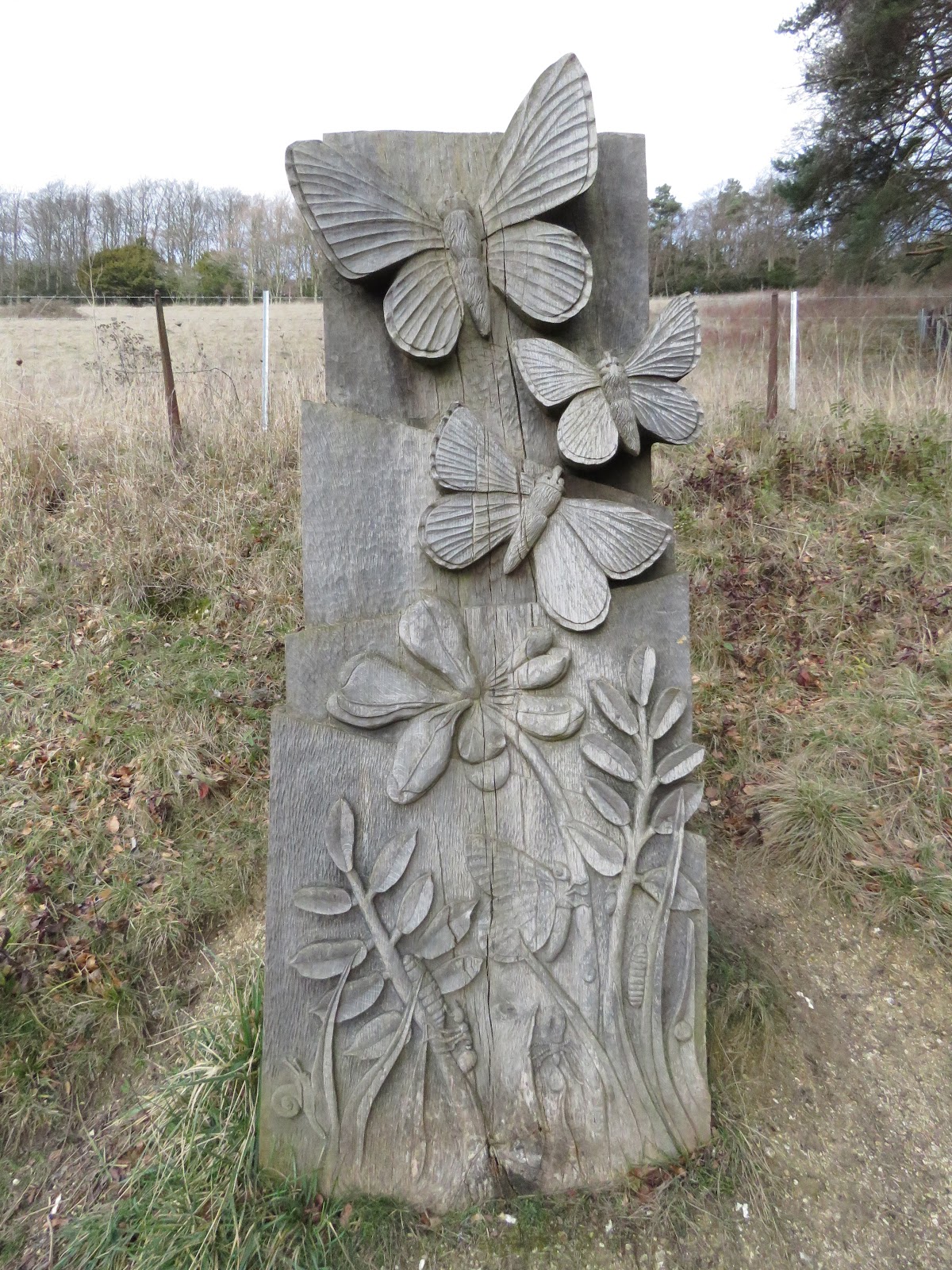
On the edge of Ranmore Common, at the very bottom of Denbigh's Hillside, you will find this charming wooden carving. It depicts the life cycle of the rare Adonis Blue butterfly, a species that can be readily found on the chalky slopes above. It was created by local artist Iain Hamilton Crafer, from a two tonne piece of felled oak. Below is a detail from the sculpture of an ant tending a caterpillar. On chalk downland it is usually the Red Ant that 'looks after' the caterpillar, offering it protection from predators in return for a fix of honeydew that is secreted by the larvae. If you would like to see the butterfly for real - and not just a giant wooden facsimile - go along on a warm day in May when the first brood should be on the wing. The food plant of the caterpillar is Horseshoe Vetch, so you will often see the adult butterflies flying around this flower which is easily found across the open grassland. It was a good day to be out. Despite a bit of a breez...

Splendid in the sun

Image
A splendid three days at Dungeness, staying at the exclusive 'Hotel Hollingworth', with fine whiskey and dodgy country music being the establishment's specialities... The birding was wonderful. High pressure and hot sun are never going to be the ideal conditions for a fall/arrival, but is always good for a bit of skywatching, and the sea was better than expected. An intense hour-and-a-half of birding with Mark H occurred yesterday (19th), with a marked movement of raptors, the birds seemingly arriving from the north and concentrating around the Water Tower/Boulderwall area before spiralling away high or carrying on southwards, across the reserve. The most numerous were Common Buzzard (14), Marsh Harrier (10, with a further four local birds), 4 Sparrowhawk, a Red Kite and most notable of all, a thuggish female Goshawk. Prior to this raptor-fest, a flock of three Hawfinches headed eastwards, possibly pitching down in bushes close to the RSPB visitor centre. Sea watch...

Bits and pieces...

...or a 'Dave Clark Five' kind of day, according to Mark H. If you don't understand the link, then ask your grandparents, or Google it... The day began with yet another beautiful sunrise, which got many of us snapping away with our cameras, although not to the same manic level as Owen L, who seems to be suffering with Tourette's of the aperture when it comes to cataloging the changing skies at Dungeness. No arrival, no proper viz-mig, but an interesting day on the sea. Across the peninsula, highlights included Great Northern Diver, a handful of Little Auks, a few Sooty Shearwaters, two very smart Common Redpolls (both trapped), a Cattle Egret and an adult female Goshawk, which made it a right old mix of species. I didn't see it all, but did see the latter with my personal chauffeur Mark H, as we drove along the track at Dengemarsh. Maybe typical of November, a virtual avian pick-and-mix!

40 years, White-arses and a Gos

Image
40 years On April 12th 1976 - 40 years ago to the very day - my 17-year old self first set foot on Dungeness and entered No. 11 RNSS, better known as Dungeness Bird Observatory. This is what I thought at the time... My first impression of Dungeness is not a favourable one. It appears an open waste of shingle, strewn with ramshackle dwellings and set against the vast nuclear power station that has squeezed perspective to such an extent that it appears two-dimensional, as if it were merely an enormous theatrical backdrop. Peering from the car making its way along the single road towards the peninsula’s point, I’m wondering what on earth I have let myself in for. I am about to join a four-day bird-watching course being held at Dungeness Bird Observatory. The focal point of our passage along to the peninsula’s snout is always the power station, dwarfing the two lighthouses that as recently as 1960 had been the tallest buildings for miles around. My attention then tur...

Somewhere in the Surrey Hills...

Image
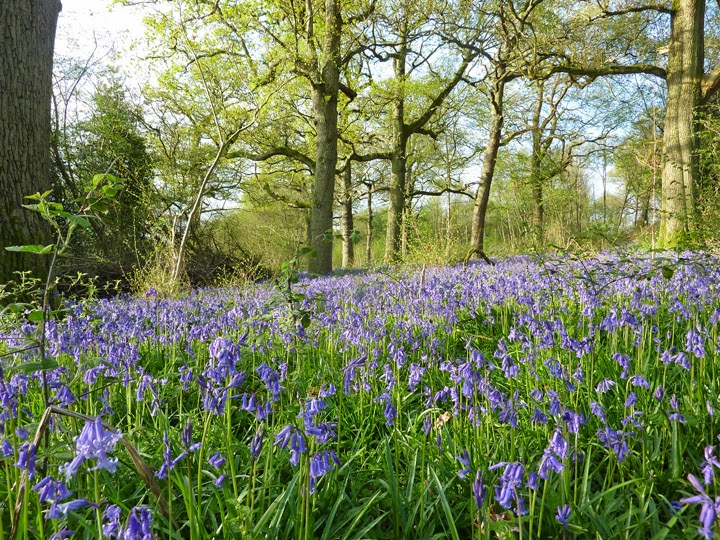
Sometimes you need to engineer a change to get your enthusiasm back, to recharge your batteries or to keep your mind sharp. So far this year my local birding has been, well, predictable. Last week saw me take part in - and enjoy -  an organised visible migration watch from Leith Hill Tower ( see here ).  This made me try something different this morning, so rather than head for the 'same old, same old',  I took an OS Map, my binoculars and headed for the outer Surrey Hills, to explore places that I only vaguely knew, or hadn't visited at all. It was just what the doctor ordered... It was a glorious morning. The woodland ground flora is well advanced, with lots of Bluebells already in flower, with plenty of Wood Anemone, Greater Stitchwort, Cuckooflower and even a patch of Yellow Archangel colouring the scene. Around me were calling Cuckoos , singing Willow Warblers and Firecrests . Venturing out onto more open ground, a few hirundines were heading north, with Swallo...