Posts

Showing posts with the label Headley Heath

October - Hawfinches return

My plans were thrown into disarray on September 30th - I had hoped to stay on at Dungeness Bird Observatory well into mid-October, but a staff member fell ill with a nasty bout of Covid, so I thought it best to return home. As much as it was disappointing to miss out on more 'shingle time' it at least gave me the chance to do a bit of Uber-patch vis-migging, something that I am quite partial to. So, Colley Hill beckoned on October 3rd which happily coincided with a flock of seven Ring Ouzels that were inadvertently flushed from scarp-top scrub, with one female/imm staying behind to allow close, if partially hidden, observation. The nearby farm fields at Mogador were full of brassica, enticing at least 110 Skylark to linger within the crop. I returned to Colley Hill the following day ( 4th ) which was blessed with a mad 30-minute spell which saw two Great White Egret fly north, a Woodlark alight on the open sward before heading west and a single Hawfinch fly right past my head -...

The dying of the year

Image
By the time that the calendar creeps towards mid-November, there is a part of me that accepts that the year is on the way out. Even though there are still at least six weeks to go until that becomes a reality, something buried deep within me has always felt that way. From a schoolboy kicking through deep drifts of leaves to an adult scanning the skies for some late migrant thrush action, mid-November says decay, whispers 'end', suggests a last act before it creeps off 'stage right'. As morose and macabre as that sounds, these feelings are not those of death but more like a readying for a coming birth - that of a new year and a not-to-distant spring  - the pagan in me is alive and kicking! I've spent a lot of time skywatching from Epsom Downs over the past few weeks. And Colley Hill. And Box Hill. Even the back garden has had a look-in (although has not lived up to its previous successes). It has all been a little bit... meh (as the kids say). Apart from a couple of ...

Grey and dull again

Image
Another grey, dull morning. My check of the garden MV came up with a decent moth, as the migrant tortrix, Cydia amplana (above), was sitting on one of the first egg boxes checked. This is the second garden record, and although a good inland record it was not surprising, as they have been recorded in good numbers down on the coast over the past few days. I was at Canons Farm by 07.00hrs - bad mistake - it was birdless. I haven't known this site to be so poor in the twenty years that I have been running an ornithological ruler over it. Once upon a time I would have stuck at it, but instead I went over to Headley Heath, hoping to at least find a large tit flock in which I might be able to prize some migrants from. It worked, to a fashion. Within 10 minutes I was watching a mixed passerine flock of 120 birds, mostly Blue Tits, but, within it were four Willow Warblers and 12 Chiffchaffs. Over the next three hours the Chiffchaff count rose to 65, but migrants were largely absent. There w...

A few longhorn beetles

Image
A few invertebrate images from yesterday afternoon's visit to Headley Heath. Once I start looking down rather than up, I know the summer is here... Stenocorus meridianus, a big brute of a longhorn that just wouldn't keep still for me. Thanks to Martin Fowlie for correcting my identification. Anaglyptus mysticus  - and very smart too My favourite species from the Headley Heath session was this Rhagium mordax If you fancy finding some longhorn beetles for yourself find a few recently felled tree trunks like this and just spend 15-20 minutes nosing around. Look under the peeling bark but try not to break it off.

Lesser Marshwort

Image
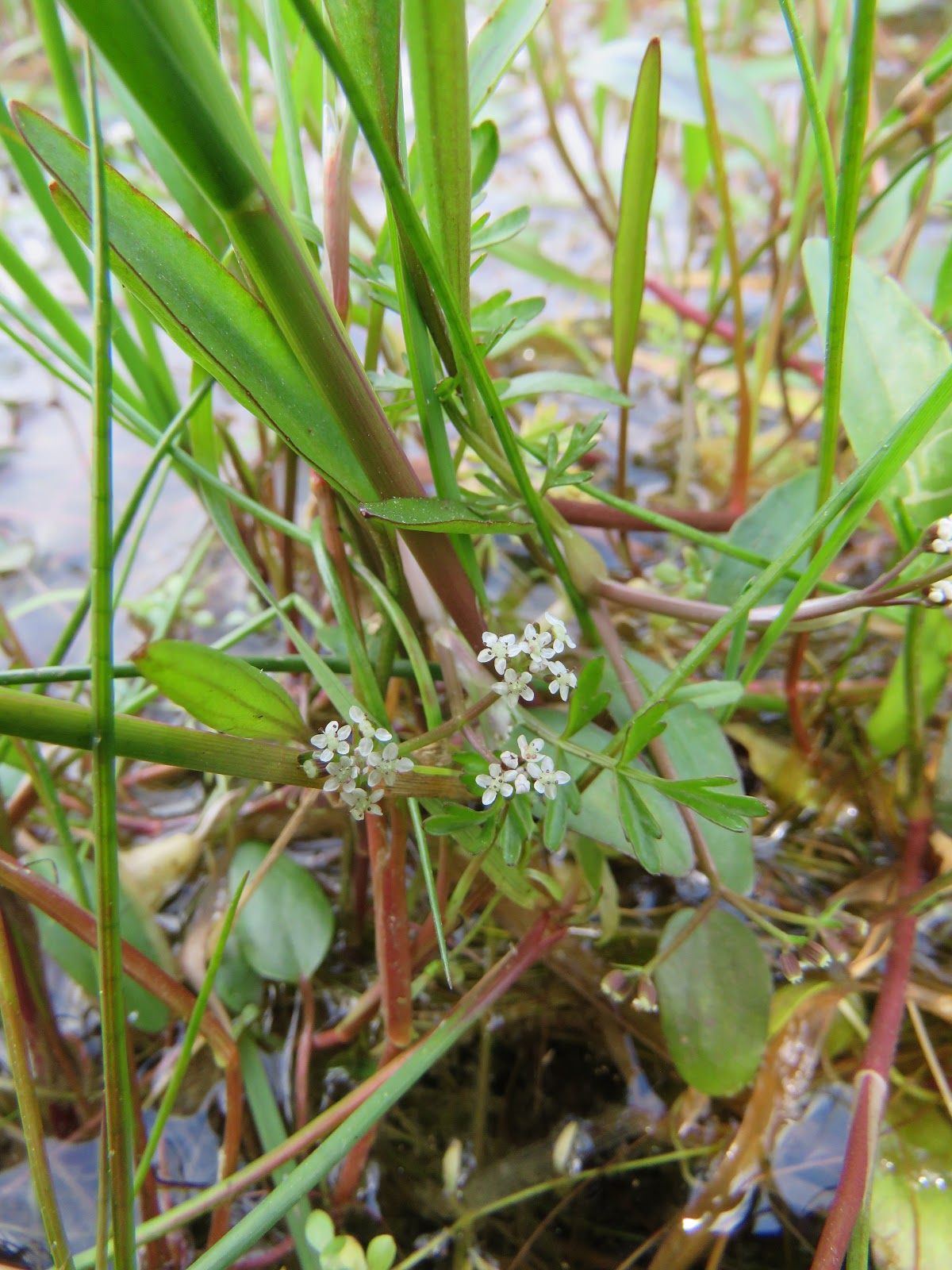
On the edge of Headley Heath is a pond that was home to the exceedingly rare plant, Starfruit. It was a well-known site amongst botanists and saw a steady stream of them come to pay their respects over the years. The pond was not managed, it became overgrown and when a mass of cleared vegetation was dumped by its side the Starfruit had had enough. It disappeared. Three years ago the pond was cleared. The surrounding vegetation was removed, and the Starfruit's seed bank was shocked back into life. You can read about my audience with this reawakening here.  Sometime last year I was browsing online when my attention was drawn to this very same pond, with a reference being made to the presence of Lesser Marshwort - not a rare species, but certainly a local one. I had not seen it before, in all likelihood I had overlooked it over the years across several locations. This afternoon I went back... The plant was found quickly, but there wasn't a lot of it and had I not known it was ther...

They're back!

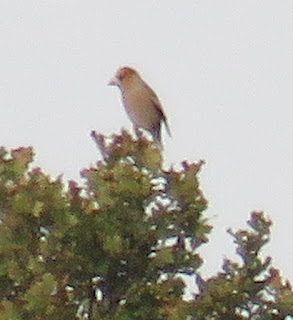
I make no secret of the fact that I love Hawfinches. It pleases me to have these lovely birds as a fairly regular species within the local area, but, typical of that species, they can sometimes go missing for months on end. It is with great pleasure that, over the past week, I have been able to watch them once again, with a minimum of 11 birds (possibly as many as 16) having been seen over the past week in the western valleys of Headley Heath, and up on the adjoining wooded slope at High Ashurst.  I position myself overlooking the valleys on their eastern flank, which gives me good views across the tree lines. Both my sessions here have been from 13.30hrs until dusk. The earliest that a Hawfinch has appeared is 14.00hrs, and the latest 15.42hrs. The busiest time seems to be around 15.00hrs. Views are usually of birds flying along the distant tree line, or circling the valleys. A couple of times birds have alighted and given reasonable scope views. Twice a flock of five has been rec...

The turning of time's circle

Image
Early November has become special to me. It may well be autumn past its birding best, but there are plenty of opportunities to seek and find, plus experiences to be had that mix the ornithological with the spiritual - something that other times of the year just cannot replicate. Yesterday afternoon found me sitting on the top of a valley at Headley Heath. My views were directly westward, looking straight at the setting sun, a yellow ball ladling out a watery golden light, its weak warmth just winning over the still chillness of a calm day. As I peeled off a couple of layers and luxuriated  - even bathed - in this November ‘heat', I couldn’t help but feel very pleased with things. For the next few hours, all things Covid, Brexit and Trump were banished, and my quest to count birds coming into roost was in the ascendency.  My vantage point allowed me to see across two steep-sided valleys, lightly wooded on their sides but clear at both their bases and tops. Anything that flew ov...

A close dragon

Image
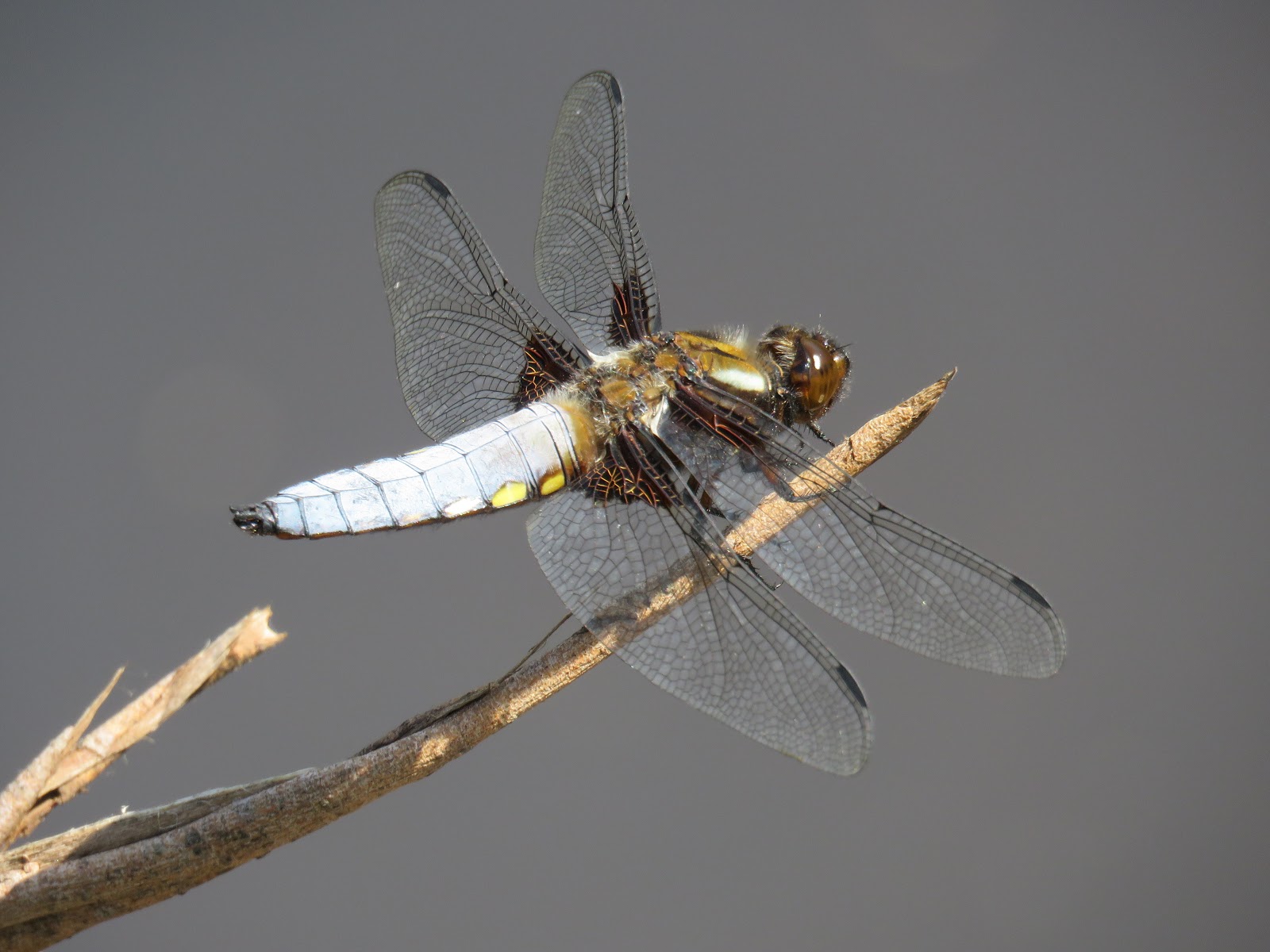
An afternoon visit to Headley Heath was fairly uneventful, although a couple of Garden Warblers were seen and heard in amongst the many Blackcaps, at least four Willow Warblers were on territory, my first Large Skipper of the year was on the wing and, at the 'Starfruit Pond', there were many Broad-bodied Chasers in action, including one that kindly kept posing for me on a close branch.

Redwing roost

With good numbers of Hawfinches having been picked up by vismiggers over the past few weeks I was inspired to check out the western-most valleys on Headley Heath - where, two years ago almost to the day,  I located a Hawfinch roost which stayed into December, drawing a fair few birders to enjoy the experience. I arrived at 13.30hrs and positioned myself between the two valleys, at the spot that proved so rewarding back in 2017. Two hours later I was not just Hawfinch-less but almost birdless. It was really quiet, with just a handful of Chaffinch, Goldfinch, Redwing and Fieldfare to break the monotony. I decided to switch position, moving up to the top of the eastern valley and look back westwards. The light was beginning to fade but the calm conditions and slight chill in the air were quite invigorating, so I stayed put, just taking in the lovely scene before me. Then, at 15.55 hrs, and for the next 30 minutes, Redwings started to pour into the valleys, arriving from the west (Bo...

Rubus laciniatus

Image
This is Rubus laciniatus, a distinctive bramble that exhibits cut leaves. It has a few 'English' names, including Parsley-leaved, Fern-leaved and Cut-leaved Bramble. It is a fairly widespread alien across Surrey and can be found locally on Headley Heath (where I took this picture yesterday).

Headley in the winter sun

Image
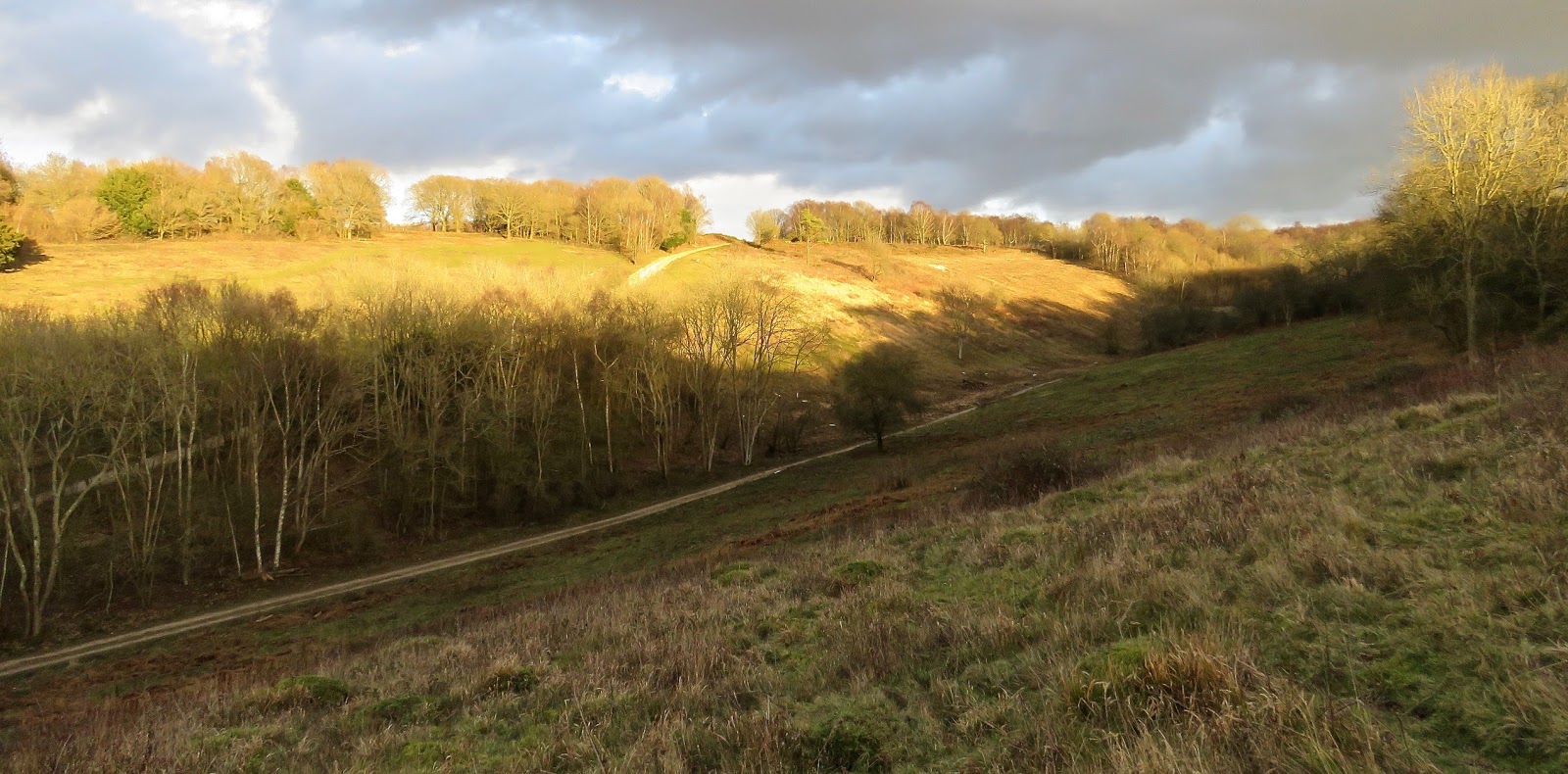
Yesterday saw one of those afternoons when the sky just wouldn't settle down. One moment it was dark, then there were sharp showers, soon followed by the sun peeking through a thin veil of cloud, finally a full sun that was so bright that it lit up the winter panorama in a burning amber light. The photograph above (taken at Headley Heath) sums it up pretty well. And yes, I did see a H**finch, but just the one. They seem to have largely moved on from here. What hadn't moved on, mainly because they possesses neither wings nor legs, are the clumps of Spurge-laurel (above and below), to be found on the westerly border of the site. Headley is a strange place, with acid heathland rubbing shoulders with chalk downland. It leads to a right old mix of flowering plants which makes any botanical walk there interesting to say the least.

Flying torpedo

With the continuing presence of Hawfinches, and there being no way of knowing when such numbers will grace us with such site fidelity again, I returned to Headley Heath for a spot of Coccothraustes worship. Again, no other birders were present, so I had the far valleys to myself. Arriving at 13.20hrs it was but twenty minutes before three flew in, and in the following two hours they were backed up by several other encounters, including a flock of four. The total of 12 suggests that the Headley birds are finally moving away. To sit in such glorious valleys and have these fat cigar / heavy torpedo shaped birds, triangular of wing and generous of wing bar, fly overhead and giving, at times, intimate views, are moments to remember. One bright male sat in a tree top for well over ten minutes, away from camera range but well within that of binoculars. He positively shone out in the afternoon gloom. It might be some time before we witness these numbers again...

Field work

Yet another visit was made to Headley Heath yesterday afternoon. I have been checking elsewhere for 'you know what' but have so far come up with blanks - Juniper Top, Juniper Bottom, Box Hill, Mickleham Downs and Norbury Park, but in the process have been able to reacquaint myself with some beautiful parts of northern Surrey. Whereas there might not have been any H*******, there were plenty of Marsh Tits, Bullfinches and Redwings, so it was time ornithologically well spent. Back to yesterday afternoon. The 'big bills' we're still present, but not as numerous as they have been. 15 was my estimate, with a largest flock of five. No birders seen, funny how the lure of such events does quickly wear off, but that's fine by me, as I wandered the quiet valleys and had a couple of close encounters, both dull females. I also flushed a Woodcock. As the light started to fade I couldn't help wonder how much longer these testosterone-fuelled finches will remain, wheth...

The H word

Hawfinches. Some of you might be getting sick and tired of reading about them. Especially those of you who have been forlornly chasing them. But, as a man once said, "If you're tired of Hawfinches, you're tired of birding." Or something like that. Anyhow, I went back to Headley Heath this afternoon for another dose of the 'H' word, where I was joined by Ian Jones and later by a handful of other birder's that included David Stubbs. Unlike yesterday, the birds were not lining up like good little girls and boys to be counted easily, and by the afternoon's end the final tally was a bit of a guess, with a minimum of 26 but possibly as many as 35. The largest flock was of seven. If you are after closer and more prolonged views, then it is best to  position yourself to the east of the two valleys I mentioned yesterday, looking westwards towards High Ashurst. Most of the action took place in the adjacent canopy, with small flocks zipping about and frequent...

The Headley Hawfinches

Image
Yes, I know it's pants.... Seeing that there are so many Hawfinches zapping about all over the place, I thought that I would try and find some locally that were not just moving through, but using 'my' fair part of Surrey to feed and roost. The place of choice was the steep wooded valleys to be found on the western side of Headley Heath. This area has plenty of 'Hawfinch pedigree', where I have, in the past, seen this species shortly after dawn and considered it a possible roost site. Back in the 1970s and 1980s I would regularly visit the Bedgebury Pinetum Hawfinch roost in Kent, and remembered that they often came in early, sometimes a good hour and a half before sunset. So, armed with a thermos flask and plenty of hope, I took up my position (at 12.30hrs) on a grassy hill between the two westernmost valleys, with good visibility up to the tree-line on the neighbouring hills. The first hour was slow, save for the odd flock of Redwings that swept on through. T...

Hunting Hawfinch

Image
That most magnificent of finches, the Hawfinch, has been appearing in small numbers across the UK, from small northern islands to southern headlands and even in our very own county of Surrey (particularly in the Capel area, largely down to that most diligent of observers, Wes Attridge). With the chances of this species being at large, and it being one of my favourites, I thought I ought to check out a couple of places nearby that have a bit of 'Hawfinch form'... First up was Juniper Bottom, where in March 2013 a large flock delighted birders from far and wide. My slow walk along the valley, with frequent stops and spells of intent listening, could only drum up a fair number of crests and tits (including Marsh). Carrying through and up onto Juniper Top, the tree-line and canopy scanning did not supply the target species, but I was entertained by a Peregrine and seven Common Buzzards. Next on my travels was Headley Heath, and a walk out to the western most valleys, all wel...

Klimt at Headley

Image
Headley Heath is a special place for me - some of my earliest birding took place here, with warm summer evenings in the company of churring Nightjars and roding Woodcocks. In recent years I have twice come across Hawfinch flocks, but my efforts to do so again have been unsuccessful. I went back again this morning for another try. The western side of Headley Heath is divided by several steep-sided, shallow valleys. The ground here is wet and the eroded sides spew forth flints. Most of the ground is heavily vegetated, with the scrub becoming wood, most of the mature trees being at the top of the ridge on the western most boundary. And it is here where I have seen those near-mythical Hawfinches before. But not today. I did, however, record 15+ Bullfinch and 5 Marsh Tit, amongst few other birds - it was very quiet. Away from the valleys, Silver Birch is the predominant tree. There are a few places where they dominate an area, young trees packed tight and growing with thin, straig...

Box Hill Hike

Image
There is an eight mile circular hike that starts and finishes at the Box Hill cafe and shop. Back in the summer we walked this trail, which boasts more than a few steep ascents and descents. An additional mile was added on, as we parked at Headley Heath and walked in to join the well-marked route. This morning, with Katrina, Rebecca and Jessica all willing and able, we tackled it once more. The weather was cold, sunny and calm. Ideal walking conditions... Headley Heath - a high plateau of gorse and heather with plenty of light woodland Autumn colours to the fore Once off of the high ground a series of wooded valleys lead to the eastern slopes of Box Hill As you head west along the slopes of Box Hill, you come across deep drove-ways, in places flanked by Juniper bushes Looking back west You are never far from a beech tree, these youthful examples rubbing shoulders with those much older We made steady time to Box Hill itself, and after a fortifying flapjack ...

Turning on, tuning in and dropping out

Image
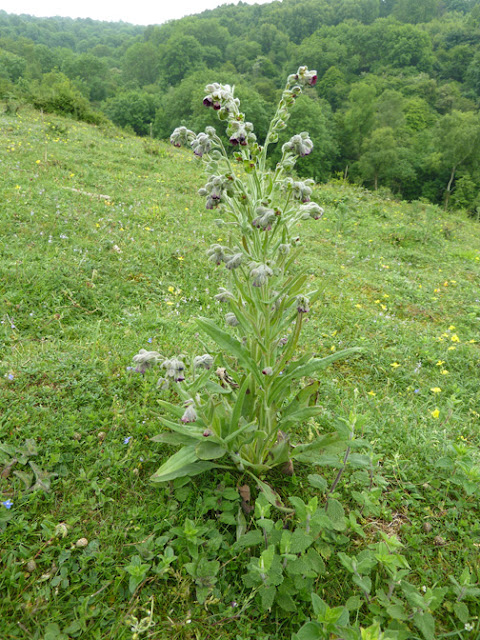
Headley Heath didn't really produce the goods this morning. It was warm but dull, so insect activity was suppressed (or should that be depressed). Even walking through vegetation that would normally unleash squadrons of disturbed flying things yielded little. Plants, too, were not playing ball. I even wandered over to the Martagon Lily site (which I have seen fully in flower by early June in some years), but could only find tight buds on up to 25 plants. It has been known from here since the early 19th century. Shame I cannot show you a bloom as it is rather fetching. I sat down close to a fine specimen of Hound's-tongue (above) and huffed a bit - the morning had not been inspiring. However, the view from where I sat was magnificent, the air was warm, so I closed my eyes and let my senses take over. Bird song filtered up to me from the valley below, the chalk downland herbs were sending delicate wafts of scent my way - life wasn't so bad after all. Opening my eyes the ...

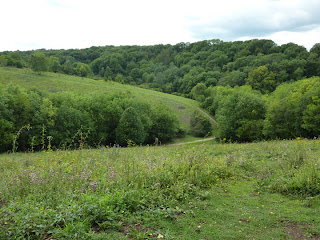
Hawfinch valley

Image
Headley Heath holds a special place in my natural history heart. It is one of those places that I cut my ornithological teeth on back in the 1970s, with evenings spent in the company of Nightjars and Woodcocks. More recently it has been the moths and plants that have caught my attention there. Today I visited with moss and lichen in mind, but it was the birdlife that stole the show. I took the picture above whilst sitting on a bench (very dude, I know) taking in the view and scanning the sky for anything that might float by. Earlier in the morning I had heard a calling Hawfinch maybe half a mile from this spot, but was still delighted to then see a flock of 11 of these magnificent finches fly from left to right across the far valley shown in this photo. I have seen Hawfinches here before, in this very spot, one October morning back in 2005 when a flock of eight entertained me for up to 10 minutes, I have since refered to this place as 'Hawfinch valley' (this being reinforce...