Posts

Showing posts with the label Surrey

14 days 'at home'

Image
The project came about when I was considering a day trip to Wiltshire to try and find some elusive day-flying moths. My intended targets included The Forester and Scarce Forester. I had already recorded Cistus Forester, but those other two species had defied several attempts to see them. They differ little in appearance and identification is down to minuscule size-differences and the tip of the antennae. The more I thought about it the more ridiculous it seemed to me that I was considering a 200-mile round trip to try and find almost identical moths to one that I had seen before. Admittedly, there would have been more to such a trip than Forester moths, but it got me thinking. I do like a project, something to hang my observations on, to give my time in the field some sort of added meaning beyond just random enjoyment. In light of many things - climate change, low-carbon footprint, biodiversity collapse - I am increasingly questioning what I do and how I do it, particularly how I condu...

Surrey 5km bird race

Image
Back in March, Ed Stubbs announced the launch of a Surrey-based bird race, to take part on May 7th. The rules were simple: between 00.00hrs - 18.00hrs observers were asked to record as many species as possible within a 5km radius of a nominated point. The use of 'green' transport - foot or bike - was encouraged. Solo birders or gathered teams were both welcome. I was, of course, in! So, where would my nominated point be? The most obvious starting place would be my home in Banstead. I would then be able to carry out the whole day 'on foot'. I started to look at a route, which would, by necessity, have to take in the very few limited water bodies within that area. There was a downside - there would be plenty of walking through areas that would not, in all honesty, hold much. There was also a wish to be spending the day in an area that might hold a few surprises, be they untrodden footpaths, unvisited tracts of land and stunning scenery - in the end I plumped for Colley Hi...

Of local Ouzels

Image
Ring Ouzels are one of those birds that can make a patchworker's day - they are unusual enough, and good-looking enough, to warrant giving you a feeling of satisfied pleasure - especially if the bird before you is a male. Here in northern Surrey I am lucky enough to be able call this thrush an almost annual passage migrant. If I don't see one locally during a calendar year it will be more because of my lack of effort rather than the birds not having been there. Within the uberpatch they are most likely to be found on scrubby downland, farmland or within horse paddocks, but they can pop up anywhere. The most unlikely location was a suburban back garden in Cheam one April afternoon. The map below illustrates where, across the uberpatch, I have recorded them, broken down into spring and autumn passage birds. I have not plotted every sighting, as both Beddington and Canons Farm have hosted multiple encounters, but the spring/autumn breakdown is reflected. My local extreme dates are...

Surrey-by-the-sea

Image
This image may not mean much to the majority of birders -  but to me and one or two other 'Surrey-ites' it is an image of hope. You see that sliver of silver in the middle of the picture? That is the English Channel at Shoreham, spied through a gap in the South Downs. And, get this, this photograph was taken from the top of Leith Hill tower, IN SURREY! Yes, we can, believe it or not, see the sea from this land-locked and most ornithologically deprived of counties. Just this small consolation prize can open up the mind to all sorts of possibilities. I am imagining a conveyor belt of migrants arriving over the sea, heading for that gap and making a bee-line for the Surrey Hills, and then spreading out across the high plateau that I haunt. Hirundines, chats, warblers, all waiting for the nod of Spring. And I'm here waiting for them... with the patience of a Saint and the hope of a chronic optimist. My plan is for a 100% on foot traipse around the mini-Uber patch tomorrow - ...

Surrey v Northumberland catch-up

Image
By the end of May, the Surrey v Northumberland birding patch challenge seemed to be going in just the one direction - and that was northbound! My spring campaign was heavy on effort but light on reward. And then Stewart's early summer was lit up by some truly memorable birding . It all seemed like a foregone conclusion that, regardless of my best intentions, I was going to get walloped. But then Beddington (above) came to the rescue. The sewage farm has always been a part of the 'uber-patch' but in recent times I have not been able to gain independent access to the site. That all changed in early July. The net result? A great big burst of wader additions to the list - Wood Sandpiper, Greenshank, Dunlin, Redshank, Oystercatcher and Turnstone - the latter two good species for the inland birder. A Red-crested Pochard and a Spotted Flycatcher (sadly a scarce passage migrant in my area nowadays) have also been gains this week. So, that means: Uber patch 2019 total is ...

The Hawfinch irruption in Surrey 2017-18

Image
I have been collating material for a paper on the Hawfinch irruption in Surrey for future publication in the Surrey Bird Report. As this is unlikely to see the light of day for a while, I thought it worthwhile making the first draft accessible, not only because it is still fresh in the minds of those who witnessed it, but also in the hope that there will be plenty more information forthcoming from observers who will hopefully read it. This is very much a first draft. The Surrey Hawfinch irruption paper has been updated, with Wes Attridge's ringing data added. Please click on this link to download.

An inconvenient truth

Yes, it's time to dig up that old chestnut once again, JUST WHERE IS SURREY? For some of you it's just that sleepy county south of London where stockbrokers live, the National Trust has an exceedingly high level of membership and millions of cock-a-poos run freely alongside Labrador-doodles. All true, but it is also home to several hundred birders who have an identity crisis, and that is where on earth is the county boundary? From time to time social media reveals a spasm of collective confusion, roughly along the lines of why we should/shouldn't accept Staines Reservoir as part of birding Surrey. A SHORT HISTORY LESSON... Back in the depths of time Surrey was created, its lands running north to the southern bank of the Thames. In 1852 a geographical division of the United Kingdom was devised that resulted in clear divisions of the vice-counties, also called the Watsonian vice-counties. In 1889 the county of London was created and the boroughs of Wandsworth, Lambe...

Belonging

Image
We should each have a place where we feel that we belong - a place that is home, that feels safe, and is invested in warm and happy memories. Ordinarily these are the places of our childhood, where we did our growing, via a meandering route that was made joyful with carefree times. Although I was born in (and lived in) South London for the first three years of my life, the Hertfordshire market town of Tring was where I conciously grew up - I wrote about that period of my life here . They were good times. But at the age of 12 we moved, first to Hitchin, then a year later to Sutton in Surrey. Almost immediately my parents went through a nasty, messy divorce, so I could be forgiven for not being too enamoured with the place, or the new county that I found myself unhappily living in. But something saved that period, and it was the open spaces. One afternoon my Father took us out in the car and we spent an age driving around Surrey's southern countryside. My father (who grew up in ...

A birding guide to Surrey (sort of)

Is Surrey the worst county to go birding in? It has no coastline. If we forget about the Middlesex reservoirs, it has little in the way of large bodies of water. Arguably its best birding site is behind high fences and a locked gate. Great swathes of the county are privately owned. As far as county bird totals go, it must be at the lower end of the league table, possibly struggling with the likes of Wiltshire, Buckinghamshire and Bedfordshire for relegation (if such a thing existed). Attempts at a big year list will not reach 200 species. One birder recently attempted to break this figure, over back-to-back years, having cleared his calendar by leaving employment. He had an excellent network of informants and he birded from dawn until dusk, seven days a week. He failed to reach 200 on both occasions. So, if you find yourself in the county, where would you go to get your birding fix? What sites offer you a modicum of hope?  Beddington Sewage Farm Unless you want to...

Where is Surrey?

A Twitter discussion has erupted this evening regarding the agreed boundaries for the ornithological recording area of Surrey. Some of you may wonder what the fuss is about, as, compared to our coastal neighbour's, it is hardly a county to set the birding world alight - however, as I'm only too keen to point out, it has a number of species up on our 'big brother' Kent, namely American Robin, Common Nighthawk, Yellow-billed Cuckoo, Pine Bunting, Killdeer and Glaucous-winged Gull - not bad for a runt county... Anyhow, back to the recording area discussion. In the 19th century (1852 to be exact) a geographical division of the United Kingdom was devised that resulted in clear divisions of the vice-counties, also called the Watsonian vice-counties. These were adopted by biological recorders as easily identified units in which to collate and publish natural history records, which included the Surrey Bird Club (formed in 1957). I quote directly from Wikipedia: The London ...

CK and P Dunkley

Mr and Mrs CK and P Dunkley most probably don't mean that much to you. You may have never heard of them. But if you were to pick up any Surrey Bird Report from the 1960s and 1970s you would find their initials written all over the systematic list. They were avid patch birders. What I now have to tell you is a tale of my callow youth, in not knowing how things really were and in my having a misplaced sense of importance - for, in the mid 1970s, I came across the Dunkleys and dismissed them as irrelevant to my birding world. Let me explain… As a teenage birder, with little money and no car, I travelled to the better birding destinations by way of begging lifts or going on organized trips. The latter option was, I'm ashamed to say, considered beneath me, as I had to sit on a coach with 'dude' birders, mostly old and mostly not 'proper' exponents of birding. You can now see what an arrogant little shit I was. The Surrey Bird Club ran such trips and these see...

Somewhere in the Surrey Hills...

Image
Sometimes you need to engineer a change to get your enthusiasm back, to recharge your batteries or to keep your mind sharp. So far this year my local birding has been, well, predictable. Last week saw me take part in - and enjoy -  an organised visible migration watch from Leith Hill Tower ( see here ).  This made me try something different this morning, so rather than head for the 'same old, same old',  I took an OS Map, my binoculars and headed for the outer Surrey Hills, to explore places that I only vaguely knew, or hadn't visited at all. It was just what the doctor ordered... It was a glorious morning. The woodland ground flora is well advanced, with lots of Bluebells already in flower, with plenty of Wood Anemone, Greater Stitchwort, Cuckooflower and even a patch of Yellow Archangel colouring the scene. Around me were calling Cuckoos , singing Willow Warblers and Firecrests . Venturing out onto more open ground, a few hirundines were heading north, with Swallo...

Wanted: another birding believer

Image
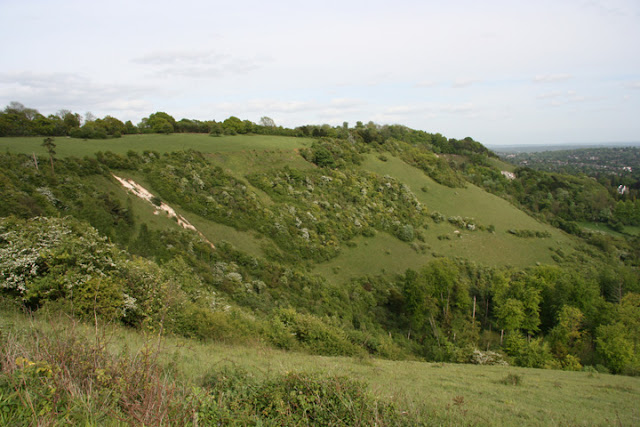
This is Colley Hill, west of Reigate and east of the Mole Gap. It's a south facing scarp of the North Downs and a place that I reckon should - should - be good for observing bird migration. My efforts so far to establish this site as such has so far resulted in a big fat blank. My search for a local site that is a migration hot spot is ongoing and, to be quite frank, one of unfinished business. Apart from Colley Hill, I reckon that the mouth of the Mole Gap (at Dorking) and the scrub to the northern side of Epsom Downs are worthy of extended observation. All these, I am sure, would reap reward from concerted effort. I do have one success, although most of this has been deflected to others. I first came across Canons Farm in 2002/3 and partially birded it in 2005-2008, this time of which was borne out of a certainty that the area had birding potential. My lone study did reveal a turnover of interesting birds (such as Woodlark, Goshawk, Golden Plover, Crossbill and a magnific...

The past is a foreign country...

...they do things differently there. Thankyou to LP Hartley for my nicking of his opening line in 'The Go-between' . It's as good a summing up of how our birding, and the birds, have changed in what is a fairly small time span. The first time that I had any of my observations published, they appeared in the 1976 Surrey Bird Club annual report. I've got a copy in front of me. The illustrations look dated and are but approximations of the species they depict, but at the time were admired. There are four plates of photographs - all black and white - and tellingly all but one of the six photos are of birds at the nest. So far so Victorian. The systematic list is revealing. Very few scarce, let alone rare birds. Cormorants were scarce away from the winter months. There were but four records of Common Buzzard (I can see that many soaring over my garden at the same time now); a Marsh Harrier was the first in the county for ten years; only three sightings of Pe...