Posts

Showing posts with the label Yellowhammer

Comparison is the thief of joy

Image
This post is going to be a right old mixed bag of snippets - a potpourri of bits and pieces if you like. That could suggest that I haven't anything of note to impart to you, or there again it could be that I have got much to share - you'll be the judge of that, although my money would be placed heavily on the former.  On the birding front I have been out locally on a regular basis, but it has not been full of success, with efforts to dig out those avian gems largely unrewarded. Bird numbers have remained poor, migrants even more so, although 'keeping on keeping on' has revealed that not every hedgerow, or sky, has been empty. On 16 March, after having left the Hawfinches at Ashurst Roughs (see last post) I went to Canons Farm where there had been reports of high numbers of Stonechats. This species is a typical early spring migrant through the area, where counts in the 6-8 range would be considered high. After last autumn's record shattering numbers through the area ...

Garlic buntings

Image
A chilly north-easterly wind, clear blue skies and a harsh sunlight all added up to provide an underwhelming morning's birding. Again, perversely, I chose to bird 'the road less travelled' which equated to a few hours of seeing very little, although this is what is to be expected when the places I visit are not all that 'birdy'. If I'm staying local it just seems a more adventurous option than to visit the crowded footpaths at Beddington or Holmethorpe. There are plenty of eyes already watching these north-Surrey hotspots - all I would do is add to that mass (although I plan to visit them both soon enough). This morning's highlight was botanical, as down by the banks of the River Mole, close to Mickleham, one of spring's highlights was unfurling - the mass flowering of Ramsons (above). These bright white flowers zing out against the oh-so green leaves, the whole experience joined with the unmistakable smell of garlic. This show will look even better in a...

In the murk at Mogador

Image
Colley Hill Car Park was a seething mass of metalwork by 11.30hrs - no room to park plus at least another 50 vehicles tucked along the minor road that leads up to it. Fortunately I was leaving the area at the time, having spent the morning birding the farmland at nearby Mogador. Lockdown plays havoc with the human footfall at any of these 'edge of town' beauty spots. With the shops, cinemas, swimming pools and gymnasiums closed, who can blame people for heading out into the countryside. It will be quiet again once the shops and cafes re-open. Mogador is a relatively small area of mixed arable farmland and pasture, on the edge of Banstead Heath, blessed with big skies and a fair amount of scrub and hedgerow. I have an increasing fondness of the place. Positioned just north of the North Downs scarp at Colley Hill, I have managed to establish a rapport with its birdlife, enjoying spring and autumn migrant action plus a small but select wintering population of thrushes, finches and...

South Downs and beyond

Image
The eastern flank of Sullington Hill - full of warblers Compared to the North Downs, the South Downs generally has steep slopes on both flanks (with a narrow summit) and largely lack woodland at their tops. This creates a dramatic, open and wild landscape. This morning I walked from Washington to Amberley (West Sussex) and back. This section runs roughly parallel with the English Channel, that can be clearly seen some six-and-a-half miles to the south. First light was surprisingly muggy. Chiffchaffs were already calling and were joined by Skylarks, Yellowhammers and the rhythmic chugging of Red-legged Partridges. A largely uneventful walk to Sullington Hill was livened up by the scrub on the eastern flank being full of birds, mostly Blackcaps and Chiffchaffs. The latter was going to be a feature of the day, birds observed moving eastwards at vegetation height along the South Downs Way, using the thin strip of hedgerow as a fly-line. At least 60 were recorded. At Chantry Post it...

More Spring

Image
For me, ornithological Spring starts with the late-February passage of Stonechats. The downs close to where I live is a good place to observe this, with Priest Hill, Canons Farm and Epsom Downs being within walking distance from home. These charismatic birds continue to dribble through into early-April. This morning's visit to Canons Farm found three (two males and a female) present in the Reeds Rest Bottom area, so they could conceivably be birds left over from the five seen two days a go. The 'normal' fences and hedgerows were shunned for the open fields, with all three birds spending most of the time that I was observing them up to their vents in the grass (above). Another sign of Spring was the north-westerly passage of Meadow Pipits. Of the 70+ birds that I counted, most of these went overhead in small flocks, although a group of 40 were flushed from Stoney Knob and then moved on - possibly a resting flock. Other highlights included 12 Skylark, 35 Fieldfar...

Fool's Spring

Image
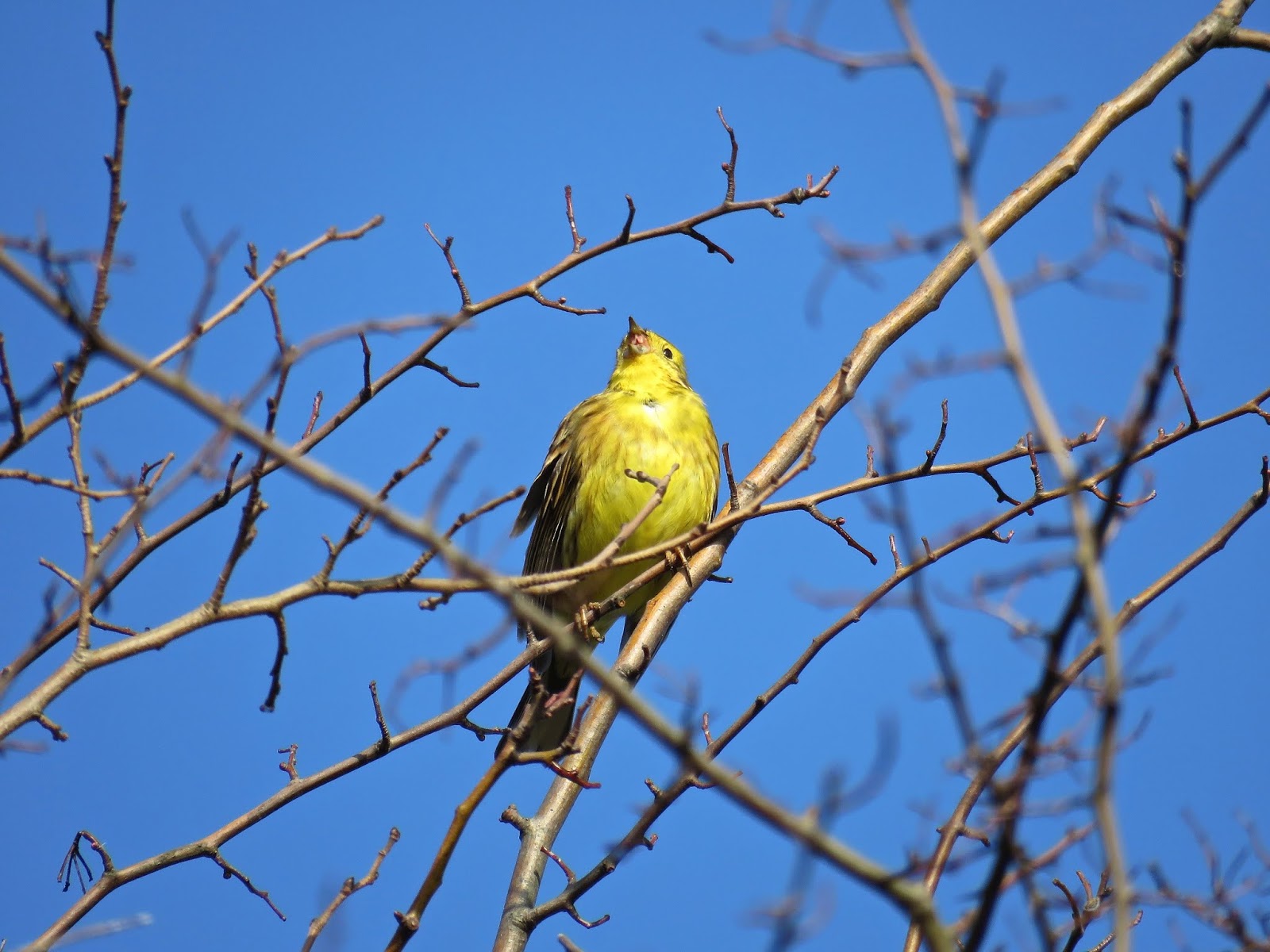
I've seen quite a few references to our current mild - nay, warm - and sunny weather being nothing more than an anomaly and that we will soon be back in the real world (cloud, chill, sleet, ice). Maybe that is so. But in the meantime let's just enjoy the 'false spring' while it is with us. Lap up the insects and enjoy the bird song. The Yellowhammer at Canons Farm (above) was certainly getting in the mood. This time last year the 'Beast from the East' was about to sweep across us - has a year really passed since then?

The cold finally snaps

Image
In glorious sunshine a six-mile circular walk taking in Ranmore Common and Polesden Lacey was made with eldest daughter Rebecca. There were plenty of snow pockets to walk through and the trees on the higher ground were coated in icy granules that had started to melt in the warm sun. The birding was disappointing, although at least six Marsh Tits were recorded, including two in fine song. It would seem that the finch numbers are to be found further west along the ridge - out of uber patch range! A late afternoon visit to Canons Farm suggested that the cold weather may be having some affect on the birds, with an influx of Fieldfare (70) and an increase in Yellowhammer numbers, with 42 gathering to roost. A Barn Owl was hunting across the fields and along the edge of the wood up by Perrotts Farmhouse and a Little Owl was spied huddled up in an oak tree on the edge of Broad Field. From the top: male Kestrel; Little Owl, Yellowhammers, Meadow Pipit

The sound of destruction

Image
A cooler and cloudier morning than of late. I took a very laid back stroll along the minor road that runs down the middle of Canons Farm. Quite a few sluggish butterflies were on the wing, including this Comma (above). In the still air the quiet was punctuated by a small amount of bird song, including three singing Yellowhammers (below). It was altogether restful and the lack of action barely mattered. This peace was, however, soon sullied. Machinery was started up and the noise emanating from it crept closer. I knew what it would be before I saw it, and when it finally appeared around the corner of a mature hedgerow my fears were confirmed - a tractor armed with a hedgerow cutter. This lump of metal was levelled against the sides of the verdant vegetation and the growth torn off, leaving ragged, broken branches and chomped leaves. There is nothing careful about this procedure, it is a rape of the growth. The flora at the base of the hedge was also cruelly destroyed. What of the b...

Naturalised plants

Image
I like nothing better than a patch of waste ground full of naturalised (or escaped) plants. They are generally bright and colourful and add a splash of vibrancy to what can be pretty forlorn places. Whether they appeared thanks to dumped soil, fly tipped waste or just bloody-minded opportunism, all are welcome. There is a patch of hard-standing at Canons Farm in front of Lunch Wood, where over the years mounds of concrete, tarmac and earth have been placed to deter squatters entering and setting up camp. This morning there was a fine show of plants amongst the undulating ground, with multi-coloured Foxgloves, Columbines of various shades, a blowsy and vibrant dark-blue geranium, Love-in-a-mist (above) and Fox-and-cubs (below). They beat Hogweed and Stinging Nettles! Apart from a Hobby and two singing Yellowhammers (below) it was quiet bird-wise, plus a rather stunning Alabonia geoffrella (bottom). I doubt if there is a better looking micro moth out there.

A very tame buzzard

Image
A morning spent at Canons Farm in the company of Geoff Barter - plus the confiding Common Buzzard (above), that has taken to hanging around Reeds Rest Cottages. The buzzard appears to be well and can fly without difficulty, so why it is being so unadventurous and 'tame' I do not know. Whatever its reasons, it sits on top of roofs, chimneys, barns and posts with little care for the passing birder. The image above has not been cropped and was taken with a bridge camera. A calmer, more sunnier day would be hard to find in the early winter, and although I couldn't claim that it was warm, the need for hat, gloves and scarf was redundant. There weren't many birds on show, so Geoff and I had to make do with a slow wander and plenty of waffle between the two of us. A flock of 60+ Skylark and a low count of four Yellowhammer (below) was made. Although I don't particularly want any, a dose of hard weather is needed to stir the ornithological pot up.

What a difference 37 years makes...

I was leafing through my 1979 diary this afternoon, looking up what that particular year's June had to offer, when I came across an entry from June 24th. I was then acting as assistant warden at Dungeness Bird Observatory, and had gone out into the recording area where... "I conducted a survey, plotting singing Reed Buntings and Yellowhammers. The trapping area provided 4 Reed and 6 Yellow; the lower long pit 6 Reed and 2 Yellow; the upper long pit 11 Reed and 5 Yellow; revealing totals of 21 pairs of Reed Bunting and 13 pairs of Yellowhammer." Any current shingle-lurker will know that if you repeated this survey now, you would find no Yellowhammers at all. They've long gone. The last DBO report (2014) records just four single birds each on a single date - and that was considered a 'good' year! Back in 1979, the ever-present song of Yellowhammers and the almost daily capture of them in the mist nets were an expected part of my summer / early autumn stay ...

When 'empty' doesn't really mean empty

Image
I've just come back from a relatively lengthy spell of birding over at Canons Farm. As I left the place I tweeted out the following: After a six hour stint, I'm off. There's only so much empty sky a man can take. This comment was made due to a fair-sized dollop of disappointment - what with a southerly airflow, and plenty of migrants having been recorded elsewhere during the week, I really thought that we would be in with a chance of picking up some stuff. At least a Swallow, maybe a Willow Warbler and even a fly-through Marsh Harrier or Osprey. But none of these materialised (the last two species mentioned unsurprisingly). There were four of us out looking as well, so the patch was being well covered. Empty sky? Did I really mean that? Looking at my notebook, that really was harsh. 10+ Common Buzzard. 1 Peregrine. 2 Greylag Geese (maybe not 'patch gold', but certainly 'patch bronze'), a smart male Brambling, a female Stonechat, a flock of 80+ Linnet, ...