Posts

Showing posts with the label butterflies

Basking skipper

Image
My first Large Skipper of the year came courtesy of this male at Headley Heath two days ago. I was quite pleased with these images, capturing him basking in the sun. Today I added Meadow Brown to the year's butterfly list, a single at Canons Farm, my earliest ever by four days.

This isn't normal

Image
It is worth reminding ourselves that today's date is February 26th. The temperature in west Wales (Porthmadog) has been recorded at 20.8C (that's 69.4F in old money) - a new UK February record high. Closer to home it has been 20.7C in Teddington. In such warm temperatures and under clear blue skies and unbroken sunshine I have been wearing just a t-shirt and shorts. Comfortably. Because the number of Brimstone butterflies flying through and hanging about in our Banstead garden had been high, I thought I'd take a slow walk around the neighbouring streets - a vaguely circular walk of 90 minutes with no repetition of the route. I just strolled and counted butterflies. The results, for today's date, are staggering. FIVE species (I've seen two on the same date in February before, but never more). 38 individuals! They were: Brimstone (32), Comma (2), Small Tortoiseshell (2, one on winter flowering heather, above), Red Admiral (1) and Peacock (1). Needless t...

The dying of Summer's light

Image
Now that we are into mid-October the need to suck the marrow out of each warm and sunny day becomes all the more urgent for the butterfly watcher. We just do not know how many more times we will see them this year. Some have long gone, their flight period but a dim and distant memory, but others are still on the wing. My 'latest date' for a number of species runs into late October and beyond, and for your entertainment they are: Clouded Yellow 2nd November 2015 Dungeness Brimstone 12th December 1998 Banstead Large White 23rd October 2001 Banstead Small White 31st October 2016 Dungeness Small Copper 1st November 1988 Dungeness Red Admiral 24th December 2014 Ewell Painted Lady 2nd November 1988 Dungeness Small Tortoiseshell 29th October 1987 Dungeness Peacock 3rd November 1992 Banstead  Comma 18th October 1978 Beddington SF Speckled Wood 13th October 2018 Headley Heath Wall 23rd October 1982 Kent Small Heath 1st November 2015 Dungeness Monarch 22nd...

Fritillary surprise!

Image
Standing by the back door, a cup of tea in hand and idly looking out at the butterflies that were attracted to next door's Buddleia, my alarm bells went off when a large orange butterfly alighted. I had my suspicions as to what it was, but it was just too far away to be certain with the naked eye. After swiftly fetching the binoculars and bridge camera, and grateful that the butterfly was still present, I was able to confirm that it was indeed a Silver-washed Fritillary! Needless to say, a garden first.

Harbingers of warmer days

Image
The snow has returned, the temperature has plummeted and yesterday's warm sunshine is but a dim and distant memory. But fear not, this cold snap is promised to be short-term and before we know it we will be able to enjoy once more those harbingers of warmer days, the butterflies. One of my pleasures is recording their first flight date, and especially those seen before the end of March - so far my earliest ever records are: Brimstone Gonepteryx rhamni 03/02/07 Small White Pieris rapae 21/03/09 Orange-tip Anthocharis cardamines 24/03/12 Holly Blue Celastrina argiolus 29/03/12 Red Admiral Vanessa atalanta 27/01/03 Small Tortoiseshell Aglais urticae 14/02/98 Peacock Inachis io 05/02/00 Comma Polygonia c-album 11/03/95 Speckled Wood Pararge aegeria 24/03/12 I'll be keeping them peeled when the sun and mild weather returns...

Rainbow Dust

Image
Peter Marren is one of my favourite authors of wildlife publications. His 'Poyser' on Britain's Rare Flowers and British Wildlife Publishing's Mushrooms are both delights which I re-read with as much enjoyment as their first sitting. Rainbow Dust explores the relationship between us dowdy people and the brilliance that are butterflies. It begins with the author laying down his own beginnings with lepidoptera and then takes us to meet those who first described them, who named them, collected them, painted them, studied them and conserved them. This gallery of 'movers and shakers' is full of characters, from the plebs to the aristocracy, and shows us how they all contributed to our appreciation of butterflies in varying, but similarly major ways. How these insects have coloured our culture, haunted our folklore and entered our psyche is laid out before us. I will never look at a Red Admiral in the same way again - the depiction of this species in the pain...

In Pursuit of Butterflies

Image
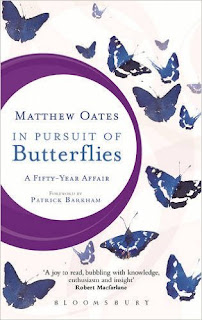
What a marvellous read. If you buy but one natural history book this year you should invest in this 450 plus paged treasure. Matthew Oates has spent the past 50 years of his life in love with butterflies and has forged a career out of studying, counting and being enthralled by them. The book is autobiographical, but it is much, much more than a 'been there, saw that' memoirs. Each page is packed not only with anecdote, but also with information - information that is anything but dry. I have learnt so much about butterflies from reading this that when I now go out into the field I am looking at them in a very different way. No longer are they just colourful and fleetingly glimpsed insects to be identified and committed to the notebook - thanks to Mr Oates I have a flicker of understanding about what they are up to and why. In his 50 years study his research has unlocked secrets of their life-cycles that had remained unknown. He certainly has his favourites, none more so th...

Changing of the guard

Image
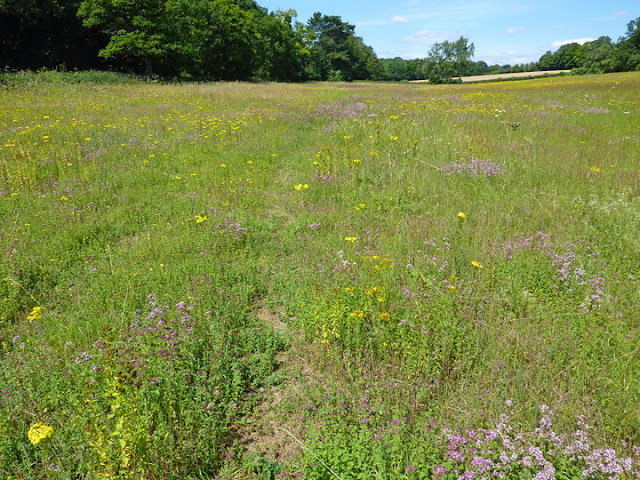
Today was the first time that I felt as if it were autumn. The vegetation is starting to look tired. Red Bartsia, Harebell, Common Toadflax and Nettle-leaved Bellflower are starting to flower. 3 Chalkhill Blues were dancing over the short sward on Park Downs (where I finally recorded Knotted Pearlwort in Surrey). The orchid fields have changed - the top picture was taken this morning (with Common Ragwort and Marjoram being the predominant providers of colour) and the bottom image on 23rd June (where the yellow was courtesy of Rough Hawk's-beard). The orchids have largely gone. Other butterflies seen included several hundred Gatekeepers, a handful of left-over Marbled Whites, Dark Green Fritillary and 3 Red Admirals. Across the road in Banstead Woods at least 4 Silver-washed Fritillaries patrolled the rides and a very large dark butterfly was briefly glimpsed as it hacked through the top of some oaks - I have a strong suspicion as to what it probably was! Something that gave itself ...

The pulling power of Senetti

Image
May 29th? It is more like March 29th... wet, cold and windy here in northern Surrey. Not the sort of weather for butterflies. Speaking of which, this morning I purchased two Senetti plants from a local garden centre - they are pericallis hybrids that are early flowerers and seem to be a recent addition to the horticultural world. I hadn't come across it until I stayed at Dungeness Bird Observatory earlier in the month and saw the fine specimen that warden Dave Walker had obtained. It wasn't so much the vibrant flower colour that caught my attention as much as the pulling power that the flowers had on butterflies - it was positively crawling with them. Dave took the picture below that clearly illustrates the point: There are over 40 Small Coppers here! I just hope that Dave has continued to dead-head the plant and that new blooms are still coming forth. I'm back down at DBO next month and quite fancy a Swallowtail or Camberwell Beauty alighting upon it...

Meet the 2015 patch

Image
The 2015 Surrey v Northumberland local patch dust-up took an unexpected twist over the weekend when our projected baseline figures were revised. Mine has been downgraded to 90 and Stewart's to 140. This is very generous of him! My own 'targets' remain the same - Birds 120, Plants 600, Moths 450 and Butterflies 36. The map to the left shows my study area for the year. It can be broken down into the following 'regions': EWELL A very modest river (you could just about jump across it) with a collection of small ponds and streams. Two SWT reserves, Howell Hill (excellent for orchids and Small Blue) and Priest Hill (good for fences and lack of access) BANSTEAD DOWNS Chalk downland with an odd flora - very few orchids but some screaming rarities such as Early Gentian and Broad-leaved Cudweed. Chalkhill and Small Blue colonies. Firecrests winter. CANONS FARM/BANSTEAD WOODS Fairly self explanatory, impoverished flora but here there is the chance of surprise pass...

Number 6 - butterfly confetti

Number 6 - 6 August 2006 - Butterflies at Braunton Burrowes This was the day when I had to literally wade through butterflies. I have never seen so many in such a small area. Braunton Burrowes is, in fact, a huge sand dune system on the north Devon coast, being some 6 x 1.5km in area. I had parked in the Broadsands car park at the southern end and started to slowly wander northwards along a line of vegetation that disappeared into the dunes. It was soon obvious that something special was on offer, as I was disturbing hundreds of butterflies with every few metres that I walked. And this didn't let up for several hundred metres. The air was filled with butterflies, like confetti at a wedding, like a ticker-tape parade along an American city street, like a bizarre multi-coloured blizzard that had gatecrashed a summer's day. There were times that I stopped still, looked around me, and gawped in absolute wonder. I wandered but 600m from the car park. 600m into a reserve that conti...

Martin Down

Image
Yesterday was spent wandering over the chalk downland reserve of Martin Down in Hampshire. The sun shone, it was pleasantly warm and a stiff north-easterly kept me cool. It was altogether most agreeable! I had been here once before (in 1981) in the company of Alastair Forsyth, after we had spent a day's birding in the New Forest. After a few beers in a nearby pub we slept in the reserve car park (me in his car, Alastair in his tent) and awoke to Barn Owl and Stone Curlew. I began by parking at the car park on the A354 and walking the entire western length of the reserve along the Bokerley Dyke, a Romano-British defence ditch. This area appears to be as rich in plants and butterflies as anywhere else on the reserve, so if your time here has to be brief, concentrate here. Very soon I was finding Field Fleawort and Burnt Orchid (above). Apart from Horseshoe Vetch there was not a lot of the 'indicator' plant species of chalk downland out in flower. By now I would expe...

Nature notes from White Hart Lane

My butterfly list for White Hart Lane, home to Tottenham Hotspur Football Club, leapt up to 2 species this afternoon, with a Large White fluttering above the pitch 45 minutes before the kick-off against Everton. This joins the Brimstone that I saw last April (before the Swansea City match). You can carry on looking for the natural history wherever you happen to be...

What a difference a year makes.

Look out of the window. What do you see? Snow? Grey skies? Leafless trees whose branches are being bullied by a biting easterly wind? Thought so. This makes it very hard to believe that this time last year we were at the start of a heat-wave, the very same one that started off a hose pipe ban and reduced southern reservoirs to cracked mud. On March 24 2012 I was at Beddington SF and saw the following: Small Tortoiseshell (26), Peacock (8), Small White (7), Brimstone (2) and single Red Admiral, Comma, Orange-tip and Speckled Wood. What are the chances of seeing even one of these this weekend. So, for the time being, let's celebrate being cold, wet and muddy - and if you do come across a confused butterfly or a hardy Wheatear, look upon them with a mixture of pity for their circumstance plus admiration for their bloody mindedness!

Mr Blue Sky

Image
It was one of those 'good to be alive' days, with unbroken sunshine, unseasonable warmth and more butterflies than I can remember for so early in the year. I was at Beddington SF during the morning - early afternoon and recorded the following: Small Tortoiseshell (26), Small White (7), Peacock (8), Brimstone (2), Red Admiral (1), Comma (1), Orange-tip (1) and Speckled Wood (1). The latter two species were my earliest ever. Birds didn't miss out on the celebration as a Red Kite flew north-westwards and the wintering Cetti's Warbler was in good voice. It's hard to think that we will most probably have a few more wintery days to come before we can safely put away the gloves and turn off the central heating.

Limitations

In the grand scheme of things, (when considering world peace and a cure for all illness), our prowess as natural history hunter-gatherers is of little consequence. However, we all carry an ego, even if there is but the faintest smidgin of one... Whilst at work this morning I received a text from David Campbell, who was, as usual, birding at Canons Farm. Attached to the text was a photograph that he had just taken of a butterfly. It was of a 'blue', and he was uncertain as to its identity, wondering whether it might be a Chalkhill Blue. To be fair he knew that it wasn't quite right for that species, as it exhibited some anomalies, but the ground colour of the upper wing was of a milky blue, with a thick black shading to the edge of the forewing - so much so that I texted him back saying that it probably was one. But within a minute or two I knew that was wrong... Today is May 24th. Chalkhill's shouldn't be on the wing until early July. Apart from the milky blue...

When butterflies swarm!

I'm still reading Patrick Barkham's excellent 'The Butterfly Isles' and mention has just been made of butterfly swarming. Apart from his own incredible experience with Heath Fritillary (1300+ at Blean Woods!), he mentions examples from the golden age of the Victorian gentleman lepidopterist, when clouds of butterflies blotted out the sun - really. I too have been lucky enough to witness such spectacles: 9 August 1978, Beddington SF, Surrey Thousands of Small and Essex Skippers emerged en masse across the heavily vegetated sludge lagoon banks, creating a golden orange haze at waist height. 24 July 1992, Middleton, West Sussex As I drove alongside a large field (crop unknown) I was staggered to realise that the white mist hanging over it was in fact tens of thousands of 'white' butterflies. I reckoned that they were all Large and Small Whites and it was simply staggering. 28 July 1997, Bude, Cornwall A walk along the cliff top heading north revealed thousands of G...

Options

I have all day Saturday too go birding. A 24 hour pass from domestic chores, not that I do that many domestic chores to be honest. There is a bit of painting and decorating that could be done, there's a back door that has started to stiffen up and a bit of insulating that could be laid in the loft. But no, they can wait (my wife may suggest that they permanently wait). So, Saturday. Where to go? What to do? The options are: Dungeness. There are two Buff-breasted Sandpipers in the area and I've no doubt that migrants have been stirred up a bit this week so there could be plenty on offer. Another south-east site: Oare Marshes (White-rumped Sandpiper), Bockhill (lovely place but I never score there), Pagham (an old favourite). Birdguides: weigh up the options on Friday evening and follow the sheep to the nearest goody. Stay local: hmmm, a few Yellow-broweds dotted about the country, Ring Ouzels leaping about urban wastelands throughout London, both of these would be more than ...