Posts

Showing posts with the label Graphosoma italicum

Inverts on the downs

Image
Banstead Downs sits just to the south of the Greater London boundary - in fact, if you cross the road at its northern limit you will be straying into the London Borough of Sutton. This relatively modest area of chalk downland has a decent record of natural history recording (no doubt due to the close proximity of London) and so for the local naturalist there is the pleasure of being able to browse historical species lists across several groups. Having lived in the general area for 55 years my ventures onto this particular downland were primarily in search of its birds, plants and butterflies, but recently that has shifted to dipping in-and-out of the wonderful array of invertebrates that it has to offer. This morning I had a small window of opportunity to go exploring. There is one small area on the eastern flank that I make a bee-line for, with low vegetation choked with Bramble, Stinging-nettle, Cow Parsley and Hogweed (with a dash of Horse-radish for good measure). It is next to a l...
More invert action

Image
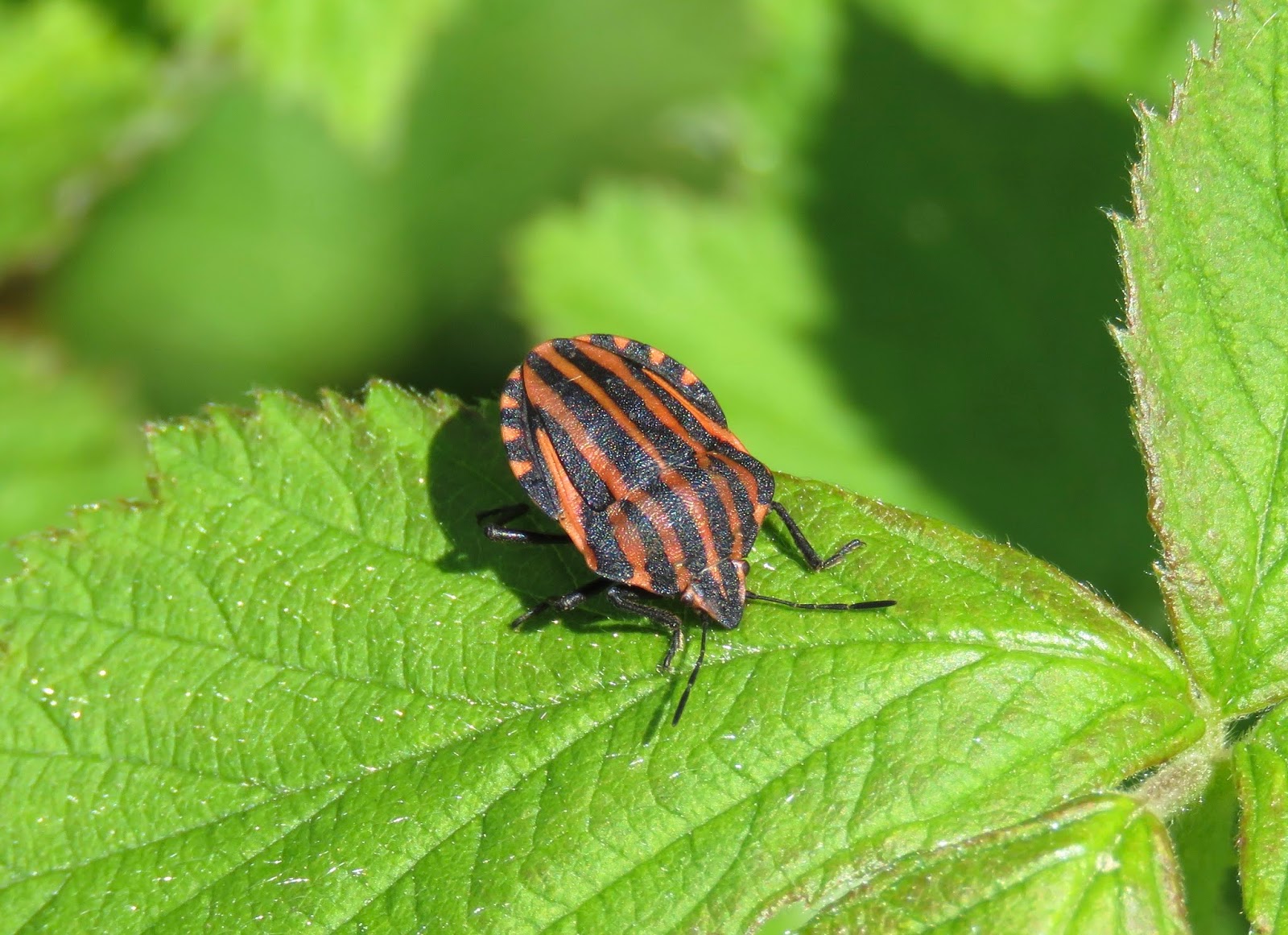
Sometimes, just a nose about locally is all it takes to produce the goods. After a morning of gardening I took myself off to check Banstead Downs for Striped Shieldbug (above). I didn't find them where I have had success before, but did come across three individuals within 3m of each other at a new site (TQ2664260543) some 500m south of the original Freedown Lane colony.  I also came across Lixus iridis (above) at four sites, all shown on the map below. Each of these areas are open in character with a heavy ground vegetation. The weevil seems to like Hogweed. Today, all three Striped Shieldbugs were on Bramble. Apart from the Striped I also recorded Brassica, Dock, Hairy and, best of all, Woundwort Shieldbug (below), my favourite - just like delicate precious jewels. The chances are, if you are in the Banstead, Wallington, Chipstead, Coulsden or Croydon areas, a check of any stand of Hogweed might provide you with either of these colonising inverts. That's my summer sorted out ...

Incoming inverts

Image
Another one of those end of year round-ups, part celebration, part blog filler. Today’s post features four invertebrate highlights, all of them either new colonists or species making a comeback.  First up is Striped Shieldbug (Graphosoma italicum). In mid-June I’d been tipped off that a specimen had been found close to Banstead Downs, so armed with a grid reference I went in search. My first attempt drew a blank (although see below), but seeing that the site was close to home I went back again on 20th July  - managing to find a singleton before I even arrived at my destination, on Hogweed, on Banstead Downs itself. I was destined to see this species again, in the same general area, on two more occasions, with one being a nymph, (in the company of Graeme Lyons), on 31st August. This shieldbug, found in the Mediterranean region, has been sparingly recorded in the UK. This species appears to be spreading north from its core range. On my initial failed hunt for Striped Shieldbug I...

Lose glasses, find iridis

Image
It was a pleasure to once again meet up with Sussex-based freelance ecologist and all-round good bloke Graeme Lyons ( you can visit his highly instructive and entertaining blog here ). He has been conducting an invertebrate survey at Chipstead Bottom over the summer, and invited me to accompany him on his latest session yesterday. I jumped at the chance. Graeme's natural history knowledge is exceptional and his desire to encourage and inspire others to look at all the natural orders is infectious. We met at 09.00hrs. It had been over six years since we last met, but immediately struck up the easy going relationship that we had previously enjoyed, chatting non-stop during the following seven hours as I followed him around, watching the master at work. Graeme was armed with a sweep net, suction sampler and beating tray, utilising all this equipment (plus more) to entice the myriad of hiding invertebrates out into the open, ready to be catalogued and identified. There were five s...

Bears on Banstead Downs

Image
Banstead Downs can be reached by foot within 10 minutes from home, yet it is a place that I strangely neglect. Ornithologically it doesn't have a lot going for it, although had I been there on May 21st 1956 I would have seen a Lesser Grey Shrike. However, botanically it has its highlights, and can boast a long and notable list of invertebrates. My three hours spent meandering across the area yesterday morning was most rewarding. I pointed the camera at whatever took my fancy and then attempted to identify the subject matter on returning home. The big drawback to this method is that an awful lot will remain unidentified - this doesn't bother me too much, as it can be highly educational whittling a species down to just its family level. Surprises abounded. A largish colony (1,000+ plants) of Betony. A clump of Bear's Breech a good mile or two away from the closest garden. Another Graphosoma italicum on the same stand of Hogweed as earlier in the week. The amount of Hemp ...

More stripey shieldbug action

Image
Banstead Downs is within a 10-15 minute stroll from home. My mission this morning was to try and track down the colourful shield-bug Graphosoma italicum , a species that is starting to appear in southern Britain. I had tried to find it earlier in the summer, when an individual was found close to the downs. Although I failed then, reward came courtesy of several Lixus iridis , a scarce weevil. I was some way short of the italicum site when I checked a stand of Hogweed, and BINGO!, there it was, just the one, in all its glory. I could only stay a short while, so whether or not there are others present is good reason for me to return.