Posts

Showing posts with the label Green Hound's-tongue

Colley potter

Image
Looking across the chalk pit to the scarp slope of Colley Hill Colley potter - sounds like a BBC1 Sunday evening family drama, doesn’t it? However, it just describes my afternoon, spent climbing up and down the steep, south-facing scarp slope of Colley Hill, together with a side trip (on foot) to the cricket pitch on Reigate Heath. It was yet another cool and blustery day, although thankfully lacking the heavy rain showers of recent days. The footpaths have become muddy again and insect life was depressed, with barely a butterfly to look at. Botanically it seems as if many species are late in flowering, certainly the carpet of flowers that is to be expected on chalk down land is so far missing. I know it’s boring because I’ve banged on about it frequently this Spring, but the lot of the dry inland birder is, at the moment, one of few birds. My scanning of the skies from the hill top just underlined how little is out there, with very little bird song and very few migrants. Thankfully I ...

Plum pudding

Image
The last of my brief 2020 round-ups involves plants. Although I was out-and-about in the field a great deal I cannot recall a year when I seemed to see so little botanically. But there were three stand-out moments... Denbies Hillside, May. I came across this striking colour variation of Scarlet Pimpernel. I've seen red, orange, rose and blue, but never a plum-coloured flower. It was my botanical highlight of the year. Norbury Park, June. I was too late to see many of them in flower, but the number of Green Hound's-tongue plants was staggering - an estimated 10,000 covering sections of the eastern wooded slopes. Box Hill, June. Always keen to see Ground-pine at a new site, this particular plant appeared courtesy of a small scrape that had been created to encourage the growth of Kidney Vetch.

Green Hound's-tongue in profusion

Image
In 1666, Green Hound's-tongue was first described by Christopher Merrett at Norbury Park in Surrey, and ever since then it has been a place where botanists have gone to pay their respects to this rare plant. I visit every year, walking the dark footpaths that cross the beech, yew and ash dominated slopes  And it's been a good year for Green Hound's-tongue at Norbury Park... a very good year indeed! This morning I walked along the lower, easternmost footpath, that runs vaguely parallel with the River Mole. I expected to find a few plants of Green Hound's-tongue (which has now largely gone over) but was surprised to find so much of it, plants on view throughout most of the walk and some in sizeable clumps. Because of these numbers I dedicated the following three hours to searching the area on this easternmost slope, going no further west than Druid's Grove (at the top of the slope), starting at the Mickleham entrance and stopping at Nicol's Field. The numb...

A forest of Green Hound's-tongue

Image
Green Hound's-tongue is a rare plant of restricted range - however, there are a few places where it can be common, such as Brockham, at the foot of the North Downs (not far from Box Hill). Within its range, this species will appear in good number where there has been some woodland edge clearing, and this is the case at Brockham. This morning there were at least 1,000 plants spread along a 100m stretch (and going 15m into the wood). It was the commonest species within this area and boasted some of the largest and most 'flowered' specimens that I have seen. Most of the open ground had individual plants generously spaced out, but in one or two places over 100 plants were crowded together. I do not doubt that a thorough search of the area would reveal many more...

The North Downs Way

Image
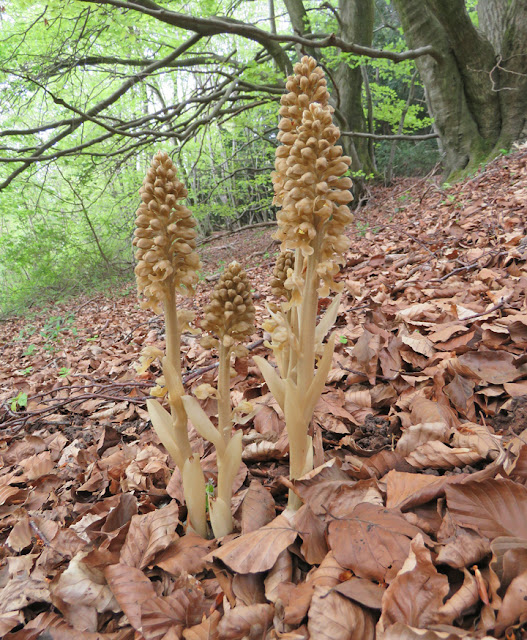
Most of the day was taken up by a Gale family walk, along the North Downs Way, from Denbigh's Hillside to Shere, where a fine lunch was taken at the Dabbling Duck before we retraced our steps. Avian highlights were a singing Common Redstart on Ranmore Common (where I've heard them in song before) and a singing Firecrest on Netley Heath (this species is not as common on the North Downs as they are along the Greensand hills). Plant wise it was wonderful, with the footpath edges full of flower, some of the highlights being a profusion of Sanicle; Bird's-nest Orchid (above, several hundred spikes on White Downs, much more advanced than last year and possibly in larger numbers); White Helleborine (a few in bud, none yet in flower) and a single Green Hound's-tongue on Ranmore Common (below), the furthest west that I've seen this species. West of White Downs was virgin territory for me, and some of it looks tremendous, in particular the open slopes of Blatchfo...

Getting ready

Image
I needed to recce a few sites in preparation for a visit, this Thursday, from Jon Dunn , who is currently writing a book on the UK's orchids. The good news is that the particular species that he is targeting this week are present, with some only just flowering - it seems to be a late year. I will hopefully have a full post about what we get up to later on in the week. Back to today - I made a whistle-stop tour of Juniper Bottom, Juniper Top, Mickleham Downs, Box Hill (several sites) and White Downs. The targets were present, in varying stages, with few out in flower, but producing a spectacle non-the-less - in fact some of these orchids look more fascinating even before reaching full flower. Birds were not to be left out, with the lower slopes of Boxhill producing a singing Firecrest and two croaking Ravens along the scarp. Butterflies were few, the temperature being quite inhospitable for them whenever the sun went in, which it did more frequently as the day wore on. Green...

Man Orchids and maybe a thousand Green Hound's-tongues

Image
I'm guilty of taking Man Orchids for granted. In 'my' part of Surrey they aren't exactly common, but there are quite a few places that you can go to and expect to see them at the right time of year. Today saw me visiting one such place, a small meadow not far from Box Hill. I could only find the one, but that was good enough. The number of Common Spotted Orchids here was low and Fragrant Orchids were only just starting to show themselves. An hour later found me on the other side of Box Hill where I came across 39 more spikes of Man Orchid in a place that I hadn't recorded them before. This site had moderate numbers of Common Spotted and Fragrant Orchids - Common Twayblades were in fine number across the greater Box Hill area. Other botanical highlights included Common Figwort, White Helleborine, Greater Butterfly Orchid (17 spikes), Sainfoin, Common Hound's-tongue, Tutsan, Hieracium maculata (in profusion at Brockham Quarry), Viper's Bugloss, Yellow-...

Green Hound's-tongue

Image
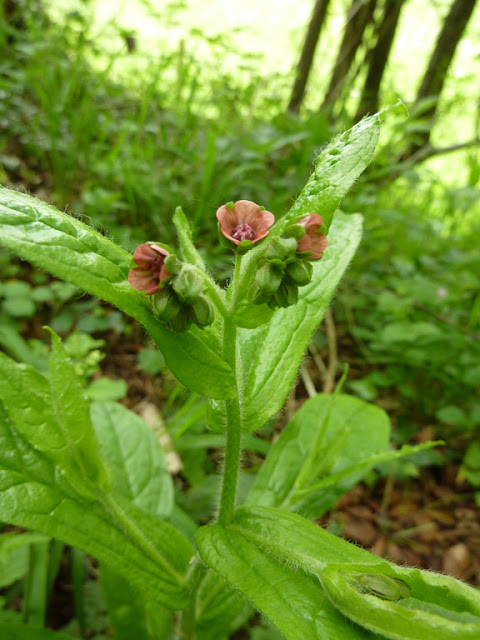
With the south-east having been awash with good birds - Roller, Red-rumped Swallows, Terek Sandpiper - I did the sensible thing and went looking for plants - I'm nothing if not utterly predictable in my perverse choice of where to go and what to do. My location of choice was Juniper Bottom (where the Hawfinch flock was earlier in the year). The flowering season is, without doubt, behind where it should be. The Bugle (pictured above) was showing well, with plenty of spikes offering themselves for insects to feed upon. The trouble is, the insects are largely missing. Only a few bees were seen, and butterfly numbers, too, were depressed. I did see two Dingy Skippers and a single Grizzled Skipper, but it was hard work. Moth-wise up to a dozen Speckled Yellow were on the wing. Along the road by the car park there is a major botanical rarity - Green Hound's-tongue. A few plants were starting to flower, the picture above showing the muted dusky-pink colour of the petals. It ...