Posts

Showing posts with the label Mickleham

Here comes the flood

Image
The River Mole does not often burst it banks, but the relentless rain that we have had throughout December has finally taken its toll. These images were taken this morning between Mickleham and Westhumble. At least 20 Little Egrets were found, all together in a field at the half-way point.

River dance

Image
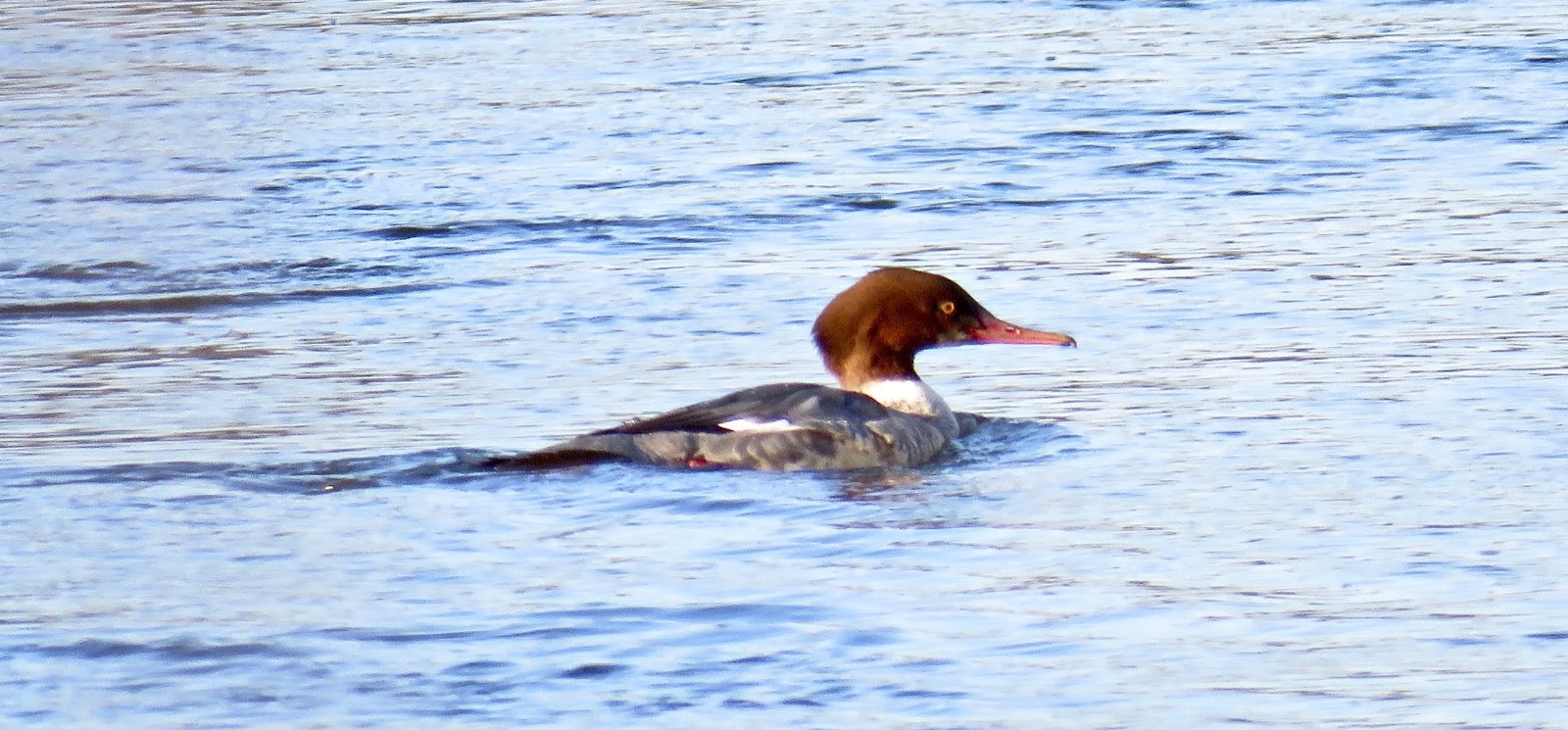
Seeing that there seems to be so little about at the moment I thought that I would 'ring the changes' and do something completely different - but still within the uber patch. Hmmm, hardly different, is it Steve?... Parking up in Mickleham Village, and crossing the A24, found me on the banks of River Mole, at this point a narrow affair. I then walked northwards, carrying on through to Common Meadow, Leatherhead, no more than a couple of miles in length but longer when you add on the meandering. It was a walk that I had not completed as a whole, having dived in-and-out over the years at various points of entry, and mainly during the summer months as the area is quite good botanically. Highlight was a red-head Goosander (above), that fed happily in the water at Common Meadow (below) with the bird deciding, after ten minutes, that it had had enough of me, and flew on. At least two Little Egrets were seen (Mickleham and Common Meadow) plus 5 Little Grebe, a Cormorant, 8 ...

Back for seconds

Image
To be honest, I'll most probably be back for thirds, fourths and fifths as I think it impossible to feel full of Hawfinch! My return to Mickleham Downs provided six birds, sat together in the same beech tree that they took a liking to yesterday morning. I will sorely miss them when they finally move on - it may be many years before such events occur again. To head off any notion that winter botany is all about shades of brown and green, have a load of this - the shocking red berries of Stinking Iris - they shine out like beacons in the subdued winter palette.

Hawfinches in the gloom

Image
It's already starting to get dark outside (12.30hrs) before the day has even had the chance to get properly light. My trawl around the slopes of Mickleham this morning was therefore conducted under a stygian gloom (I love the word stygian). The main aim of the excursion was too see a few more winter flowers, and in this I was successful, with Rustyback, Box, Stinking Hellebore, Wild Candytuft, Spurge-laurel and Butcher's-broom being the highlights. The image above shows the disturbed chalky soil that is so loved by Wild Candytuft and Stinking Hellebore (below) in particular. At about 10.35hrs I was on the western slopes of Mickleham Downs (which overlooks the village of Mickleham) when a Hawfinch flew into the top of a beech tree that was just ahead of me. A scan revealed that there were already six birds there. Over a ten minute period they flitted in, out and over the same tree before melting away. Twenty minutes later I was looking out over the same ridge from furthe...

More Hawfinch

Image
With Hawfinches turning up all over the shop (there must be several thousand across the southern half of England) a three-hour back garden vigil was in order this morning. A steady trickle of Redwing, Song Thrush, Chaffinch and Starling was obvious - together with a lone Brambling - but nothing exhibiting a brutish bill and wing bars deigned to put in an appearance. A change of scene was called for. A return to Juniper Bottom was made, mainly due to its Hawfinch pedigree and also because I could skywatch across the Mickleham valley all the way down to the Mole Gap (as viewed above). After only 15 minutes a flock of six flew across me and then veered NW. A further hour's worth of eye and ear strain could only add 100+ Redwing. The past couple of night's may have been mild, but the MV haul has been poor. Last night did at least produce a couple of Silver Y (above). The season seems to be running out of steam.

Mickleham winter flora

I normally go and pay my respects to the 'winter' flora in the Mickleham area each January, and seeing that it is February on Wednesday I only had two days in which to keep up my record. A grey, drizzly morning kept the light low and gave everything the feeling of being in two dimensions - flat was the word. I started at the White Hill car park and was soon checking the old wall that runs alongside the isolated cottage. It is here that you can usually find Rustyback , and I was pleased to come across two plants, mixed in with the more numerous Wall-rue . Then onto the slopes of Mickleham Downs, home to a great south-eastern rarity, truly wild Wild Candytuft . Several hundred plants are present, although I went no further than the first flowering plant that I came across. This species is in flower all year round here, although the books don't refer to it as having a constant flowering season. Nearby was plenty of Stinking Hellebore , in various sizes and age. Both these sp...

Box Hill Hike

Image
There is an eight mile circular hike that starts and finishes at the Box Hill cafe and shop. Back in the summer we walked this trail, which boasts more than a few steep ascents and descents. An additional mile was added on, as we parked at Headley Heath and walked in to join the well-marked route. This morning, with Katrina, Rebecca and Jessica all willing and able, we tackled it once more. The weather was cold, sunny and calm. Ideal walking conditions... Headley Heath - a high plateau of gorse and heather with plenty of light woodland Autumn colours to the fore Once off of the high ground a series of wooded valleys lead to the eastern slopes of Box Hill As you head west along the slopes of Box Hill, you come across deep drove-ways, in places flanked by Juniper bushes Looking back west You are never far from a beech tree, these youthful examples rubbing shoulders with those much older We made steady time to Box Hill itself, and after a fortifying flapjack ...

Good stuff on the downs

Image
A bit of a 'secret squirrel' post as I won't reveal the exact location of two of the species that Seth and I recorded today. Both were in the Mickleham/Box Hill area is all that I will say. Firstly was a singing Firecrest that performed admirably from a mature yew tree. Secondly was at least 1,000 plants of Wild Candytuft (above) from its only known Surrey station. This isn't a common plant anywhere. We also found it at another site, maybe half a mile away. There was a fair amount in flower. Both sites are on southward facing disturbed chalky soil. Another plant that I was pleased to see (after failing to find it on my last two visits) was this Rustyback, a fern that is on an old flint wall close to Juniper Hall Field Centre.

Greater Dodder and a micro with a long name

Image
Greater Dodder (both pictures) on Common Nettle, banks of the River Mole, Mickleham I found myself along the banks of the River Mole at Mickleham this morning, searching for Greater Dodder. I had found the plant here before, but my recent searches had drawn a blank, so I was delighted to come across four healthy patches, all on Common Nettle. Also recorded was Water Chickweed, Arrowhead and Yellow Loosestrife. After wards I headed up the hill and into Norbury Park, where Broad-leaved Helleborine and half-a-dozen Silver-washed Fritillaries were the highlight. The garden MV was quieter than of late, although a Dark Sword-grass was noteworthy. A common micro was welcomed to the list, Aspilapteryx tringipennella (below)

Green Hound's-tongue

Image
With the south-east having been awash with good birds - Roller, Red-rumped Swallows, Terek Sandpiper - I did the sensible thing and went looking for plants - I'm nothing if not utterly predictable in my perverse choice of where to go and what to do. My location of choice was Juniper Bottom (where the Hawfinch flock was earlier in the year). The flowering season is, without doubt, behind where it should be. The Bugle (pictured above) was showing well, with plenty of spikes offering themselves for insects to feed upon. The trouble is, the insects are largely missing. Only a few bees were seen, and butterfly numbers, too, were depressed. I did see two Dingy Skippers and a single Grizzled Skipper, but it was hard work. Moth-wise up to a dozen Speckled Yellow were on the wing. Along the road by the car park there is a major botanical rarity - Green Hound's-tongue. A few plants were starting to flower, the picture above showing the muted dusky-pink colour of the petals. It ...

Picture this

Image
Sometimes - and not very often when I'm involved - a picture can capture 'the moment'. This is, in my humble opinion, such an image. I was walking along a footpath in deep shade along the banks of the River Mole near Mickleham. It was late morning and the sun was still low enough to be illuminating the woodland with an ethereal light. Above, the leaf canopy had unfurled to help diffuse this light further, which in turn lit an enormous patch of newly flowering Ramsons to perfection, capturing the pristine condition of the plants, all fresh greens and brilliant whites. If you take a deep breath you can almost smell the garlic scent from your chair...

100+ birds and 100+ birders

Image
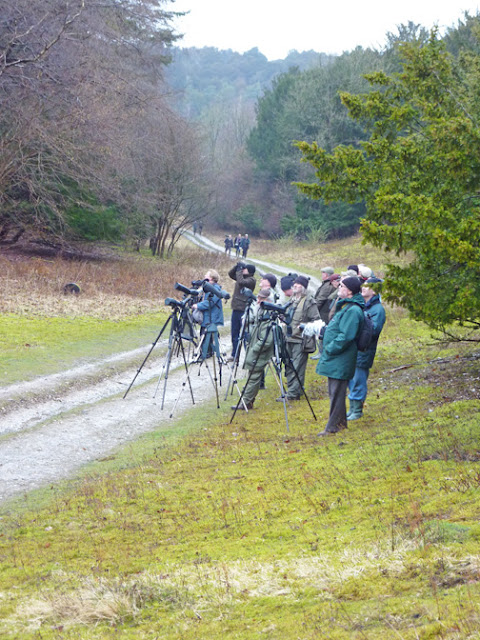
Dawn found me at Juniper Bottom near Mickleham, waiting for the arrival of the wintering Hawfinch flock that I first found eight days ago. The light was poor and the precipitation an annoying drizzle that didn't quite want to turn into proper rain (although by mid-morning it had). The first Hawfinches arrived at 06.40hrs, and for the next half hour up to 30 birds appeared, the largest flocks being 12 and six. At 07.45hrs and a little further up the valley the Hawfinch 'mother ship' finally appeared, in the guise of 80 birds spread out across a Beech tree and flanking Yews. They kept in view for maybe 10-15 minutes before doing what Hawfinches do best - just disappearing! At least 110 were present this morning. By 10.30hrs, apart from the odd call and fly-by, they had seemingly gone. Almost as numerous were the birders. The most in view at once was 40. I reckoned on 100+ in total. For all you keen students of birding demographics there were six women and just three men ...

Little boxes. Big boxes

Image
I was walking on Mickleham Downs this morning. Not a lot doing, but I was struck at how the Box varied in appearance. This very local plant is common here. You normally come across it in clumps looking like 'messy shrubs', although where it has grown to tree-like proportions it seems to ditch the lower branches (no doubt there isn't enough light for them to leaf) and become a different beast altogether. I took a few pictures to illustrate the point... Box in the open, a collection of messy 'shrubs' Mature Box. Note the lack of lower leafing branches and more tree-like appearance. Baby Box at the base of a Beech