Posts

Showing posts with the label Priest Hill

A helping hand

Image
Priest Hill. Until the Second World War it was north Surrey farmland, a mix of arable (wheat, barley, oats and potatoes) with a small herd of Jersey cows that were used for milking. A demand for the payment of death duties meant that the owners were forced to sell, which in 1942 brought in the tidy sum of £100,000 from Surrey and London County Councils. The farm was demolished in 1956 which then lead to the building of Ewell Technical College and the creation of playing fields for the use of Tulse Hill School, used to service its 2,000+ pupils, who were bussed in from South London. When Tulse Hill closed in 1990 the playing fields, changing rooms, tennis courts and cricket nets were abandoned to vandals, graffiti artists, fly tippers, travellers, glue sniffers, motor bike off-roaders... and me. I used to wander across the fast vegetating land, a vast open wasteland, to see what alien plants were springing up and what (few) birds I could find. A bit of the land was saved (Glyn Schoo...

Priest Hill - an overview

Image
There are places that I regularly post about which, to the casual reader, will not illicit any response - there will be no idea of what it looks like, its understanding of its history, and no recognition of its place in human history. This is the first of a series of posts that hope to fill a few gaps. First up is Priest Hill. Priest Hill. I've no idea as to the derivation of its name, but I can tell you that it isn't a hill. It may be on high ground in as much as you get an elevated view across west Surrey and out towards the Buckinghamshire Chiltern Hills (via the Wembley Stadium arch and Windsor Castle), but the land all around is relatively flat. Until the Second World War it was farmland, a mix of arable (wheat, barley, oats and potatoes) with a small herd of Jersey cows that were used for milking. A demand for the payment of death duties meant that the owners were forced to sell, which in 1942 brought in the tidy sum of £100,000 from Surrey and London County Councils. The...

Summer yawns and stretches

Image
At some point during the past week, Summer yawned, had a stretch, and turned into early Autumn. There were signs in the flowers that were in bloom - Red Bartsia, Hemp-agrimony, Common Toadflax, Common Fleabane, Harebell - all pointers to the season coming to its long goodbye. And as if to confirm such suspicions, today we launched into August. To most birders August is, without doubt, the autumn. My short walk to Priest Hill this morning was taken with a little bit more of a spring in my step, buoyed by the burgeoning season. I would have been happy with a passage Willow Warbler, but as it happened there was a modest movement of Common Swifts to count. I say modest, but over the two and a half hours I was present a noteworthy 633 moved south-westwards. They took their time, a slow, circuitous meander through the air space, only a few making a dash for it. This afternoon up at Walton Downs was quieter, with a few Common Swifts loafing about, and a scruffy adult Willow Warbler calling aw...

Dartford dry - km3 audit

Image
I am now 38 days into this current birding lockdown project. As we are almost at the month’s end, it seems like a good time to look at what it has provided - and, for an area that is half suburbia, half open land, I’d say that it has provided quite a lot. My home is on the south-western fringe of Banstead, happily surrounded by downland, horse-paddocks, farm and wood, but with plenty of residential area, particularly to the north. It is also dry, save for a couple of town/village ponds and one short section of a modest river. 74 species have been recorded, with the highlights (loose definition) being Red Kite, Peregrine, Golden Plover, Lapwing, Woodcock, Mediterranean Gull, Barn Owl, Little Owl, Kingfisher, Woodlark, Stonechat, Dartford Warbler (above), Firecrest, Marsh Tit, Raven, Hawfinch, Yellowhammer and Reed Bunting. On reading that list back, that isn't bad for an area just outside of a London Borough, with no appreciable water - a dry hinterland, if you will. The Dartford Wa...

Beating the bounds

Image
The past week has been mostly a case of beating the bounds of the '3km from home' circle. It has had its moments, with a Woodlark that circled the western-most fields at Canons Farm for a couple of minutes (on Monday) and an oh-so brief first-winter Mediterranean Gull on the football pitches at Priest Hill (today). In between these bursts of action it has been largely quiet, with Linnets (above) and Skylarks still present in fair numbers in the general area, plus signs of the early-Spring Stonechat passage getting underway, with five at Priest Hill this morning (where I spent some time unsuccessfully searching for a Dartford Warbler).

New Surrey Hirundine Kings

Image
On September 18th 2017 I was lucky enough to witness a massive movement of hirundines at Canons Farm , that included 6,710 House Martins (a Surrey county record) and 4,000 Swallows. It was one of the finest local days birding that I have had the pleasure to witness. And, for three years, that record has stood. Until today... My birding chums Wes and Robin have obliterated it, with a remarkable 13,302 House Martins! At the same time I was seeing nothing from my Banstead lookout, but on repositioning to nearby Priest Hill recorded 2,200 moving between SW and W (08.35 - 10.15hrs). Moving hirundines are one of the most arresting and exciting sights that a birder can witness. Without wishing to 'Top Trump' the boys, my all-time House Martin record is an almost unbelievable 90,000 at Dungeness  on 23rd September 1989. Apart from the hirundines, 60 Meadow Pipits, 10 Siskins and two Redpoll headed the same way, with nine Stonechat (four males) and two Whinchats grounded. Congratulation...

Birds in a bush

Image
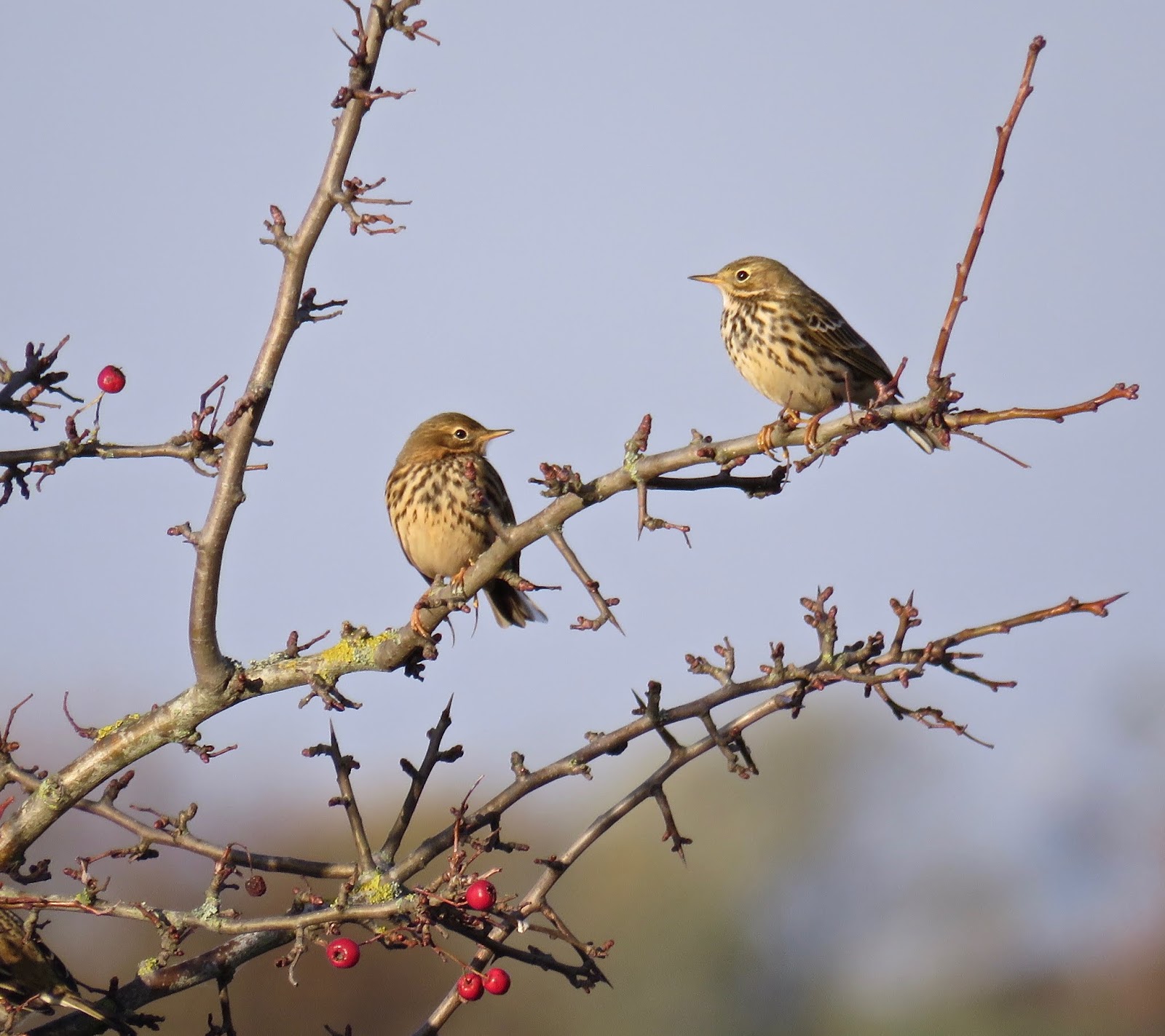
I just love the photograph above. This morning, at Priest Hill, there was a bit of activity along the central path. Apart from a group of chats (5 Stone and 3 Whin) there were quite a few pipits zipping about. Up to 30 Meadows were hiding in the rank vegetation, popping up now and again to perch on the top of bushes. Their calls appeared to entice a few of their brethren down from above, including this bird that dropped like a stone into the middle of a bush, immediately followed by a Chiffchaff. I can only apologise that they were not a Tennessee Warbler and Olive-backed Pipit. At least two Tree Pipits were involved in this mornings movement, which is worth a double-celebration from me as I appear to be hearing this species calling once again - I had feared that they had dropped out of my aural register. Back at home a dribble of pipits, wagtails and finches accompanied a spot of gardening. I'm primed for a big movement - it's overdue. As for the chats, there had been some tur...

Stonechat sweep

Image
Over the past couple of days, fellow north-Surrey birders have been returning some tidy counts of Stonechats. Now, I love Stonechats, so today was turned into a 'Stonechat Sweep Day' where all of my most chatty patches were visited - all being within five miles from home. It turned out rather well. Fist up was the grandly named Mogador , open farmland/pasture with ribbons of hedgerow and several scrubby corners -  Stonechat score: 7 (4 males). Next up was Canons Farm , always a favourite with our chat friends, and so it proved again -  Stonechat score:  7   (3 males). Epsom Downs played hard to get, with the most  chat-tastic areas disappointingly devoid of them, but when I gave them all another search they came out to play -  Stonechat score:  5   (2 males). The last stop was Priest Hill , scrubby ex-football pitches and this site stole the show, with guest appearances as well -  Stonechat score:  11   (3 males) + 4  Whincha...

More Whinchats

Image
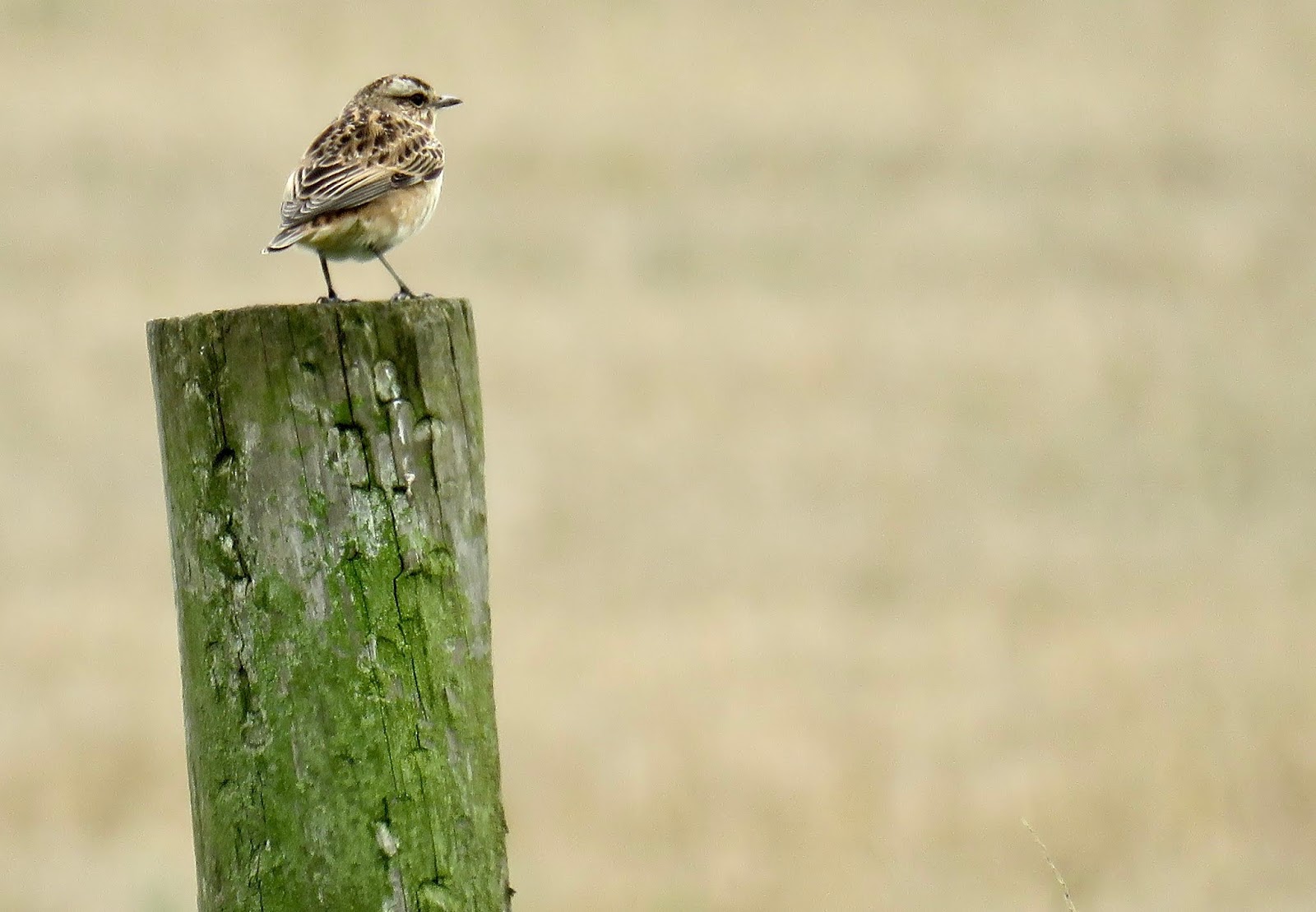
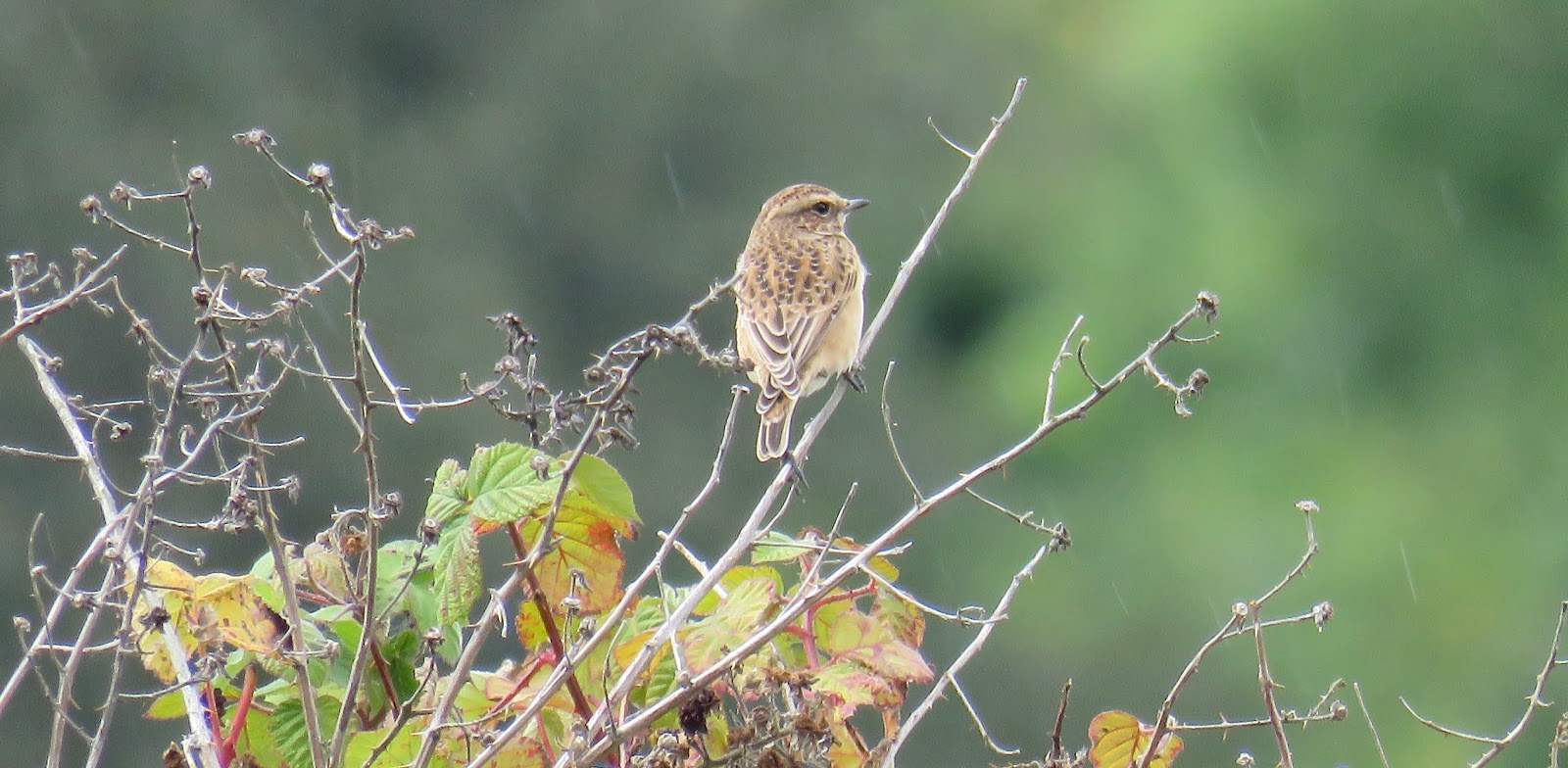
This morning saw a four-hour session at Priest Hill. The most notable event was that I actually heard a calling Tree Pipit as it flew SW - it must have been low and close. Not much else on the move though, a handful of Meadow Pipits and single Yellow and Grey Wagtail. At least four Whinchats were present, a couple which are not 'hangers-ons', as they exhibited wider and brighter supercillia than those seen over the past couple of weeks.

Whinchats

Image
Whinchats. One of my favourite birds. Luckily for me they are a frequent passage migrant on the neighbouring downland. This afternoon a minimum of five were found at Priest Hill, with at least two of them being 'new' individuals. I would love to know the true numbers passing through. Counts from here of five (24th), three (27th) and five (today) could, purely on paper, be taken as five birds hanging around or 13 different individuals. Fortunately some of these birds have been quite striking - one exhibited a bright orange upper breast (only seen on 24th), while new in today was a grey-plumaged bird plus another that had a strongly spangled mantle. So, a minimum of seven.

Going local

Image
Any regular visitor to this blog will know that I extoll the virtues of local birding, yet on the other hand moan about it in equal measure. This is a post of positivity. Yesterday saw me at Canons Farm, where a swarm of 220+ Swallows were feeding over the large bean field. They eventually headed off south-westward, with two Hobby, a Swift and a House Martin in tow. A juvenile male Peregrine was also present, trying its luck with some of the 850+ Wood Pigeon on site. This morning I met up with Steve Thomas, he of Ewell 'nog-mig' fame. Before we retired to the Wheatsheaf in Ewell for an afternoon snifter, we strolled around Priest Hill and uncovered a Wheatear, three Whinchat and three grounded Yellow Wagtails. A tidy return.

Whinchats in the rain

Image
A day's birding (on and off) all on foot from home. Was it worth it? Well yes, it had its moments... First off was a couple of hours vis-migging from Nork Park. This was the first such session and will most probably be the last. Until you actually try these things for real, the problems are not always apparent. As a site it has a great view, but the best position is alongside a noisy A road. I have enough of a problem picking up the calls of distant Tree Pipits and Redwings as it is, so the backdrop of vehicle noise will not be helpful. The park is also home to hundreds of dog-walkers and their canine companions. I was met with a mixture of suspicion and curiosity and felt quite uncomfortable. If the park returned Spurn-like numbers of migrants I would roll with it, but this is obviously not the case. I returned home and sat in the garden, which was almost silent in comparison. My close-to-home skywatches will be a lot closer to home than I envisaged. This afternoon I dodged...

Lady Luck

Image
A new month, a new challenge. As I am still not comfortable with travelling far from home, and prefer to travel on foot, I looked at the Ordnance Survey maps last night to identify a 2km square which would act as the focus of my natural history efforts for the month of June. Our house is bang on the southern edge of TQ2261, and within this 2km square can be found Priest and Howell Hills, both SWT reserves and good for plants and butterflies, if not so much birds. Given that spring is almost over, and my attention does tend to switch away from ornithology for the summer months, this seemed like a good square to bash, particularly as the farmland close to Howell Hill has been allowed to run wild in places, and so holds the potential for some surprising plants to pop up. After a morning of painting the garden fence, I walked from home and first of all checked the farm paddocks attached to NESCOT, as a flock of Starlings has been building here - after all, a few Rose-coloured versions...

Pipit roost

Image
After last night's 'roost watch' I decided to visit another one of the local patches, Priest Hill, to see what might - or might not - be roosting. On arrival there were just a few Meadow Pipits (above) and Fieldfares mooching about, and it was quite hard work as I zig-zagged my way across the rank-grass meadows. Some respite came in the form of a Common Snipe, flushed from the largest paddock, my second record here, a dry site save for a few tiny ponds. As the light started to fade the bird activity stepped up. There was a marked dribble of corvids north and a veritable flood of gulls north-west, heading towards the west London reservoirs. At the same time up to 50+ Fieldfare departed into the murk and the first of at least 40 Meadow Pipits started to arrive, dropping down into the long grass to roost. As I left the site there was a gash of blood red on the western horizon, enough to light up a small bat that flew in a straight line, not dropping a wing beat, across ...

Green on a grey morning

Image
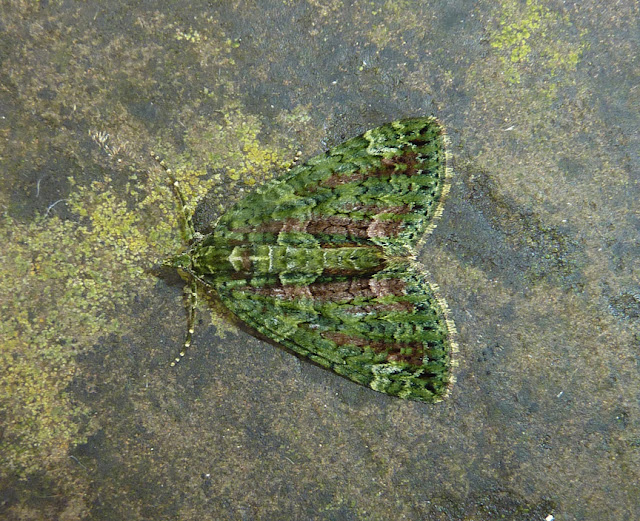
The cloud was low this morning, the light suppressed and the whole vibe was one of birding under a heavy blanket of dirty cotton wool. An early visit to Canons Farm was worthwhile, with a Barn Owl, Spotted Flycatcher, Grey Wagtail (scarce here), two Whinchats and four Stonechats being most notable. Afterwards an underwhelming brief sortie around Priest Hill was rescued by a solitary Whinchat. The garden MV was fairly lively, with Centre-barred Sallow, Orange Sallow and Large Ranunculus being typical of late September. I also trapped the greenest Red-green Carpet that I have ever seen (below).

About to crack

There's only so much worthiness you can feel and servitude you can bestow towards a dry inland birding patch. Bloody-mindedness, obstinacy and a big dollop of wishful thinking are prerequisites to be able to maintain a regular presence, but, believe me, they can all come to a shuddering halt, and the way things are that might just happen soon. A dawn start at Priest Hill in a murky calm smelt of birds, and on entering the reserve there were plenty of calling Robins and the odd 'cheeping' Chiffchaff, but three hours later that was about it - 35+ Robins and 10 Chiffchaffs. The autumn here so far has been a hard slog for little reward. An early lunch and a check on what was going on elsewhere (the best being Yellow-browed Warbler at Elephant and Castle and a Blyth's Reed Warbler at Sandwich Bay) set me up for an afternoon at Canons Farm. Better than this morning, but it was still hard work. As is often the way with this site, just as I was about to give up there was a pu...

Fallen Jay

Image
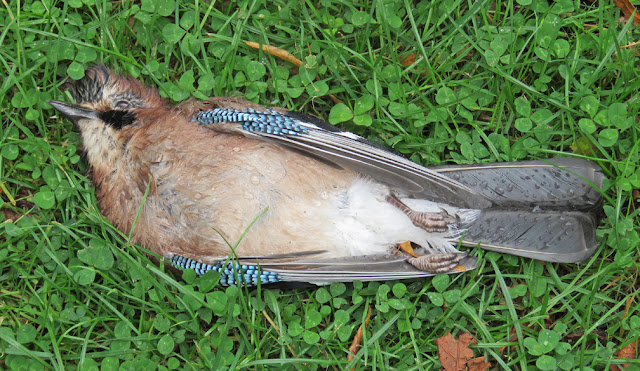
The autumn is really starting to feel like autumn now - chillier temperatures, the leaves starting to fall (particularly the Horse Chestnuts) and rapidly darkening evenings. Priest Hill this morning added to the season's hold, with the first large arrival/movement of Woodpigeons - at least 800 were present, including a single flock of 750. Although Meadow Pipits were not actively passing overhead, a flock of 60 had gathered on the meadows. Single Goldcrest, Lesser Whitethroat and Willow Warbler were other highlights. One sad event was the demise of this Jay (above), found on the roadside adjacent to the reserve entrance. This species holds a special place in my birding world, which you can read about here if you so wish.

A question

Another morning spent at Priest Hill, leaning up against a gate and counting migrating Meadow Pipits. I didn't arrive until 09.45hrs and they were already dribbling over, but by 12.00hrs the trickle had dried up, resulting in a total of 186 S/SW. Just like two days ago, little else was moving with them. A question I find asking myself is why overhead passerine diurnal migration seems to stop (or run out of steam) by lunchtime. I've seen hirundines carry on well into the afternoon, but as for pipits, wagtails, buntings and finches (which normally make up the bulk of such movements) they seem to find afternoon movement not to their liking. Do they actually land and stop? Do they fly higher so that they are out of sight and sound? Meadow Pipit one : "I'm getting a bit of wing-strain here, how long we been flying? Meadow Pipit two: "Must be six hours by now" Meadow Pipit one: "Well sod this for a lark, let's pitch down in that nice looking meadow...

Simple pleasures

My first visit to Priest Hill in almost a fortnight. Grounded migrants were largely absent, but from just after 10.00hrs a steady trickle of Meadow Pipits started up, all heading S to SW. I stood rooted to the spot for almost two hours and ended up with a total of 122 - mostly small groups of one to three but including flocks of 19, 11 and 10. I can honestly say it was some of the purest, most enjoyable birding that I've had this year. To watch actively migrating birds is always a privilege and a pleasure. The fact that these modest looking birds are possibly on their way to the Iberian peninsula adds so much to the experience. Not much else was moving with them, with no wagtails and very few hirundines, but that didn't matter.

New micro, quiet birding

Image
The garden MV continues to get put out and switched on. Those moths whose flight times are more 'September' than 'July' are starting to show, and each night the composition of species recorded is subtly changing. It's "goodbye" to some for another year and "hello" to others. There are also plenty of migrants out there, so it is risky not lighting up, as you never know what you might miss if you don't! I continue to dabble with the micros, by no means critically examining each and every one, but looking at some which catch my eye, like the Scythropia crataegella (above), not just a new moth for the garden, but one I haven't seen before. Common as muck by the way. Bird wise, quiet. My last two visits to Priest Hill have been almost pointless (barring the thought that at least I have proven that no fall or movement had taken place). This morning I revisited my old stomping ground at Canons Farm, where a Whinchat and Hobby were the star...