Posts

Showing posts with the label moss

The wonder in the detail

Image
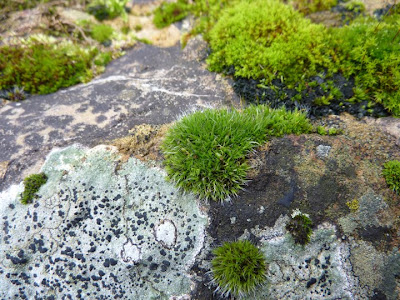
More natural artwork, this time courtesy of a cheeky moss and lichen combo. If each day were 1,000 hours long and we lived for several hundred years, I might have the time to get into these living wonders. I do not know how some people find the time (and have the brain capacity) to multi-task in their natural history studies. I start to get a headache if I try and go beyond birds, moths and plants... The above image, on first glance, is pleasing enough - a cushion or two of Grimmia on a lichen encrusted wall. But the harder you look, the more you see - further species are present, and the colour range wide. If we were to zoom in more is revealed... Admittedly it's not sharp, but there must be a further dozen species here. One wall would most probably keep a lichenologist busy for several days. And to think that we all walk past such organisms each and  every day and we are supposed to be observant advocators of our wildlife!

Moss bros

Image
The low, scudding cloud, keen wind and drenching rain disappeared at about the same time as Graeme Lyons, Seth Gibson and I arrived at the top of Ditchling Beacon this morning. We were then joined by Tony Davis who made up a quartet of pan-listers - our aim?  - to be schooled in the ways of moss, by our tutor for the day, Graeme. It all worked rather well. Graeme showed us the typical species of bryophyte to be found on chalk grassland, explaining the features to look out for and the confusion species to be aware of. After half-an-hour of this came mini-tests, then a full-on exam as we tried to show each other what we had been shown. I must admit that, at last, some of this moss lark had stuck in my mind! For a most enlightening account of the mosses of Ditchling Beacon's north face, please see here for an earlier post of Graeme's . After the 'moss-fest' we then started on a new pastime for me - sieving vegetation for invertebrates (and anything else that happened...

Am I becoming a pan-species tourist?

Image
This is how my 'pan-species' list has been compiled: Firstly, through many years of birdwatching, I had gathered a British list. Secondly, an interest in butterflies (and then moths) mushroomed into another list. Thirdly, a decision to look at plants became an obsession that took me all over Britain, gathering - yes, yet another list. I put all of these together to produce my first 'pan-list' (although I didn't think of it as such back then, just another list to join all the other lists). Curiosity then got the better of me and I tried to recollect all of the other life forms that I had seen. This comprised mostly large, easy to identify species - mammals, a handful of fungi, dragonflies, that sort of thing. Then things took off. Mark Telfer's collation of such listers got me all excited and I tried my hand at other things, such as fungi. Up until this point most of my records were self-found and self-determined. Then things became more difficult. If I...

Of moss and men

Image
I spent a most enjoyable day on Epsom Common, taking part in the LNHS bryophytes field meeting that was lead most successfully by Peter Howarth. As a virtual beginner in this area, it was most instructive to be shown a succession of common species and being talked through the identification of them in an unhurried and patient way. My scribbling into a notebook of the latin names was aided by clear annunciation, as my transcribing was done phonetically and not one name caused me a problem when I deciphered my notes this evening. I won't list them all here, suffice to say that I was most probably shown 45+ species. Now comes the hard part - going through my mosses and liverworts field guide, to try and ensure that some of what I've been shown today will stick. I was doubly fortunate as I finally met up with all-round good bloke and fellow pan-lister Seth Gibson (that's him taking a picture of a tree trunk full of bryophytes). His sharpness in the field was regularly demon...

More potpourri

Sarah Raven's excellent TV series, 'Bees, butterflies and blooms' finished last night with her attempts to turn Birmingham into a city that boasted wildflower meadows within its concrete heart. She and the Brummie councellors succeded to a point. The cameras also visited Leeds and Liverpool where some simply stunning transformations had taken place. Sterile grass banks and prim and proper flower beds had been turned into billowing masses of Corn Marigolds, Cornflowers, vervains and a host of other flowers that encourage pollinating insects to subsequently proliferate. The series has made me think about how we treat our modest garden here in Banstead. We are on chalk and the opportunities are many to encourage the sort of plant species that insects love. I posted about a similar scheme in Cheam Park last June (click here).  I'm looking forward to donning the gardening gloves, searching out the trowel and attacking our chalky soil in the very near future. I'll keep y...

Slowly going blind by moss

Image
I have been spending far too long at the computer today, slowly working my way through the photos that I took yesterday on my moss/liverwort/lichen foray. My eyes and head do ache... Together with field guides, internet sites and a large dollop of faith, I have been trying to piece together what, exactly, is what. Needless to say, these organisms are not easy. There are thousands of the bloody things, many are similar, many need the deft eye of an expert and many need to be left well alone. I was quite pleased to identify a minimum of 15 species, with several pending and quite a few more destined to remain in a folder marked 'unknown'. I am seriously thinking about going on an organised bryological outing to get a bit of help. I enjoyed yesterday immensly - when you look at things from a different perspective it is astonishing just what there is to be seen. Moss was green and slimy to me not long ago. It is a thing of beauty in reality. I may well bore you with several images i...