Posts

Then and now. Go figure

Once upon a time, we went out birdwatching. It would normally be to a local place, where you would bump into other birdwatchers - they weren't called birders then, just birdwatchers. There would be a sense of originality about what we were engaged in as the chances were nobody had reported any sightings from that place for a few days, and if there was something special in the area we would most probably find out about it when we turned up that very day. The birdwatchers that you bumped into would also be a surprise as the chances were you wouldn't know that they were going to be there at the same time as you. Most people carried scuffed-up optics that were not terribly good and not many of us had a scope - however, we were very proud of them and treasured them. If we needed to get closer to a bird to see it better we used stealth and hard-won field craft to creep up on it. If it flew off we tried again. And again. The one or two field guides that were on the market were woefu...

Pan-listing update

Image
Click here to see an updated list of all of those geeks, saddos, boffins and freaks who make up Mark Telfer's pan-listing league table. I'm proud to count myself among them, even if my slide down the list makes me aware that I need to undertake a bit of serious field action this year to stabilise my position. Maybe it's time to get that pesky mosses and liverworts book off the shelf once more. I'm currently on 3,182 species. I would hope to haul my sorry arse up into the 3,500+ region by the years end. Talking of books, Peter Marren's Mushrooms book is nothing short than a shot of pure mycological adrenalin into the arm that has got me really excited about looking for fungi again. I did quite a bit in the autumn of 2011 but haven't since - don't ask me why. He doesn't make any bones about the difficulty of identification within some groups but makes it clear that he thinks it's alright to walk away if confused. Not many writers consider this ac...

Bring it all on

Image
January has at last given way to February, and if things go as they normally do, before the month's end, we should all enjoy the odd mild day where spring will show its hand. The MV trap should start to produce, the number of flowering plant species increase and bird migration become more than just a memory but a reality. I've had a very quiet start to 2013. My local birding has been uneventful, but this I have accepted with a calmness that is not of my normal nature. Part of this is that I have a number of long-term projects on the go that are servicing my 'natural history' needs. I am also quietly awaiting the chance to once more take on some other wildlife groups that I have flirted with in the past, particularly invertebrates. I'm quite excited about this. The pan-listing bug has kicked in again and, although some may see this as merely an exercise in 'ticking and running' it is more an opportunity to broaden my knowledge. Last year I missed out o...

Stirring under the snow

Image
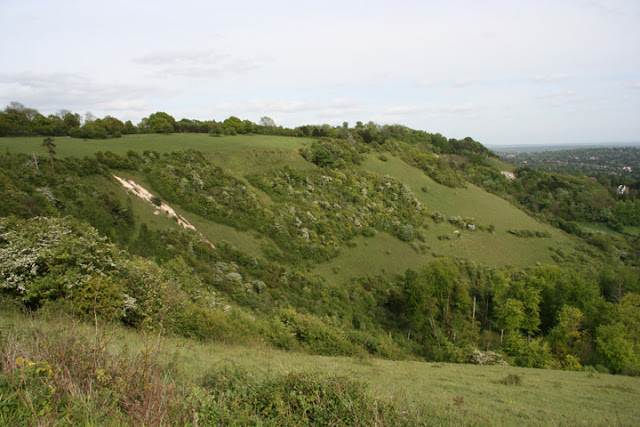
Colley Hill this morning, looking westwards towards where I would have been standing when I took the photograph shown in the previous post. Don't be fooled into thinking that there must be Mountain Hares, Ptarmigans and rare saxifrages nearby, because this is only at the heady height of 220m. Granted, a virtual mountain range for an East Anglian, but a poor excuse for upland to our more northern friends. It was quiet. Three individual Skylarks moving east was just about it as far as viz mig went, and the only surprise was flushing four Red-legged Partridges on the southern scarp. Most gratifying was the melting snow revealing the leaves of thousands of violets, plus some flowering Dog's Mercury. There was even enough warmth in the sun to unleash a few hardy flies.

Wanted: another birding believer

Image
This is Colley Hill, west of Reigate and east of the Mole Gap. It's a south facing scarp of the North Downs and a place that I reckon should - should - be good for observing bird migration. My efforts so far to establish this site as such has so far resulted in a big fat blank. My search for a local site that is a migration hot spot is ongoing and, to be quite frank, one of unfinished business. Apart from Colley Hill, I reckon that the mouth of the Mole Gap (at Dorking) and the scrub to the northern side of Epsom Downs are worthy of extended observation. All these, I am sure, would reap reward from concerted effort. I do have one success, although most of this has been deflected to others. I first came across Canons Farm in 2002/3 and partially birded it in 2005-2008, this time of which was borne out of a certainty that the area had birding potential. My lone study did reveal a turnover of interesting birds (such as Woodlark, Goshawk, Golden Plover, Crossbill and a magnific...

Sightlines

Image
Sightlines by Kathleen Jamie was a Christmas present. I’d suggested it as a gift from one of my daughters after coming across a copy in a bookshop and liking what I saw as I flicked through it. What I’d read was enough to convince me that this was worth a read. I’ve now done so and can thoroughly recommend it. If you are the sort that shies away from prose and creative writing then be warned. As much as Jamie’s writing is accurate natural history reporting it is undeniably descriptive, but her skills are in conveying not only her feelings towards a subject but also being able to transport the reader to the places that she is telling us about. Each chapter is a separate essay, most of the action taking place in northern climes (Scotland, Norway, Greenland). They are varied in subject matter, from a whale museum in Bergen; a pathology lab putting cancers under the microscope; watching Killer Whales from a seabird colony; observing a lunar eclipse; through to glaciers and iceber...

How to spend a bit of time

Image
A bit of spare time + a computer + notebooks full of records = creating meaningless reports. That's what I've been doing, on and off, for the past few months. My highly personal and ludicrous uber patch has inspired me to collate all of my records from that area and produce three reports - one each for birds, moths and plants. At the core of each is a systematic list with such information as highest counts, early and late dates, details of rarities and a list of sites. It is work in progress, with only the bird report remotely completed. Who's it for? Just me, although any interested party will be welcome to a pdf when they are finished. Being electronic means, of course, they never will be finished. I update them after every trip out into the field...