Posts

Queen of the Wheatears!

Image
April is now practically consigned to history, and with it comes closure on the 4th ND&B Wheatear Trophy. This year's battle was a more sedate affair, with none of last year's dog fight at the end, which saw skullduggery and underhand tactics - most un-Oenanthe-like! Our previous winners were: 2013 Gavin Haig (Devon) With Gavin's return to blogging this year, hopes were high that our very first winner would make an assault on the trophy, especially since he has adopted some prime birding real estate on the Dorset coast. But where was he? He posted absolutely no white-arse images at all! 2014 Martin Casemore (Kent) When you live at Dungeness, and possess an enormous lens (steady now...), there can be no excuse for not having a go at reclaiming the trophy. Although he started with good, early intent, the pressure must have become too much, as he disappeared to Morocco for ten days at the end of April!! Despite this, he managed a creditable seven white-arses. 20...

Catching it while I can

Image
One of the downsides of watching (or checking) an area over a number of years is that you sometimes observe a slow (and at times sudden) demise of a species. My visit to Epsom Downs this morning (un)helpfully illustrated this. I have known a spot at the base of Juniper Hill where Early Purple Orchids grow - not many spikes, but reliably flowering each April. A half-hearted attempt last year failed to find any, and today's more thorough visit had the same outcome. In fact, where I was hoping to find the orchids I was confronted by a mound of dumped soil.  Now gone? Another place I checked was an area of compacted, stony ground, at the northern end of the downs. This is where I can expect to find Rue-leaved Saxifrage (below). Year on year there are fewer plants. Today there were fewer still. How much longer will this species keep a toe-hold here?

Few-flowered Garlic

Image
Outside of Headley village church is a dense bank of Few-flowered Garlic. This is now spreading into neighbouring areas, particularly by the small pond that butts up to the church wall. It is quite a sight at the moment and well worth a look if you happen to be passing.

Hard work

Image
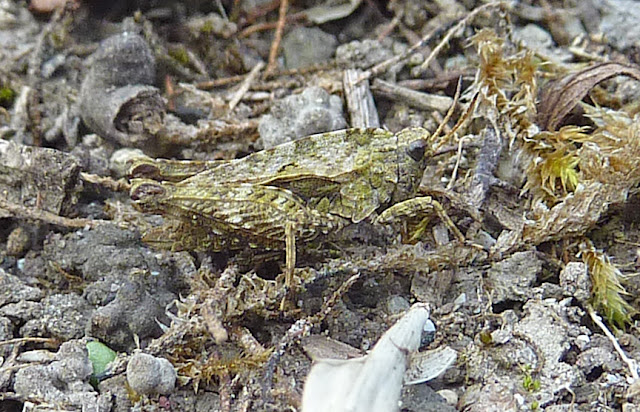
Phew, it really was a struggle today. With not much happening at Canons Farm, I went off to Mickleham to see how far forward the chalk downland flora was - answer being 'not that far at all'. I took a few snaps, then came home... Common Groundhopper - I've not knowingly seen one before - if, indeed, it is one... Greater Stitchwort - undoubtably out all over the place... ... whereas Bush Vetch is only just starting

Guiding lights

Image
I'm not old enough to remember the effect that the publication of A Field Guide to the Birds of Britain and Europe had on the ornithological community in 1954. Written by Roger Tory Peterson, Guy Montfort and Phil Hollom, this took the template from the successful American field guide written by the first mentioned author. Gone were the flowery heroic portraits of birds (such as those by Archibald Thorburn) and in came illustrations whose sole purpose was to educate the reader in the ways of how to identify the species. The text was heavily biased towards this new art of field identification, and the plates helped the reader even further by the use of clearly marked key features - there was no second guessing going on here! This was but the third bird field guide that I owned. I bought it out of a sense of duty towards its perceived worthiness (as much as I also purchased Collins Pocket Guide to British Birds by Richard Fitter and Richard Richardson). These guides, although h...

Almost lilliputian flora

Image
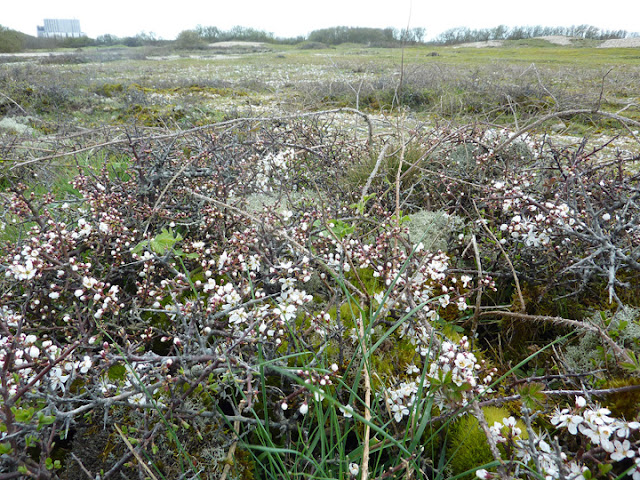
For an inland botanist, a trip to Dungeness is an eye-opener in many ways. The suite of plants present will obviously be different to the ones that you are used to and even those that you are familiar with can appear very different indeed. The windswept and open nature of the shingle, the paucity of soil and dryness can all combine to stunt growth. This is no more apparent than in the populations of Blackthorn and Broom that lie, prostrate, across much of the shingle. I've crouched down to take the photograph above of this Blackthorn bush, most probably a foot high at the most, and this is not as small as they get. Some fight for light with the lichens that surround them! These are no young specimens that will soon tower all around them, but decades old bushes, older than you and I. Some plants just are small, plain and simple. The Early Forget-me-not is coming out in flower across the shingle right now, but from head height it can be a struggle to see the flowers. My pla...

Mining bee's-knees at Dungeness

Image
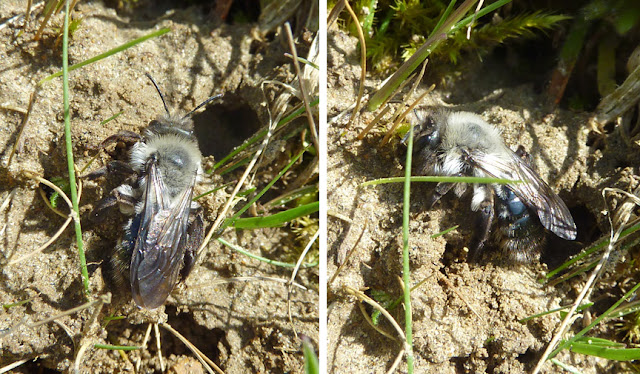
I've just come back from a few days at Dungeness, my first visit since the lengthy late-autumn sojourn. A cool airstream that emanated from colder places to the north and west of the UK are not conducive to Mediterranean over-shoots, but a few migrants did brave the conditions. As ever, the reserve's resident flagship species were readily on view.  Highlights were Black-necked Grebe, Great White Egret, Bittern, Tundra Bean Goose, Whimbrel, Iceland Gull, Little Gull, Mediterranean Gull, Black Tern, Ring Ouzel, Reed Warbler, Lesser Whitethroat, Bearded Tit and Raven. Still on the subject of 'flying things', I was keen to catch up with the very rare and localised Grey-backed Mining Bee ( Andrena vaga ). Since 2010 it has become established in Hampshire and Kent, with a colony being discovered on the RSPB reserve at Dungeness by David Walker.  For some reason (bad timing, woeful neglect) I had failed to see them - until now. My first two visits of this trip to the colony...