Posts

Showing posts with the label Silver-washed Fritillary

Less fuss than me

Image
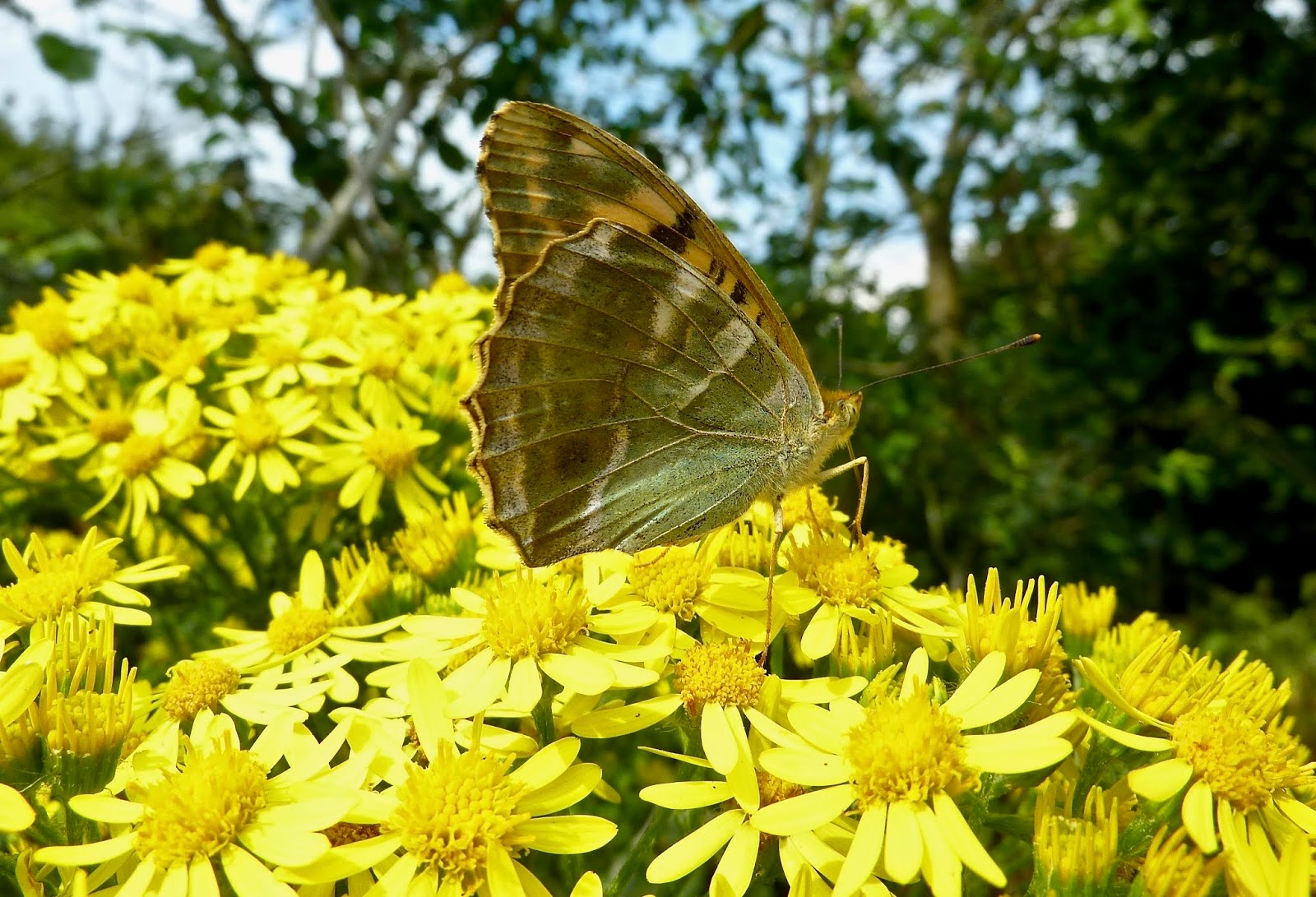
The afternoon was spent sheltering under trees - my walk, across Epsom and Walton Downs, was a wet affair. Who can remember when it used to just rain? Our precipitation now seems to come in two flavours - none, or deluge. The calcareous footpaths that I was wandering along became chalk streams within minutes, my footwear soaked through. A Yew became a refuge for over 30 minutes, where I was able to feel very wet and surprisingly cold as I looked out at an ever darkening sky. Even when brightness seemed to hold the ascendency another nasty belt of rain rushed in on a brisk north-westerly, sending me to scurry back to my shelter. During one of these periods of incarceration, a Silver-washed Fritillary floated past, alighting nearby. It didn't seem bothered by the rain, and allowed me to spend a few moments in its company. I then let it be, marvelling that such a delicate insect should be able to stay exposed to the heavy rain with seemingly little consequence. It was making far less ...

Drowsy with butterflies

Image
Armed with some up to date information from my good friend Gordon Hay, I spent the afternoon on Bookham Common. With precise directions I was able to stand alongside the favoured oaks of that most sought after of butterflies, the Purple Emperor. After only a ten minute wait one came out to patrol the top of an oak tree, gliding in the blue sky and taking up position on an outer leaf. It was roused into action twice - once to see off an Emperor Dragonfly, and again to joust with another Purple Emperor. Both then disappeared into the canopy. The rides were awash with Silver-washed Fritillary (65+) and White Admiral (35+). Hot, drowsy, humid and wonderful.

24 spikes and a butterfly

Image
The countdown continues for my most enjoyable natural history events of the last five years: 6. Sheepleas in the light and dark I have never been one of those naturalists who have fallen totally under the spell of orchids. Don't get me wrong, I enjoy looking at them and have spent some wonderful times in their company. But I cannot pretend to be in total awe of them like many others are. If they are there, then great, but my enthusiasm and energy is just as high for many other plant families. I guess that is why it took me so long to finally see Narrow-lipped Helleborine, even though one of the well known stations for this species is not all that far from my home. In early August of 2016, news started to filter out that the Narrow-lipped Helleborines at Sheepleas, in Surrey, were having a rather good year. Over the years these plants have had a rather 'up-and-down' time of it, with poor flowering years; damage due to being nibbled by deer or slugs; and a slight veil...

June-July: the sun has got its hat on

Image
Summertime lived up to all of the hype and billing. The sun shone, the rain stayed away and the temperature soared. It was a good time to trawl the countryside for plants, butterflies and moths. Instead of remembering to pack the waterproofs it was sunscreen and water that you needed to make sure that you had onboard. The garden MV is at its most productive at this time of year, and in line with previous summers a number of new species for the site appeared, most notable of which were Great Oak Beauty, Kent Black Arches, The Mocha (above) and Oak Processionary. Moth numbers, although not at levels that were enjoyed 20-30 years ago, seemed to be a bit higher than those of the past few years. Another lepidopteran highlight occurred at the end of July, when a single Silver-washed Fritillary alighted a back garden buddleia (below) - the first recorded here and indicative of a number of species that were wandering from their breeding sites in the hot weather. It was also a good summer ...

Fritillary surprise!

Image
Standing by the back door, a cup of tea in hand and idly looking out at the butterflies that were attracted to next door's Buddleia, my alarm bells went off when a large orange butterfly alighted. I had my suspicions as to what it was, but it was just too far away to be certain with the naked eye. After swiftly fetching the binoculars and bridge camera, and grateful that the butterfly was still present, I was able to confirm that it was indeed a Silver-washed Fritillary! Needless to say, a garden first.

Boys from the brown stuff

Image
Today it was a pleasure to welcome Beddington Sewage Farm stalwarts Peter Alfrey and Kevin Guest onto the chalk for a botanical foray. A start at Epsom Downs provided Cypress Spurge and Round-headed Rampion, with butterflies also highlighting with a second-generation Small Blue and plenty of Chalkhill Blues. We then continued onto Mickleham and a scour of Juniper Bottom. The orchids were largely over, although there were a few Broad-leaved Helleborines in bud. Corn Mint (below) was a pleasant find, along with plenty of Silver-washed and Dark Green Fritillaries, plus one Purple Emperor which flew down the middle of the path and straight through us. The slopes of Box Hill at the zig-zag were a great disappointment, with the parched ground not a great place for much flower or insect activity. We cut our losses and headed to the River Mole at Young Street, where a combination of cool shade and watery aspect cooled us down. Botanical highlights included Small Teasel (below), Arro...

Fritillary slopes

Image
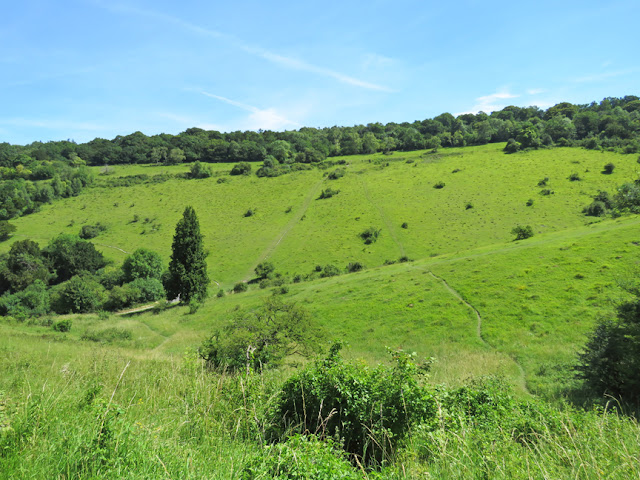
The slopes of the Box Hill zig-zag (above) were alive with butterflies this morning. It was hot, but a slight breeze did make the time spent out in the field not too oppressive. Undoubted highlight were the numbers of Dark Green Fritillaries - at least 140 were recorded, mostly low over the top of the short chalk downland sward. They were in all states of wear and tear, but only a few settled, and those that did were low in the vegetation, making photography a challenge (below). At least 25 Silver-washed Fritillaries were nearby, more likely to be found in the woodland rides and edges. After watching both species for several days, it becomes quite easy to identify them in flight, the Dark Green smaller and sedate, the Silver-washed (below) larger and dashing. There were also good numbers of Comma (bottom), similar of colour to the Fritillaries but that much smaller in flight.

In-between days

Image
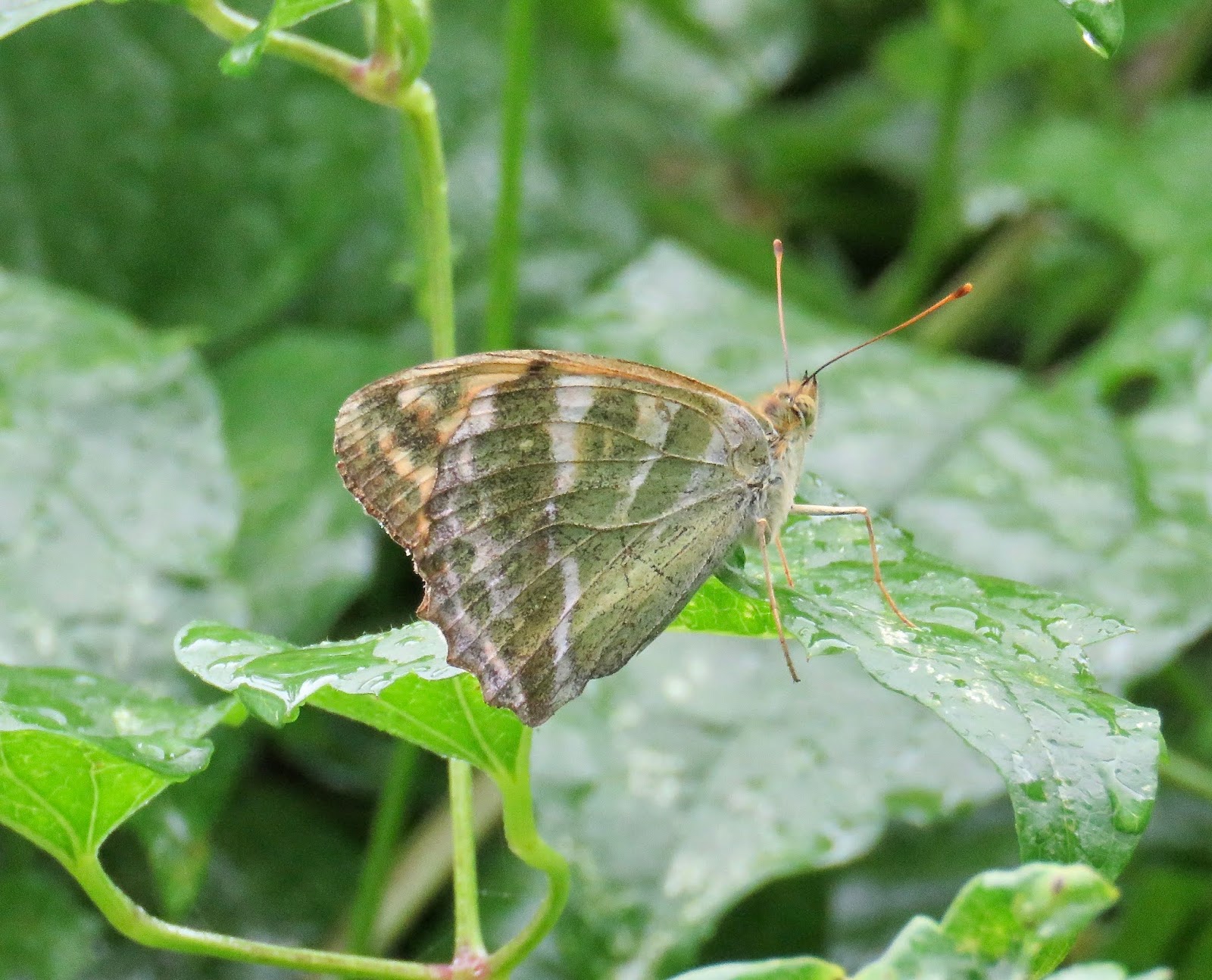
The start of July sees a lull in the number of species of butterfly on the wing, with more than a few of them being between broods. I spent the morning/early afternoon at Park Downs, Banstead Woods and Chipstead Bottom in glorious weather, and, regardless of the 'butterfly trough', still recorded a fair few species (and in good numbers), including two White-letter Hairstreak, 2 Dark Green Fritillary and 15+ Silver-washed Fritillary. Brimstone - second brood starting to emerge Silver-washed Fritillary Ringlet - up to 100 present Dark Green Fritillary

Zig-zag in the heatwave

Image
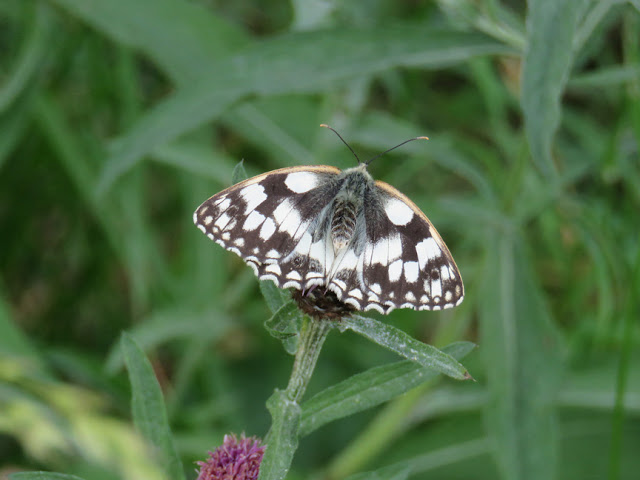
The heatwave continues, with the Met Office suggesting that here in the south-east we might be hitting 34C today. This mornings check of the garden MV was disappointing. Before the weather conditions became too oppressive, I visited Juniper Bottom (to the NE of Box Hill) that offered a handful of Dark Green and Silver-washed Fritillaries, and then the Box Hill zig-zag, where up to 400 Marbled Whites (above) and 60+ Dark Green Fritillaries danced above the grassy slopes. I also came across 5 spikes of Musk Orchid (below) - without my DSLR, the bridge camera struggled to focus on the plant, as it blended in seamlessly with the grass stems in front, alongside and behind it! A single Marsh Tit was heard calling. Also present at both sites were a number of Banded Demoiselle (below), some way from water, the nearest source being the River Mole, some half mile away. This female can be told from the similar Beautiful Demoiselle by exhibiting a white (and not buff) spot near the tip o...

A dream come true

Image
Butterflies in 2016 - a meeting with valezina To be perfectly honest, it was only recently that I had started to harbour a desire to see a valezina form Silver-washed Fritillary. The fires were stoked by the tales of Matthew Oates in the excellent book 'In Pursuit of Butterflies' where his searches for the forms of Purple Emperors and Silver-washed Fritillaries became tales of wonder. About the same time, whilst reading up on the life of local entomologist and artist FW Frowhawk, I discovered that the valezina butterfly was such a favourite of his that he had named his daughter after it - and then, together with Jon Dunn, we made a pilgrimage to the great man's grave at Headley, in Surrey. The time seemed ripe to find one. Apparently, this form is not common in Surrey. I see the species without trouble in the wooded areas of Banstead, Reigate and Box Hill, but never of the desired form. Further west, in the woods of Dorset and Hampshire, the proportion of valezina fem...

Late summer on the farm

Image
What better way to celebrate the arrival of September than to head out for a day's birding at a top location. Dungeness? Portland? Spurn? No, Canons Farm... I shouldn't be so harsh on the place, as it has given me a lot of pleasure over the years. Unrewarded hard graft and frustrating days may outweigh the good birds and notable migration, but, as one wise old birder once said to me, "you remember your good days because of your poor ones." Today was an inbetweeny one. I was joined throughout by Geoff Barter, another birder of a certain age that can happily choose to wander the birding wastelands of northern Surrey on the back of a lifetimes worth of 'birding good times' from elsewhere - maybe Canons Farm is like a retirement home for the satiated ornithologist. According to Geoff's phone app, we walked five miles across, up and over the farm today. We did give it a good bash, and not without reward: a Red Kite, 10 Common Buzzard, 2 Hobby, 4 Sparrowh...

Narrow-lips and a valezina

Image
Sheepleas, a Surrey Wildlife Trust reserve situated between Guildford and West Horsley, is one of those places that had dropped off of my radar. I last visited in 1998, from when I can remember a vast network of footpaths, and was also aware that Narrow-lipped Helleborine can occur there. This local and decreasing species is something of a phantom in the county, often being nibbled by deer (or slugs) before it gets a chance to flower - and that is if it decides to appear above ground at all! So, when a number of twitter and Facebook account holders started to post images of said orchid from said reserve, my curiosity was awoken... The short story is that I saw 24 spikes in all, within a small, discrete area: The nearby meadows were crammed to bursting point with flower. I have never seen so much Clustered Bellflower in one place, nudging neighbouring Marjoram, Wild Basil, Agrimony, Common Knapweed, Burnet Saxifrage and St.John's Wort (didn't specify them!) for room...

Just butterflies

Image
I spent this morning and early afternoon in the Juniper Bottom/Top/Box Hill area, otherwise known as 'Hawfinch Valley'. None of the monster-billed finches were seen or heard, but the butterflies were out in force. At least 60+ Silver-washed Fritillary (above), 8 Dark-green Fritillary and a single White Admiral were the highlights. The zig-zag downland was, however, disappointing, with little on the wing and my hunt for an early Straw Belle proved to be a failure. However, in such glorious surroundings and in matching weather it would be churlish to complain.