Posts

Showing posts with the label Stonechat

Getting better

Image
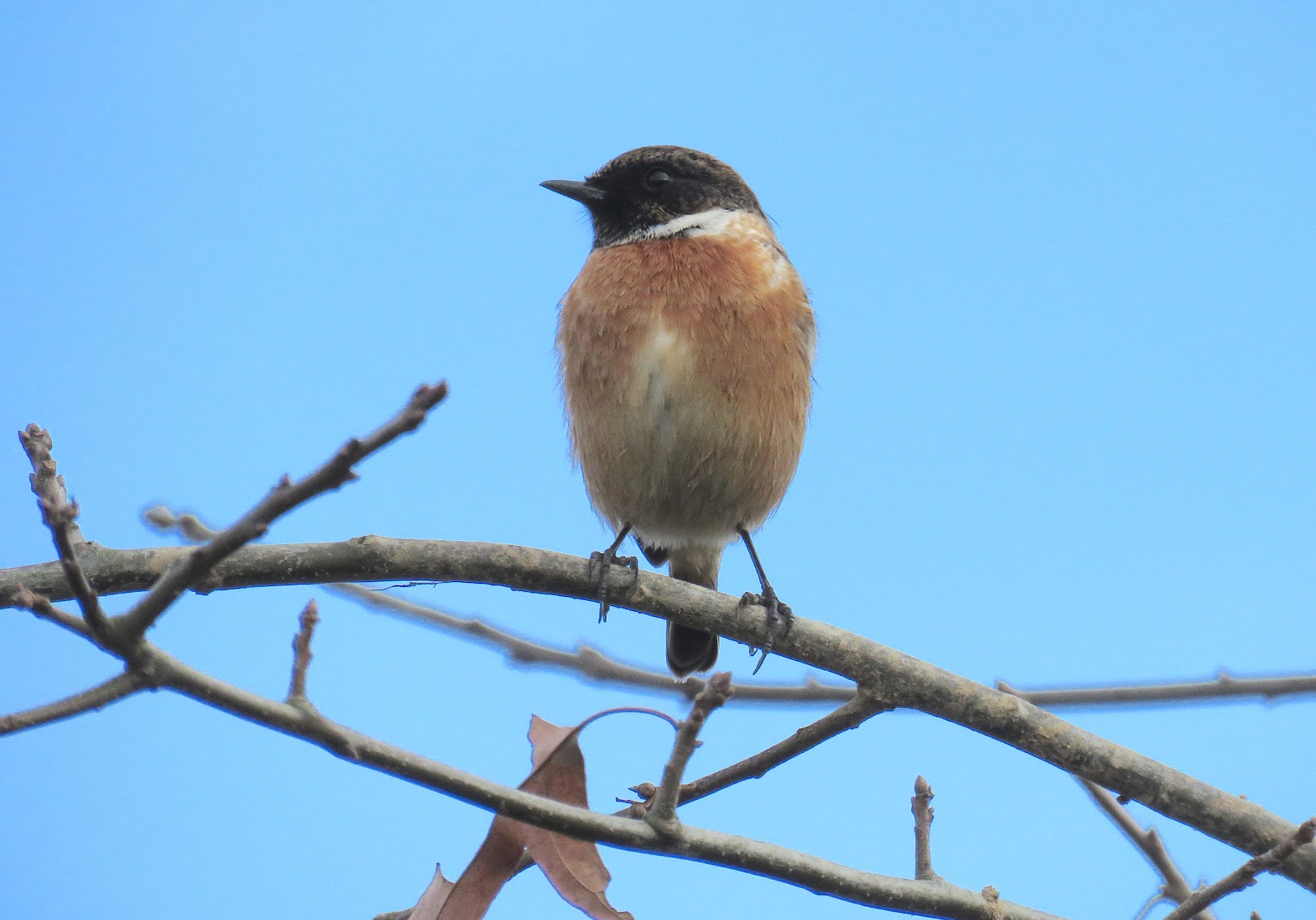
The Beatles sang "I've got to admit it's getting better..." and I could say the same about the local birding over the past week. Redwings, after a winter of having gone missing, have suddenly appeared, with 300+ present on rank grassland/woodland within 800m from home last week and up to 360 feeding on Walton Downs horse paddocks this afternoon. My first decent sized group of Stonechats of the spring decided to show themselves on Epsom Downs (this afternoon) with six birds (four males, two females) that only encouraged head-scratching from myself in my trying to age and assign them to a subspecies - as one male was so much paler on the underparts than the others (a cleaner orange, clear white and dark black head, pictured above) and one of the females was brighter and cleaner than the other. I've read up, but am none the wiser. Maybe best to leave alone. A walk across Epsom and Walton Downs earlier today also rustled up three displaying Lapwing (a sound I never ti...

Stones and Darts

Image
The last 10 days has seen me become obsessed in scouring the local patches for large, open, weedy fields and scanning them for Stonechats - the reason? - we are experiencing ridiculously high numbers of these charismatic chats at the moment. Prior to this, my highest local day total for a single site was 10. And as will be shortly revealed, that day total has been smashed, several times over. The first inkling that something unusual was happening occurred on 30th September when I was skywatching from the base of the scarp slope just east of Box Hill. I was aware of three, maybe four Stonechats in front of me, but was more interested in the small number of birds passing overhead. Now and again I would take a break from looking up and scan the fence lines close by. And that was when I was confronted by a loose flock of 17 Stonechats, 10 of which I managed to capture in the image above (one of them is hidden on the bottom wire). Now this was unusual! I returned three days later to find th...

On your marks...

Image
2021 - pretty crap, wasn't it... So welcome then to 2022, which doesn't have to try too hard to be a better year than the last - I just hope that I haven't tempted fate or jinxed it by writing that! Plans. Every New Year has plans. I vary from creating a monstrous list of aims and ideas which, slowly during the first few months of the year, crash and burn. I am now a more circumspect 'planner'. I like to have something to hang my natural history observations on (a bit like the relationship a pair of trousers has with a clothes hanger), so do try and get a bit of process behind my sightings. At the very least this will include writing up my notes; making my observations available to the databases via BirdTrack and Trektellen; be a conscientious team-player by tweeting and WhatsApping my sightings; and keeping this very blog alive. Last year I posted fewer times than ever before, my mojo having gone missing. Hopefully it has been refound. 2022 seems to be the year tha...

We will remember them

Image
When the Woodland Trust purchased Langley Bottom Farm several years ago, it most probably saved this corner of the Surrey downs from becoming yet another golf course or, worse still, a housing estate. The farmland of the north downs has always struggled to provide well, with the dry chalky soil riddled with flints and it does not carry much value. Langley Bottom Farm had been cared for sympathetically, with a good arable flora and set-aside strips and game cover present that catered for a small shoot. Lapwings still bred on three fields and a good population of Skylarks were present all year round. Small copses had been left alone, and much of the hedgerow was deep and ancient. Needless to say, when the Woodland Trust revealed their plans for the farm, and of their intention to plant it with trees to create a commemorative wood, the local naturalists were concerned. After several meetings with interested parties a compromise was agreed. Open fields would be left for the Lapwings, and a...

The chat mystery

Image
Another lockdown walk from home saw me scouring the fields, copses and downland across Epsom and Walton. Yet again it was underwhelming. Very few birds seem to be wintering here, certainly not the expected numbers of finches and thrushes during the winter months. Even the Skylarks, which numbered 125+ only last week, have dwindled away. So, thank goodness for Stonechats! One of my favourite species at any time of the year, but when you have them performing on a grey and dreary morning, when there appears to be little else on offer, they become even more special. Last Sunday I had found a pair, lurking with the sheep, down in a fold in the hills on the border of Epsom and Walton Downs. Two days ago they had enticed another male to join them. This morning, all three were still present and correct. Or were they? On looking closely at the female, I could see that it was ringed - the female that I had watched earlier in the week had not been. So, either this is a new bird (and the other has...

Fog and ice

Image
A hard frost with a large helping of fog greeted me at dawn this morning. A route-march up onto Epsom Downs soon had me warm, and a quick circuit across the race-course and the fields of Walton Downs provided the following highlights: 8 Red-legged Partridge, 70+ Skylark and a pair of Stonechats. The male of the latter was ringed - I cannot get anything on the inscription, but it looks like a newish BTO-type band. I'd like to think that it was ringed by those kind people at Dungeness Bird Observatory, and it has quite rightly decided to pay this corner of Surrey a visit... The vegetation remained resolutely iced, frosted, hoary and rimed. Rather invigorating.

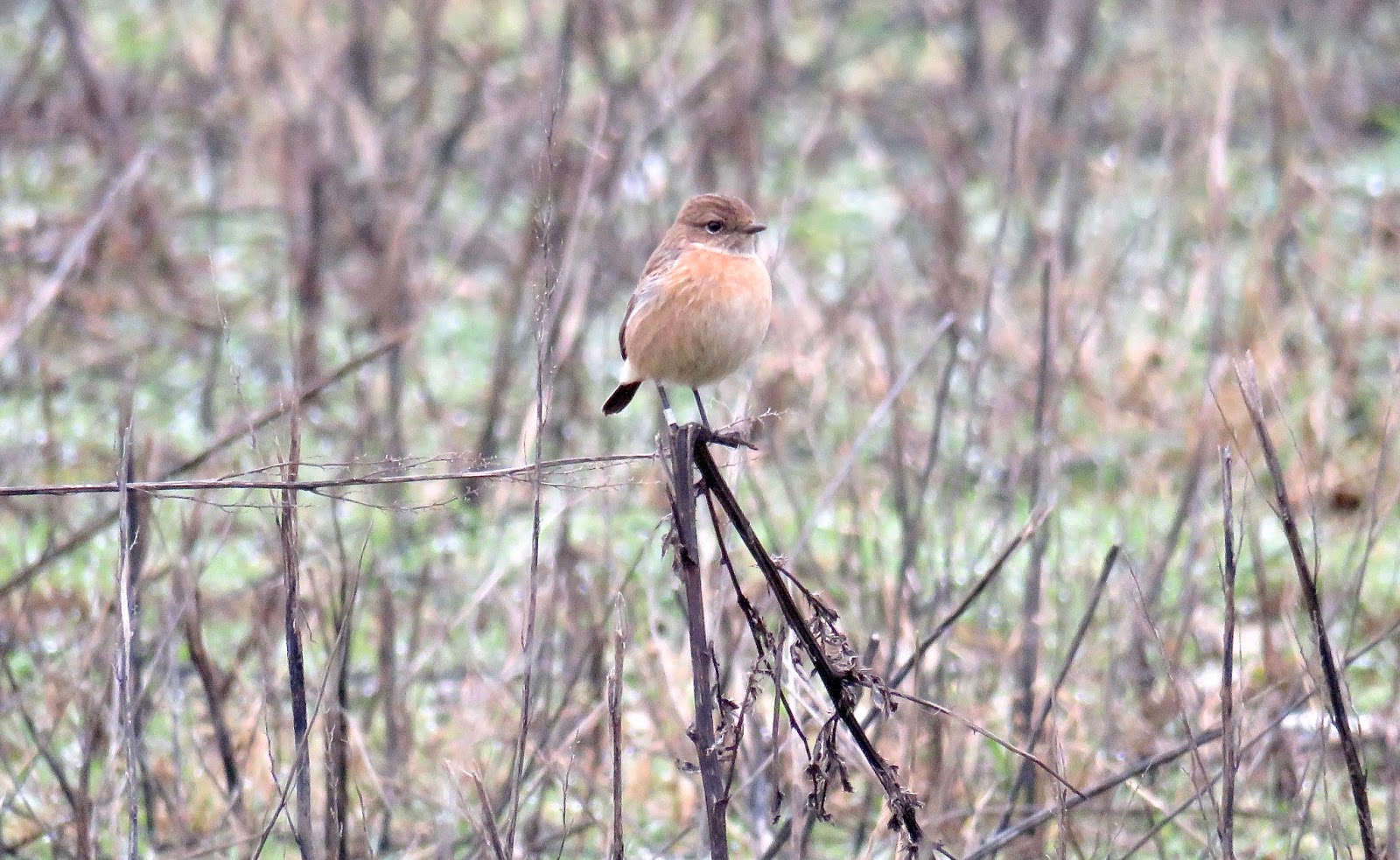
A Stonechat. Discuss.

Image
Yesterday afternoon, in dull light and rain, I came across a strikingly pale Stonechat in a grassy paddock at Little Woodcote in Surrey. It had something of the Whinchat about it, all creamy peaches and obvious supercillium, but it was distant and flighty. My schoolboy error was in not having my scope with me, and seeing that I needed to get home, the bridge camera came out and I took a couple of dodgy shots. These were enough to elicit interest from a few birders, one of which, Peter Alfrey, met me shortly after first light this morning to try and see if the bird was (a) still present and (b) a wanderer from further east. Thankfully the bird had stayed overnight and had remained in the meadow, and not only that, it was an awfully lot closer than yesterday. A ‘typical’ female Stonechat was keeping it company, highlighting the striking paleness of ‘our’ birds underparts, lacking the orange-russet tones of its typical hibernans companion. Again, the supercillium was marked and obvious. ...

Stonechat sweep

Image
Over the past couple of days, fellow north-Surrey birders have been returning some tidy counts of Stonechats. Now, I love Stonechats, so today was turned into a 'Stonechat Sweep Day' where all of my most chatty patches were visited - all being within five miles from home. It turned out rather well. Fist up was the grandly named Mogador , open farmland/pasture with ribbons of hedgerow and several scrubby corners -  Stonechat score: 7 (4 males). Next up was Canons Farm , always a favourite with our chat friends, and so it proved again -  Stonechat score:  7   (3 males). Epsom Downs played hard to get, with the most  chat-tastic areas disappointingly devoid of them, but when I gave them all another search they came out to play -  Stonechat score:  5   (2 males). The last stop was Priest Hill , scrubby ex-football pitches and this site stole the show, with guest appearances as well -  Stonechat score:  11   (3 males) + 4  Whincha...

More Spring

Image
For me, ornithological Spring starts with the late-February passage of Stonechats. The downs close to where I live is a good place to observe this, with Priest Hill, Canons Farm and Epsom Downs being within walking distance from home. These charismatic birds continue to dribble through into early-April. This morning's visit to Canons Farm found three (two males and a female) present in the Reeds Rest Bottom area, so they could conceivably be birds left over from the five seen two days a go. The 'normal' fences and hedgerows were shunned for the open fields, with all three birds spending most of the time that I was observing them up to their vents in the grass (above). Another sign of Spring was the north-westerly passage of Meadow Pipits. Of the 70+ birds that I counted, most of these went overhead in small flocks, although a group of 40 were flushed from Stoney Knob and then moved on - possibly a resting flock. Other highlights included 12 Skylark, 35 Fieldfar...

Beating the bounds

Image
I fancied stretching my legs today, so decided upon a walk around the perimeter of the 'mini-uber patch'. I left home, on foot, at 06.10hrs and returned seven hours later. According to an app on my phone this comprised of 36,925 steps covering 24km (just under 15 miles). It might have done my cardiovascular system the world of good, but as far as the birding went it was very poor - little in song, much of the walk seemingly bird less, highlights hard to suggest. The footpaths were in bad condition, not just ankle-deep mud with washed away foundation, but sorely lacking in vegetation clearance. In the summer some of these are going to be impassable. It is quite sad to walk through beautiful countryside that is so bereft of wildlife. What were once arable and pastural farm fields are now largely horse paddocks, golf course or monoculture grass. The area between Banstead and Gatton that I passed once played host to Tree Sparrow colonies - 56 pairs in 10 colonies some 50-odd yea...

Patch formica

Image
A spare hour this afternoon, in-between bouts of drizzle and rain, saw me wander over to Canons Farm. I just stuck to the central road (more of a track) and scanned to my left and right, daydreaming of Pallid Swifts, Stone Curlews and the like. I was rewarded with a group of three Egyptian Geese, flying low across Broadfield in a westerly direction. My pleasure was heightened by the fact that they were a patch tick for me - vaguely of annual occurrence here. I tweeted out the news, admitting that, although they were not worthy of being described as 'patch gold' they deserved some form of accolade. My twitter chums responded with various suggestions, the winner being Gavin Haig's 'patch formica'. His reasons for that suggestion? Because he felt it needed to be something man-made and tacky. I get where he is coming from. Did I take a picture of the glorious fly-by? No way. You'll have to make do with this Stonechat instead. Shame it wasn't a Bluetail.

Stonechat time

Image
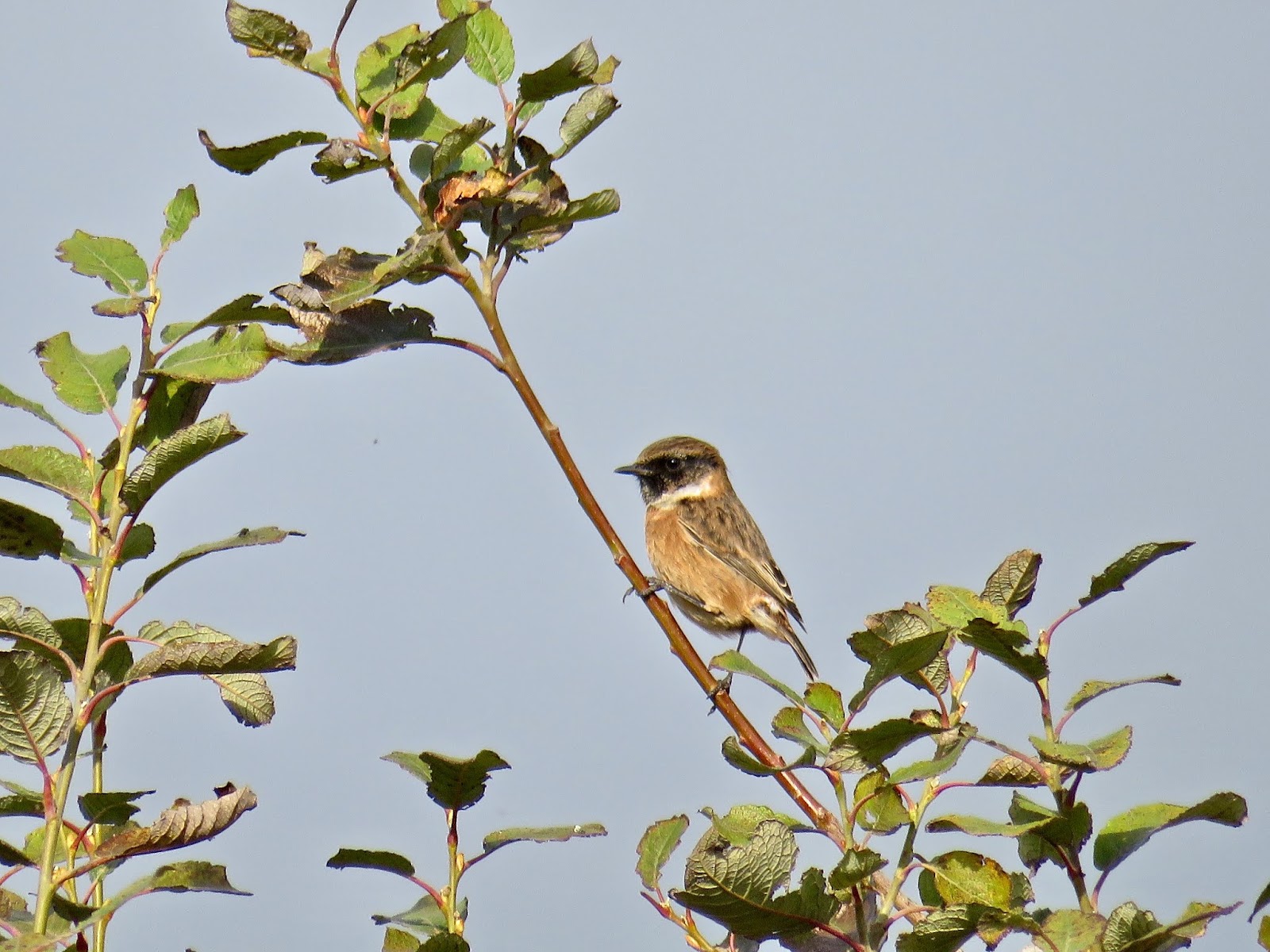
We are in the full swing of Stonechat passage that is enjoyed during each 'mid-autumn' period. This year seems to be a good one for this most charismatic of chats, with multiple counts and obvious turnover at several sites. Over the past few days I have observed: Canons Farm: one (a female) on 15th; three (all males) on 16th; three (two males, one female) on 17th; six (two males and four females) on 19th. Mogador: six (two males and four females) on 17th Priest Hill: five (all females) on 18th; six (two males, four females) on 19th. Epsom Downs: seven (two males, five females) on 20th. As can be seen, by keeping a note on the sexual composition of the flocks, there is some turnover going on, that sometimes the numbers can only hint at. Just because five birds become six birds the following day does not necessarily mean that just a single new bird has arrived - they could all be different! Although the species does breed in the county (mostly on the western heath...

What is Mogador?

Image
A local day's birding that didn't promise much but ended up being one of great interest. Throughout the day, cloudless blue skies meant that if anything was moving through the area it was high - I picked up a number of passerines too far up to specifically identify, all heading south, and I suspect that they were mostly pipits. This was slightly born out by the number of Meadow Pipits found in the fields at Canons Farm (40) and Mogador (70). The other 'species of the day' were Stonechats, with three at Canons Farm (different from yesterday) and six at Mogador (two males). The latter site also held a male Common Redstart, with Colley Hill also chipping in with a female type plus a Whinchat. Mogador is not a site that crops up regularly on the birding map. It occupies high ground just inland from the scarp slope of the North Downs (at Colley Hill.) It is open farmland (arable and cattle) with thin ribbons of low vegetation with small groups of bushes for good measure...

Hidden webs revealed

Image
This glorious weather unearths hidden wonders - some the fields of Canons Farm are covered with spider's webs, only appreciable when viewed against the strong, low sunlight. I have absolutely no idea which species produces such a web. Want another Stonechat image? I thought so...

Warming the soul

Image
The signs were all present and correct to suggest that Spring is on the way - the first day of 2019 bestowed with genuine warmth; at least 4 Brimstones on the wing close to home by mid-morning; that earliest of passage migrants, the Stonechat, appearing locally; very high Common Buzzards passing straight through the air space; and a suite of insects busily nectaring on hellebores, Christmas Box and early flowering heathers. Days like these warm the soul.

Groundhog blogging

Image
There are certain things that appear on this blog with regularity - you could, in fact, almost set your calendar to them. One of these repeat performers is Green Hellebore (above and below). Every January I pay a visit to the clump that haunt a copse on Walton Downs, take a few pictures and post them on here. That is where I went this morning. Job done. This will be followed by Spurge Laurel and Wild Candytuft in the coming weeks. Bird wise a strange morning. Long spells of deadly quiet punctuated by skies full of birds. Highlights were Red Kite, Common Buzzard, Sparrowhawk, 60 Stock Dove, 100+ Skylark, 250+ Redwing, only 3 Fieldfare, 2 Stonechat, a Marsh Tit, a Raven and 120 Goldfinch. Talking about repeat performers, Stonechat photos will most probably pop up on ND&B several times this year. Here's the first offering, the female of a pair seen this morning...

Benign times

Image
The blue skies, warm sun and light winds are a delight to be out in but it does mean that the autumn birding is a little on the slow side. Stonechats appear to be present on most of the local open spaces, including Epsom Downs (above). Yesterday afternoon a covey of 11 Red-legged Partridges were found on the farmland on Walton Downs, a remnant of the old shoot that ceased raising their guns over five years ago (below). A few late butterflies are on the wing: Small Copper, Small White, Brimstone and Red Admiral. The past few nights have been too cold to bother with the moth trap. It feels more like late summer than late autumn.

Birding locally off-piste

Image
Sometimes it pays to just wander off the beaten track, search areas that just don't get looked at and, regardless of the outcome, enjoy the ride. Combine that philosophy with a calm, sunny and warm afternoon and you are on to a winner. I parked up at Margery Wood and walked northwards across the open farmland at Mogador. This area always looks good to me, a mixture of rough grassland, some crops and plenty of isolated scrubby bushes. My love of chats is an open secret, so a group of four tame Stonechats, together with an isolated single, was success enough. There are many footpaths that then criss-cross both Walton and Banstead Heaths and, although tempted by them, returned to search the slopes of Colley Hill - but not before a noisy flock of five Crossbills flew over heading eastwards. Colley Hill is one of my favourite places, although my birding success here is poor. The cleared slopes, with isolated scrub, looks ideal for migrants. I always think it looks ideal for Ring Ou...

Chats to the rescue

Image
Any regular visitor to this blog will know that I love chats. I don't mind which species, they are all wonderful. They sit out in the open, are confiding and are generally highly colourful. This afternoons visit to Canons Farm would have been an abject failure had it not been for the 10 Stonechats present - a male at Bog Field (above), a female at Pipit Meadow and a group of eight (four males) at Reeds Rest Bottom. One other highlight was a mass of (Wild) Radish flowering on the upper slopes of Pipit Meadow. You can share in its understated magnificence below...

400 (no, not birds) and some chats

Image
Chats... you just can't get enough of them, can you - at least I can't. I spent a good hour standing by a field edge at Canons Farm watching a party of 4 Stonechat and a Whinchat as they flitted and sallied around the hedgerows, fences and vegetation in the field. A couple of them came close enough for a few decent images to be obtained. Back at home, the garden MV came up trumps with a Delicate, a migrant moth that has been turning up on the south coast in good numbers. It also happens to be the 400th species of macro that I've recorded here.