Posts

Showing posts with the label weather

Milky-blue

Image
Chalkhill Blues are, to me, redolent of sunny warm skies. We are lucky here on the Surrey chalk downs that in a good year the slopes can shimmer with milky-blue as thousands dance above the sward - but not this year. They seem to be in depressed numbers. The downland flora has been rather compromised this summer, with the dry and warm March, April and May ensuring that little flowered and left behind stunted and dried up blooms. The Chalkhill Blue food plant, Horseshoe Vetch, can carpet large areas of the slope at Denbies Hillside, but on my visits this summer it has been in short supply. This is where today's photograph was taken. Talking of the weather,  The Hairy Birder blog  mentioned his dissatisfaction with the online weather forecasts, and how they vary. I have noticed this as well. I check three sources - Met Office (often wrong), BBC (correct more often than not) and XC Weather (not bad but always over-estimating wind strength). How three sources, using similar, ...

Storm 'something or other'

Well, how was Storm Ciara for you? The scores on the doors here at Banstead was of two wrecked fence panels, two loosened fence posts and water incursion along a side-alcove. It could have been worse - have you seen the footage of a side of an hotel collapsing into a river in Yorkshire? Or the many homes and businesses that have been flooded for the second, third, even fourth time in the past few years? Who's idea was it to build on flood plains? Anyway, when weather events such as these come along, us birders think not of dislodged roof tiles and smashed fence panels but of storm driven rarities, mass seabird spectaculars and exhausted auks sheltering on inland duck ponds. And, of course, such avian hopes hardly ever materialise. Those that did seawatch yesterday report of nothing happening and us inland birders got excited if we saw a bird - any bird - out and about braving the winds. The time of year doesn't help either, had it been September or October then we could hav...

Busily doing nothing

Well, that's not quite correct, but it has felt like it. The relentless strong westerly airflow, together with sudden downpours or long periods of drizzle have put to bed thoughts of those warm balmy days of late February. I have hardly picked up the binoculars, instead finding stuff to do indoors or seeking refuge in shops, pubs, art galleries, doing artwork or reading books. I cannot complain... This morning I took part in a bit of community work, assisting in the planting of a wild hedgerow on the local allotment where I'm helping out record the wildlife. 200 mixed plugs of oak, blackthorn, silver birch, rowan and hazel were donated by the Woodland Trust and put in place by seven of us in quick time, helped along by tea, coffee and home made cake. As for the birding, this stormy interlude has had the feel of pushing a reset button. When it all calms down next week I will enter the field with renewed vigour, and maybe, just maybe, a summer migrant or two will be awaiting.

The cold finally snaps

Image
In glorious sunshine a six-mile circular walk taking in Ranmore Common and Polesden Lacey was made with eldest daughter Rebecca. There were plenty of snow pockets to walk through and the trees on the higher ground were coated in icy granules that had started to melt in the warm sun. The birding was disappointing, although at least six Marsh Tits were recorded, including two in fine song. It would seem that the finch numbers are to be found further west along the ridge - out of uber patch range! A late afternoon visit to Canons Farm suggested that the cold weather may be having some affect on the birds, with an influx of Fieldfare (70) and an increase in Yellowhammer numbers, with 42 gathering to roost. A Barn Owl was hunting across the fields and along the edge of the wood up by Perrotts Farmhouse and a Little Owl was spied huddled up in an oak tree on the edge of Broad Field. From the top: male Kestrel; Little Owl, Yellowhammers, Meadow Pipit

Fair-weather birder

Image
I used to go out birding in all sorts of weather - pouring rain, heavy snow, gale-force winds and heatwave. As the saying goes, 'there is no such thing as poor weather, just inappropriate clothing'. But I now have to admit, even when wearing appropriate clothing there is poor weather that tips over into the 'not worth going out birding' category. Take yesterday on Walton Downs. A foggy dawn. Looks pretty (see above) but cuts down visibility to the point that birds are reduced to soft shapes, although their calls are still present for the observer (or, more accurately, the hearer) to have a good idea to what is about. But anything at mid-distance is lost and avian activity is reduced. So, I thought, come back later. But later (and not much later as it turned out) the fog lifted to be replaced by a cold, gusting, wet and dark suite of weather. I suppose because I can largely choose when to go birding that I have the luxury of turning round and going back indoors - ...

Above the fog

Image
On arrival at Denbigh's Hillside at 06.30hrs I was confronted by a most arresting sight. The lower valleys were all fog bound, giving off the illusion of a vast inland sea. The video above, and the images below, really do not do it justice. Birding wise a pleasant morning and early afternoon, with a Goshawk, three Red Kites, 12+ Common Buzzards, three Stonechats, 20+ Chiffchaffs and four Ravens. To the sound of cranking Ravens and mewing Buzzards and Kites I was delighted to watch at least 10 Clouded Yellows patrolling the slopes, with the odd butterfly stopping to nectar (below). And last, but not least, a weedy strip in one of the fields beneath the hills held Broad-leaved Spurge, with the fruits exhibiting the tell-tale warts (below). My luck was in as I checked just the one plant!

1976 and all that

1976. Can you remember it? To me, in my advancing and increasingly befuddled state, 1976 was only a handful of years ago, but you will have to be approaching 50 to have any recollection of it at all. 1976 is now 42 years ago - blimey! Even if you were born well after it, you may well have heard of 1976 because of the summer heatwave that was enjoyed/endured. It was 100 degrees F each and every day from May 1st - August 31st, it didn't rain at all, roads melted, rivers ran dry, reservoirs became vast empty bowls, all the grass died, we were all covered in dust, ice cream ran out, beer ran out, there was a hose pipe ban for four months, we had to queue up at standpipes to get our drinking water... OK, it wasn't quite like that, but that isn't far from the truth. For some reason 1976 stands out as the hot summer to be measured against, although I can remember 1975, 1983 and 2003 having pretty special hot and sunny summers. In fact, in the latter year, the UK's record hi...

Snow stopped play

Image
With the weather forecasters strongly suggesting that we could be in for a week of snow and ice, I felt duty-bound to get a Hawfinch count in before 'Snowmageddon' was let loose upon us. I arrived at Bramblehall Wood at 06.45hrs in a light snow shower which continued, more on than off, for the hour that I was present. The Hawfinches were quite lethargic this morning, with very little movement between the woods and those that were perched up in the tree tops seemed quite happy to stay put. The middle section of the wood was favoured. Of interest, a number of birds arrived high from the west - possibly indicating that they had come in directly from Juniper Top / Ashurst Rough rather than filtering down the slope - they usually arrive at a lower elevation. A total of 260 were present, although I did leave a little early, so more may well have come in after I had gone. After 3-4 weeks of observing these birds I now feel confident that this early morning gathering is of birds f...

Ronnie Raindrops

In 1953 the Americans started to name their storms with female names and then, in an act of equality (or because they were running out) they started to use male names as well. In 2015, as always eager to copy our 'friends' across the pond, we followed suit. Not for us Storms Chuck, Wilma and Buck, more a case of good old British names, although we have yet to witness a Storm Tyler or Jayden. And now we also have to give weather events snappy monikers, such as the dose of cold air coming in from Russia being referred to as 'The beast from the east'. How far will this go? BBC TV Weather Forecast, April 1st 2020 Philip Avery presenting. "Good morning. If you have already looked out the window you will have noticed that it is a little bit Colin Cloudy which may well end up with a few Ronnie Raindrops. But don't worry, because Suzy Sun will most probably show her face this afternoon. But as darkness falls, watch out as it might get a bit Brian Breezy." ...

Winter Solstice and apparent snow

Today, at 16.28hrs we will have reached the precise moment of mid-winter. Neither the time (or the date) is the same each year, but for 2017 that is the marker. Our ancestors used to mark this date with cheer and trepidation - the light was about to return, but the 'famine' months of deepest winter were about to get a grip. Cattle were slaughtered (for their meat and also to save on feed), drink was fermented and ready to sup, and the stones were aligned in the hope that the Gods would be kind. Today we just turn up the thermostat and ensure that we've got enough cranberry sauce in the cupboard... White Christmases? Where did the wish for them and myth about them come from? I heard something about this on the radio the other day, which suggested that Dickens is to blame. Even back in the Victorian era they were sentimental for them, which just goes to show that it didn't always look like the North Pole here in December. This week will see my 60th Christmas Day (I know...

Invasion of the coccothraustes under a very odd sky

Image
And still they come, delighting those lucky enough to be standing underneath them - Hawfinches that is. This autumn's 'invasion' continues on a broad front that is giving observers the opportunity to see this species in places where they normally do not occur - like my garden for instance. I took up my position for a spot of viz-migging at about 07.30hrs and stuck at it for almost four hours. Although much quieter than yesterday, the main target did arrive, with a flock of four Hawfinch over low, heading east, at 07.50hrs, and then a single five minutes later that circled a couple of times before it too departed eastwards. Calls were heard on both occasions, a suprisingly thin sound from such a beefy bird. I was more than a little pleased. Since I first looked at a bird book over forty years ago, the Hawfinch has always intrigued me, from its striking appearance down to its secretive nature. Even when you know that they are present in a wood they can be difficult to pi...

Mammatus clouds plus a sunset

Image
The morning of May 20th was warm, bright and sunny at Dungeness. At approximately 09.00hrs a dark band of cloud appeared on the south-western horizon and slowly, but surely, crept towards us. The light quickly faded, and the arriving cloud was dramatic enough to stop a few of us in our tracks to stare skyward. It was not just a case of the threatening nature of what we were observing, neither the accompanying thunder and lightening, but the strange cloud formation. This formation is called mammatus (after mammary, or breast). It is suggested that the circular shapes are caused by pockets of cold air puffing downwards. They are associated with thunderstorms, as we could easily confirm. It was a magical 15 minutes as the clouds passed overhead, a visitation from another world. At times I looked across at some nearby birders, who took not a blind bit of notice - you see, what was above them didn't have feathers... their loss. A couple of evenings later we were treated t...

Storm Katie

Well, how was it for you? Storms like this sweep through northern Britain on a regular basis, but us soft Southerners believe that such meteorological events are rarities that are indicative of the coming of Satan himself. But in truth they are becoming less of a surprise now, with our weather, to quote comic Stewart Lee, being "no weather at all, punctuated by catastrophe" - or something like that. Being a serial weather forecast junkie, I knew Katie was coming, and when awoken at 03.30hrs by heavy rain hammering against the window, borne on a banshee wailing wind, cannot say that I was anything but prepared for it. We have had a bit of a damp problem in an alcove, which is exacerbated by strong wind and heavy rain, so needless to say an inspection of the property this morning found a bit more damp to contend with - plus one smashed fence panel, a bit of masonry and tile by the back door and various branches that were, until this morning, attached to an Ash tree. What ...

Eastern (and Southern) promise

Several months ago, whilst I was daydreaming about spending the late autumn at Dungeness, one of the subjects that I kept returning to was the weather. Would the winds be favourable for the odd good bird, conducive to arrivals and not too bad for sea watching? If I could have put in an order it would have been for light winds between E and S, a puff of warmth and largely dry weather. I must have done something right in a previous life, because so far there has been several days with such conditions and the Met Office are promising even more of the same well into next week! Thoughts are now turning to Pallid Swifts, Desert Wheatears, Bluetails and at the very least flocks of Pallas's Warblers chasing Richard's Pipits. Most of today was spent sea watching with the gang and a leisurely drive around the pits with Mark H, Chris P and Ellie the telescope (don't ask...)

4 February 1287

Five thousand years ago, in an area of sea that is today Rye Bay, we would have found offshore barrier beaches that were constantly shifting with the insistence of the sea. Over several thousand years this shingle was moved and deposited in stages eastwards and started to accumulate on tidal sands. Each mini era of activity formed shingle ridges, mimicking the waves they had been sculpted by, and within each peak and swell was laid bare the genesis of the place that would later be called Dungeness. As much as this process was a gradual one, at times, during the dark ages, great storms quickened proceedings, not only reconstructing the shoreline with brutal immediacy but also altering the flow of the nearby rivers. The area inland from all of this activity was a volatile place as well, what with the rising of the landmass, formation of marshland and periodic inundation of the sea. Man also played his part in altering the landscape to serve his needs, draining to create fertile farmland...

Big skies

Image
Why is it that we are drawn to open vistas, panoramic views and big skies? I've read somewhere that it may be that it is hardwired in us, a throwback to our ancestral savannah home, and our need to see into the distance to prepare for possible danger. Such reasons are largely null and void in 2015, but my need for the 'big sky' is a strong one. I'm drawn to such places, be they Dungeness (above), the North Downs (middle) or humble Canons Farm (bottom). They all supply me with peace. Thinking time. They strip away the immense detail of our daily lives, the media tittle-tattle, subdue the human bustle and act as a balm to the stresses of today (and if you don't think you have any, the way that we live in the so-called civilised world, we are surrounded and bombarded by them). Human traces are reduced in such situations, so distant towns become islands of lego, roads thin grey snakes wriggling through the green and pylons just silver insects marching across t...

An antidote to this miserable weather

Image
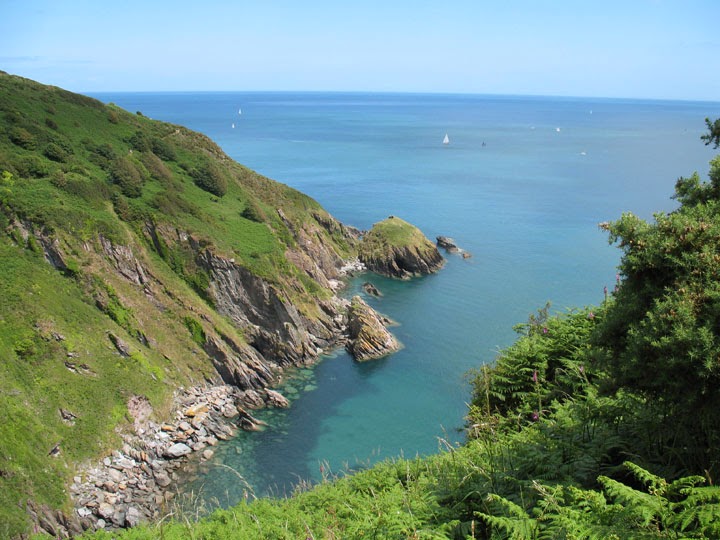
We are currently going through an unsavoury period of weather - even those of us in the cosseted south-east are experiencing winds and rainfall more akin to an outlying Scottish isle. As an antidote to all of this, and a promise of things to come, I thought I'd share with you a few days spent botanising in South Devon back in late June 2009. The weather was simply perfect - calmness, warmth and sunny skies - and the wildlife played ball so that my many plant targets were largely met. But what was most stunning, and memorable, about my few days was the scenery. DAY ONE First stop was Berry Head (left). The cliff tops and faces were a veritable hanging gardens of vegetation, including some national rarities. Small Hare's-ear had eluded me in the past, but on this particular morning I found up to 20 small plants with ease. My self-congratulations were tempered when I found out that the Berry Head population of this tiny flowerer is estimated to be between five and six th...

Storm

Image
The St. Judes storm gave us Southern Softies a bit of a shake-up earlier in the week. North of Watford they most probably wondered what all the fuss was about, but we mustn't lose sight of those whose lives were affected, and for a few it was truly tragic. In all honesty there was little to show for it in my neighbourhood - a few fence panels down, the odd branch splayed across the pavement and one fallen beech tree that closed a side road for an hour or two. In the copses and woods signs of the violent weather were more apparent, as the images above show. At least in these places the trees will be left alone, opening the canopy and giving home to dead-wood loving invertebrates. As I sit here typing this, the wind is up again. No doubt a few trees were weakened last Monday and will take only a little persuasion to fall...

I do care what the weather man says

Image
I'm not a 'global-warming' sceptic, but I am starting to realise that the climate models that were created when 'global-warming' was all the rage were not entirely accurate. It used to be all so simple - increased temperatures meant melting ice caps, rising sea levels and a hotter climate for the UK (mild frost-free winters and long sunny summers). We all thought that this meant breeding Mediterranean birds, street cafes and a run on flip-flops in the shops. Now it seems that 'global-warming' actually manifests itself by producing weather from any of the four seasons that can appear at any time of year. Extreme weather has always been a part of our climate, but not so much of it at such regular intervals. We are currently 'enjoying' a very late spring (coldest March since 1963), which has followed on from the wettest summer on record which in turn followed the hottest March since dinosaurs ruled the Earth. And this followed the bizarre weather of ...

Bloody fools and those that aren't

It's a bloody fool who looks out of the window or watches a weather forecast and decides that 'it's no good for birding' and, based on such gut instinct, decides to stay indoors. I should know, I've been that bloody fool on more than one occasion. With a biting easterly all the way from Siberia, snow, wind chill and a blanket of dull greyness you could be forgiven for thinking that bird migration would be halted. Not a bit of it. This weekend has seen Red-rumped Swallow and Common Swift on Scilly, a Bluethroat and Kentish Plover in the Portland area, quite a few Ring Ouzels strewn across the south, three (or four) Stone-Curlews (including one at Wanstead), a passage of overland Little Gulls, Common Redstart, Hobby - I could go on. Obviously not all birders have been fooled into thinking that their efforts were bound to go unrewarded. In Surrey, Tices Meadow outdid Beddington with Kittiwake, Little Gull, Black-tailed Godwit, LRP, Grey Plover, Ringed Plover, Redsh...