Posts

Showing posts with the label Cut-leaved Germander

A helping hand

Image
Priest Hill. Until the Second World War it was north Surrey farmland, a mix of arable (wheat, barley, oats and potatoes) with a small herd of Jersey cows that were used for milking. A demand for the payment of death duties meant that the owners were forced to sell, which in 1942 brought in the tidy sum of £100,000 from Surrey and London County Councils. The farm was demolished in 1956 which then lead to the building of Ewell Technical College and the creation of playing fields for the use of Tulse Hill School, used to service its 2,000+ pupils, who were bussed in from South London. When Tulse Hill closed in 1990 the playing fields, changing rooms, tennis courts and cricket nets were abandoned to vandals, graffiti artists, fly tippers, travellers, glue sniffers, motor bike off-roaders... and me. I used to wander across the fast vegetating land, a vast open wasteland, to see what alien plants were springing up and what (few) birds I could find. A bit of the land was saved (Glyn Schoo...

Dragon's-teeth and chalky corners

Image
Cut-leaved Gremander Wild Candytuft There's a chalky corner of north-east Surrey where a couple of caring botanists have cultivated a number of scarce plant species from Surrey-sourced seed. This has been done with the blessing of various organisations. This 'nursery' acts as a back-up to the vulnerable wild populations, so that if ever they should disappear (at the likely hand of man), the species will still exist within the county and could be repopulated by the offspring of those very same missing plants. This chalky corner is tended to rather than managed, and it is incredible how well some of the species that are present just set seed with wild abandon (unlike at their 'wild' sites). Broad-leaved Cudweed, Wild Candytuft, Basil Thyme and Cut-leaved Germander are spreading away from their original seeding sites with vigour. Night-flowering Catchfly, White Mullein, Prickly Poppy, Rough Poppy and Hairy Rock-cress are just some of the other plants being lo...

Plants save the morning

Image
For some daft reason I found myself at Canons Farm at the ungodly hour of 05.00... a calling Tawny Owl slightly convinced me that it was all worthwhile, but it slowly went downhill from there, with just a couple of Greylag Geese (patch goodie), a Swift, three House Martins, 4 Swallows and a Wheatear trying desperately hard to turn ornithological water into wine. It didn't work... However, at times like these I can put another of my natural history hats on, so the 'botanical' one came out and I went to check the freshly ploughed strip at Fames Rough. This disturbance is irregularly carried out to help maintain the two ultra rare species that grow there - Ground Pine and Cut-leaved Germander. And the good news is that they are both present again this year, although the 11 GP and 3 C-LG plants that I found were on last years strip, roughly in the same place where the GP grew in 2015. This made me feel very happy indeed, as I understand that both species are not doing very we...

2015 review: June-July (part two); local rarities

Image
Sorry Dylan, more premature reminiscences and more flowers... In June I happened to bump into local botanist Peter Wakeham on Park Downs. He told me about the time that he had been spending at Langley Vale Farm, surveying the plants in light of the Woodland Trusts purchase. My ears pricked up at its mention, as I had spent some time birding the area (from public footpaths) and had botanised some of the field margins over the years (seeing such rarities as Night-flowering Catchfly). The WT had opened up access to a great deal of the farm and his offer of a guided tour was eagerly taken up. We met on a swelteringly hot July 1st, which was the start of my visiting the farm on a regular basis. On that initial visit, Peter showed me Narrow-fruited Cornsalad and Cat-mint, both new species for me. A couple of weeks later I found myself at a bare, chalky field edge on the north-western side of the farm. One of the first species that I spied was a sizeable Venus's Looking-glass...

The plants keep on giving

Image
Today, I didn't intend to spend any time looking at plants along the edges of fields, but ultimately I couldn't resist it. Walking along the footpath that snakes around the large field between Holly Lane East and Park Downs, at the meeting point of several footpaths, the crops had not taken, so I got down on my knees and searched the stunted flora. Sharp-leaved Fluellen was not uncommon and several plants of Small Toadflax also caught my eye. A nice start! Next up was Perrotts Farm and the field directly north of Ruffett Wood (called Pipit Meadow by the birding fraternity) which was exhibiting a bare strip at its north-western end - I needed no encouragement to check it! This too was of interest, with more Sharp-leaved Fluellen being found, but also a great deal of Dwarf Spurge (above) - this surprised me as I have not seen this species at this locality before - John Peacock will know of its historical status on the farm. I was quite close to Fames Rough and felt it wou...

Ground Pine and Cut-leaved Germander

Image
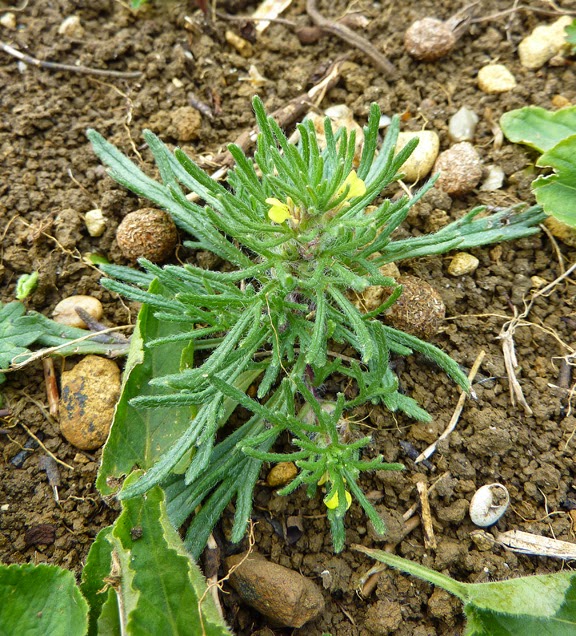
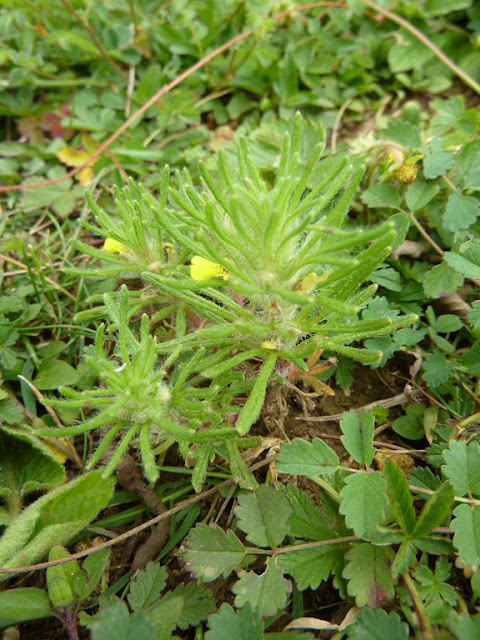
Ground Pine This was quite a small plant - I have seen virtual clumps! Cut-leaved Germander This afternoon I visited Fames Rough, nestled along Chipstead Bottom in Surrey. The ploughed strip is certainly producing the goods as no less than 22 plants of Cut-leaved Germander were found (none in flower) and, best of all, a single flowering Ground Pine. The strip was smothered in both Sharp-leaved and Round-leaved Fluellens. Well worth a visit.

Botanical foray

Image
This morning found me haunting the chalky slopes of Chipstead Bottom, as one of a band of fellow botanists and all-round naturalists who were part of Peter Wakeham's organised walk. As usual, Peter shared with us his knowledge of the area and expertise with the plants - you always come away the richer and wiser from his forays. And there were a few familiar faces in our number: local boys David Campbell, Ian Magness and Paul Goodman; Beddington absconders Nick Gardener and Peter Alfrey; plus I finally got to meet Bill Dykes, fresh from his 'second for Britain' micro moth success. I began a bit earlier in the day walking the rides of Banstead Woods in the hope of a Purple Emperor. They have been seen already this year on Bookham Common, but I drew a blank. Compensation came in the form of plenty of Marbled Whites, a firm favourite of mine. Other lepidoptera that gatecrashed the botanical party was a Blackneck (disturbed from vegetation but then on show for all to see), ...

Rarities that need a helping hand

Image
I was delighted to come across this ploughed strip of land at Fames Rough, Chipstead this morning. The Downlands Project (if it was they) are to be congratulated for undertaking this task, to ensure that we can enjoy another year of flowering Ground Pine (below) and Cut-leaved Germander. Both species have a long history at the site, but have periodically 'disappeared' due to lack of ground disturbance, which they both need as they are poor competitors, although their seed can remain buried (and viable) for many years. The strip measures approximately 100 x 5 meters. I will return throughout the summer with some anticipation. Ground Pine - picture taken on the North Downs several years ago

Ground Pine still fine

Image
A visit to Fames Rough to check on the rare plants was made yesterday morning. The Cut-leaved Germander has gone over, each plant now a ghostly pale coffee colour that makes it stand out a mile. Several of the Ground Pines still exhibited the odd flower (as above) with most plants looking washed out and yellowish. I came across a large patch of Apple Mint back on Canons Farm which has, up until now, evaded my detection. I then spent the next ten minutes wandering around sniffing the crushed leaves between my fingers - nice...

Ajuga do nicely

Image
Nestled in amongst woodland along the south-facing slope of Chipstead Bottom is an unassuming strip of chalk downland known as Fames Rough. To most botanists that name will immediately bring to mind two very rare plants - Cut-leaved Germander and Ground Pine. It was during World War Two (when this strip of land was ploughed up for the war effort) that the buried seeds of both of these plants were kicked back into life and flowered profusely. From that time onwards a watchful eye has been kept on these rare plants. Neither of them like their habitat to scrub up, and will head back underground until the top soil is disturbed to create the open sward that they need. Regeneration of the surrounding vegetation has lead to spells in which they have largely failed to appear. In 2000 I can remember being overwhelmed by the number of Cut-leaved Germander plants present. Conditions were then good for them. However, two years ago I failed to find either species. The Downlands Project...

The Lyon's share

Image
It's a cheap trick I know - give a post an adult title (as in yesterday's 'Roman Snail porn') and watch and wait for the poor unsuspecting web-surfers who will arrive at your site expecting to see large Italians fornicating but instead will view just shell-on-shell action. One of those lured was our very own pan-lister and blogger, Graeme Lyons. When he found out that, apart from the snails there could be a bit of rare plant ticking to be had as well, he was on his way up to the North Downs. I would like to report that I showed him everything that I mentioned as a possible tick. The truth is I showed him the area in which I expected to find the target species and he then looked down on the ground and said "There it is". That bloke has a sharp pair of eyes. We did go through the card without a miss - Roman Snail, Greater Yellow Rattle, Cut-leaved Germander, Ground Pine and Green Hound's-tongue. I will post tomorrow about these species as it is worth expan...