Posts

Showing posts with the label Kestrel

PSL complete

Image
Back in the mists of time (or at least the turn of the millennium) I sat down and worked out my UK list of lifeforms that I had identified. This was primarily made up of birds, plants, butterflies and moths, although I was able to dig up plenty of additional filler, such as dragonflies, easy to identify insects and a whole host of miscellaneous creatures that I could remember having seen. I kept it in a notebook and now and again would suddenly remember something from the past and add it to the list. The list was purely for a bit of fun, and as far as I were aware there was nobody else that kept such a pointless tally - but I was so very, very wrong. I cannot remember the moment that I became aware of other 'lifeform listers' although I'm pretty sure that the name Mark Telfer was involved. He, too, kept such a list and not only that, he was on the lookout for other like-minded souls, to gather (and publish) a league table of totals. Even though my competitive listing days w...

Discovery - 3km (Day 2)

Image
Three kilometres from home is not a big distance. And when you have lived in the same house for over 30 years, you would expect to know all of those three kilometres intimately, in whatever direction that you choose to take from your front door. And you would be wrong. If lockdown has any silver lining it is that our enforced retreat into the home area opens up the possibility of discovery. When I look at an OS map of my home area, I am familiar with what lies due south (and to a certain extent north) of me - but not so much to the west and certainly hardly anything to the north-east. I have walked thousands of miles from home, quite literally, but for some reason my inner-compass has taken me away from the north-east. Today I went in search of this 'empty quarter'. I started with a visit to Priest Hill (north-west and 15+ Greenfinch), then Banstead Downs (north and 40+ Redwing), then veered of into the mysterious north-east. Here I hit the edge of my 3km square, hard up agains...

A bridge far enough

Image
Once upon a time, in a birding world far, far away, if you wanted to take meaningful photographs of birds, then you needed to invest heavily in photographic equipment - camera bodies, various lenses, tripods, film, developing and printing - you needed to start with a small fortune and forgo pure birding and focus almost entirely on photography. In fact, you were either a bird watcher or a bird photographer . In my birding youth there were but a handful of well-known bird photographers, largely shooting in black-and-white, with JB and S Bottomley and Eric Hosking springing most readily to mind. More affordable equipment, increased leisure time and a swelling in the interest in rarities encouraged a blossoming of 'birders with cameras' at the end of the 1970s and the turn of the 1980s. You still needed to fork out a few bob, but many did so. It became a staple part of a twitch to see these photographers selling their prints of recent rarities, and some of them made a tidy sum ...

It doesn't have to be rare...

Image
Most birders will have a place that they regularly visit, a place that will usually be fairly local to where they live, and, quite often, there may be several of them. They are fondly referred to as 'patches'. After visiting these places over a few years, the birder will become familiar with what the patch offers and will enter into a contract of benign and pleasurable birding - surprises do not come along that often, so when they do they are highly valued. This morning at Canons Farm was one big surprise. No rarity was involved, but as is so often the case when birding a patch, species that are common elsewhere can, on the site, take on a much more hallowed status. There is also the question of where birds appear on a patch. Certain species (particularly passage migrants) have a habit of turning up along the same hedgerow, in the same copse or along the same fence line. This morning's experience were of birds cropping up away from such expected sites. I arrived at t...

Friday falcon

Image
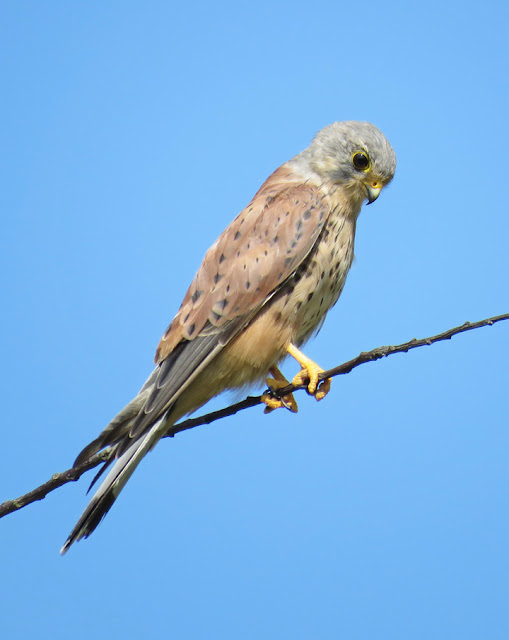
An early afternoon visit to Priest Hill which could have been sponsored by Sleepeezee Beds it was so soporific. None the less, it did include a Peregrine (that was almost the first bird I clapped eyes on) and this Kestrel that, like most of the Kestrels at Priest Hill, just love posing for the camera.

Close encounters of a Kestrel kind

Image
Another morning visit to Priest Hill and another couple of hours spent in the idle hope that (at least) a Yellow Wagtail would fly over calling, or a Whinchat deign to alight on a nearby fencepost - such is the life of the inland patch worker. Single Cormorant, Sand Martin and Lesser Whitethroat are what passed for highlights around these parts... However, life isn't measured in rarities (or common passage migrants), which is just as well at the moment. This Kestrel tried to inject some interest into the proceedings by resolutely refusing to leave its chosen perch. Both of these pictures are un-cropped. These bridge cameras are rather good!

Ring Ouzel at Priest Hill

Image
Yes I know that the image above is not quite in focus - that you are having to peer between branches of a bush - and look through a strand of barbed-wire fence - but at least you can share in my joy of this morning's male Ring Ouzel at Priest Hill. It even drew a crowd of admirers, as four birders made the trip once twitter 'twatted'. The bird stayed in Bunting Field for up to an hour, but was very wary and flighty, so I largely let it be. As some form of compensation for the poor pic, have a male Kestrel from this morning...

The Windhover

Image
The photograph above, of a hovering male Kestrel, was taken this morning at Priest Hill. It was only after I returned home that I became aware that today has been designated as 'World Poetry Day' and, being a surprisingly cultured oaf, immediately thought that this image would be apt for a post. The Windhover was written by Gerard Manley Hopkins, that clerical poet who celebrated the natural world in many of his writings. It was a poem that I came across at school, when studying for my English Literature O-level, where I was lucky enough to be taught by a fine teacher, one Mr McTiffin. He instilled in me a love for the written word that has remained to this very day. So, for an appreciation of the Kestrel, over to you Gerard... I caught this morning morning's minion, kingdom of daylight's dauphin, dapple-dawn-drawn Falcon, in his riding Of the rolling level underneath him steady air, and striding High there, how he rung upon the rein of a wimpling wing In his ecst...

Confiding Kestrels

Image
Today appears to be the day that the spring migrants have chosen to arrive in good number for the first time - coastal stations are widely reporting Wheatears (with some London birders also getting in on the act), Garganey are filtering through on sea and arriving at wetlands, and there are even Alpine Swifts blessing a few birders with brief, pulse-quickening fly-bys. Me? None of the above. I have tried, a couple of hours at Priest Hill this morning that, although summer migrant-less, did have its interests. A flock of 25 Meadow Pipits were restless brief stop overs; there were still three Reed Buntings on site; up to 15 Skylarks were present (with much singing and chasing); two Little Owls were calling from the south-eastern hedge; and a Tawny Owl joined in from the main copse. Yesterday, I met up there with local birder Steve Thomas, someone who has visited Priest Hill infrequently over the past few years. He successfully gripped me off with tales of old - two reeling Grassho...

Warming up down on the farm

Image
My last visit to Canons Farm was a slow affair, with few flocks of birds and the fields eerily quiet - well today things had picked up a bit. It wasn't exactly heaving, but a gathering of thrushes along the border of Broadfield and Poultry Field comprised 235 Redwing and 60 Fieldfare. The winter wheat in this area has grown above thrush height, so there were most probably many more hidden from view. Another welcome gathering was 100+ Linnet (below) that sat in tree tops and sang amongst themselves, in a rather distracted and absent-minded way. The sound carried some distance, and together with several displaying Skylarks (and a singing Little Owl) gave the whole morning more than a touch of spring. Other highlights included 2 Common Buzzard, a Kestrel (top), 5 Rooks and a single Yellowhammer. The countdown has definitely started - the 'downland' passage of Stonechats is now due, Common Buzzards and Red Kites are soon to be expected and it is touching distance b...

A photogenic Kestrel

Image
After a morning of wintery showers I ventured over to Canons Farm which was, quite frankly, bloody hard work. In previous winters the fields have at least had flocks of assorted finches, corvids and pigeons to sift through. not forgetting the hundreds of thrushes that commuted between favoured feeding areas. This winter has seen almost empty pastures - the Fieldfare flock is hovering around the 100 mark and apart from 20-40 Skylarks and 30-40 Yellowhammers (that isn't, admittedly, too shabby) there is very little to entertain the birder. I spent a bit of time mucking about with the Nikon Coolpix P600 bridge camera that I bought last November. My main reason for getting it was down to its 60x optical zoom, this enabling me to obtain half decent 'record shots' of birds with minimal effort. A particularly social Kestrel (above) allowed me to snap away. Let's just hope that any Red-foot in the spring will be just as co-operative...

Poetry corner

When I was 'doing' my O-levels (as they were called back in 1975), part of my English Literature exam covered the English poets. One scribe in particular gained my admiration, and that was the birding clergyman, Gerard Manley Hopkins. So, to celebrate National Poetry Day, let's remind ourselves of his celebration of the Kestrel, as described in probably his best known work, The Windhover . I caught this morning morning's minion, kingdom of daylight's dauphin, dapple-dawn-drawn Falcon, in his riding Of the rolling level underneath him steady air, and striding High there, how he rung upon the rein of a wimpling wing In his ecstasy! then off, off forth on swing, As a skate's heel sweeps smooth on a bow-bend: the hurl and gliding Rebuffed the big wind. My heart in hiding Stirred for a bird, - the achieve of, the mastery of the thing! Brute beauty and valour and act, oh, air, pride, plume, here Buckle! AND the fire that breaks from thee then, a billion Times to...

Vis mig

Image
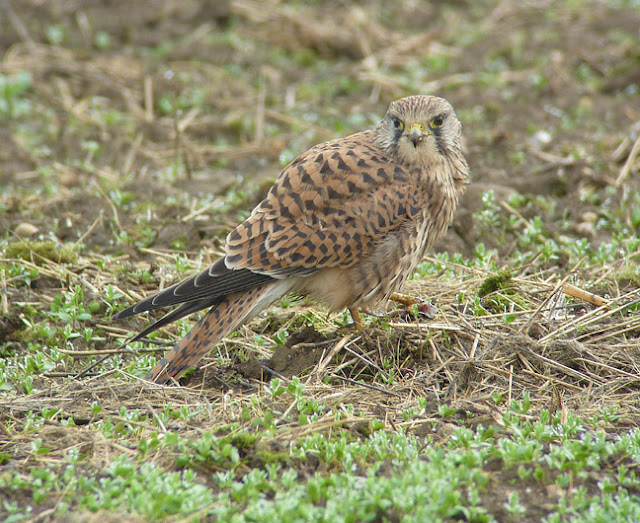
I like nothing better than a good passage of diurnal migrants passing overhead - migration and movement in all its glory. This morning at Canons Farm there was, for the first three hours of daylight, a good passage of Redwing (700), Starling (3,000) and Chaffinch (300) in a westerly/south-westerly direction. The odd Redpoll, Siskin and Brambling was thrown in for good measure. One of last weeks Ring Ouzels was still haunting the hedgerows. The Kestrel pictured above decided to pounce on an earthworm and consume it only yards away. Even I had to digiscope it.