Posts

Showing posts with the label Wheatear

Surrey 5km bird race

Image
Back in March, Ed Stubbs announced the launch of a Surrey-based bird race, to take part on May 7th. The rules were simple: between 00.00hrs - 18.00hrs observers were asked to record as many species as possible within a 5km radius of a nominated point. The use of 'green' transport - foot or bike - was encouraged. Solo birders or gathered teams were both welcome. I was, of course, in! So, where would my nominated point be? The most obvious starting place would be my home in Banstead. I would then be able to carry out the whole day 'on foot'. I started to look at a route, which would, by necessity, have to take in the very few limited water bodies within that area. There was a downside - there would be plenty of walking through areas that would not, in all honesty, hold much. There was also a wish to be spending the day in an area that might hold a few surprises, be they untrodden footpaths, unvisited tracts of land and stunning scenery - in the end I plumped for Colley Hi...

Tidying up the loose ends

Image
This post is a bit of a round-up, covering the last few days - those images that didn't quite fit into previous posts, those snippets of information that fell through the cracks in the blogging floor... to begin with, I've been visiting the 'Station field' on an almost daily basis, which is a recently cut meadow that is but a ten minute stroll from my front door. The bales of hay have been left in place, which has meant that any chats present are easy to see as they perch up, sentinel like, surveying all before them. Whinchats have only been present on one visit, although Wheatears (below) have been seen on each occasion, peaking (so far) at four last Sunday. The freshly exposed stubble has enticed up the three Red Kites (above) and six Common Buzzards to search for food. As previously mentioned, this site looks very good for sky-watching, being on proven fly lines. I await a chance to test the theory. After 33 'blank' years, the migrant tortrix Cydia amplana tu...

A 'new' location

Image
Yesterday I was walking back home from Epsom Town centre when I passed a gateway - a gateway that I have walked on by over the years - and noticed that the substantial field on the other side was being cut, the grass neatly piled and baled. My birding brain kicked in with "I bet there will be a Wheatear or two on top of those bales before the day is out" and I found myself back on site later that evening - no Wheatear, but at least six Common Buzzards were gathered, no doubt taking advantage of the recently cut grass to forage for food. I returned early this afternoon, and, joy of joys, two Wheatears were on show, along with seven Common Buzzards and a Red Kite. And there was more, for I went back two hours later and the Wheatears had been joined by three Whinchats! Now, this field is largely unbirdable, with private housing, a railway station and a mature Hawthorn hedgerow keeping observations down to the previously mentioned gateway - or so I thought. I have found a couple ...

I cannot really complain

Image
For the past two early-autumns I have visited a small section of the Sussex South Downs to get a birding fix. In a vague rectangle, between Burpham in the west, Steyning in the east, Chanctonbury in the north and Cissbury in the south, there is a delightful mix of chalk grassland, pasture, crop, copse and hedgerow, all with a good track record for birds in number and species of some repute. In my previous visits I have come to expect some big passerine flocks and migrant choked vegetation, but today was a bit of a disappointment. Passerine numbers were much depressed, especially warblers, and it was, at times, hard going. I did end up seeing a Marsh Harrier, a Hobby, four Yellow Wagtails, 13 Wheatears, five Whinchats, a Spotted Flycatcher, a Common Redstart, a Sedge Warbler and 50 Corn Buntings, so I cannot really complain. I will try and get back before September passes the baton to October, as this land is excellent for chats.

Straw chats

Image
It's been a quiet couple of weeks locally. Canons Farm, Walton and Epsom Downs, Priest Hill and Headley Heath have all been visited. Passage migrants were thin on the ground and the number of warblers much depressed - I do wonder if the breeding season has been poor, and this is why I am not seeing (or hearing) many locally-bred young birds. Bucking the trend, however, was a count of 60+ Chiffchaffs at Headley last Wednesday. This morning's wander across the farmland at Mogador was better - straw bales that had been left in a recently harvested field were acting as convenient perches for three Whinchats and two Wheatears. I stood and watched for awhile. I will never tire of chats.

We're going on a Wheatear hunt!

Image
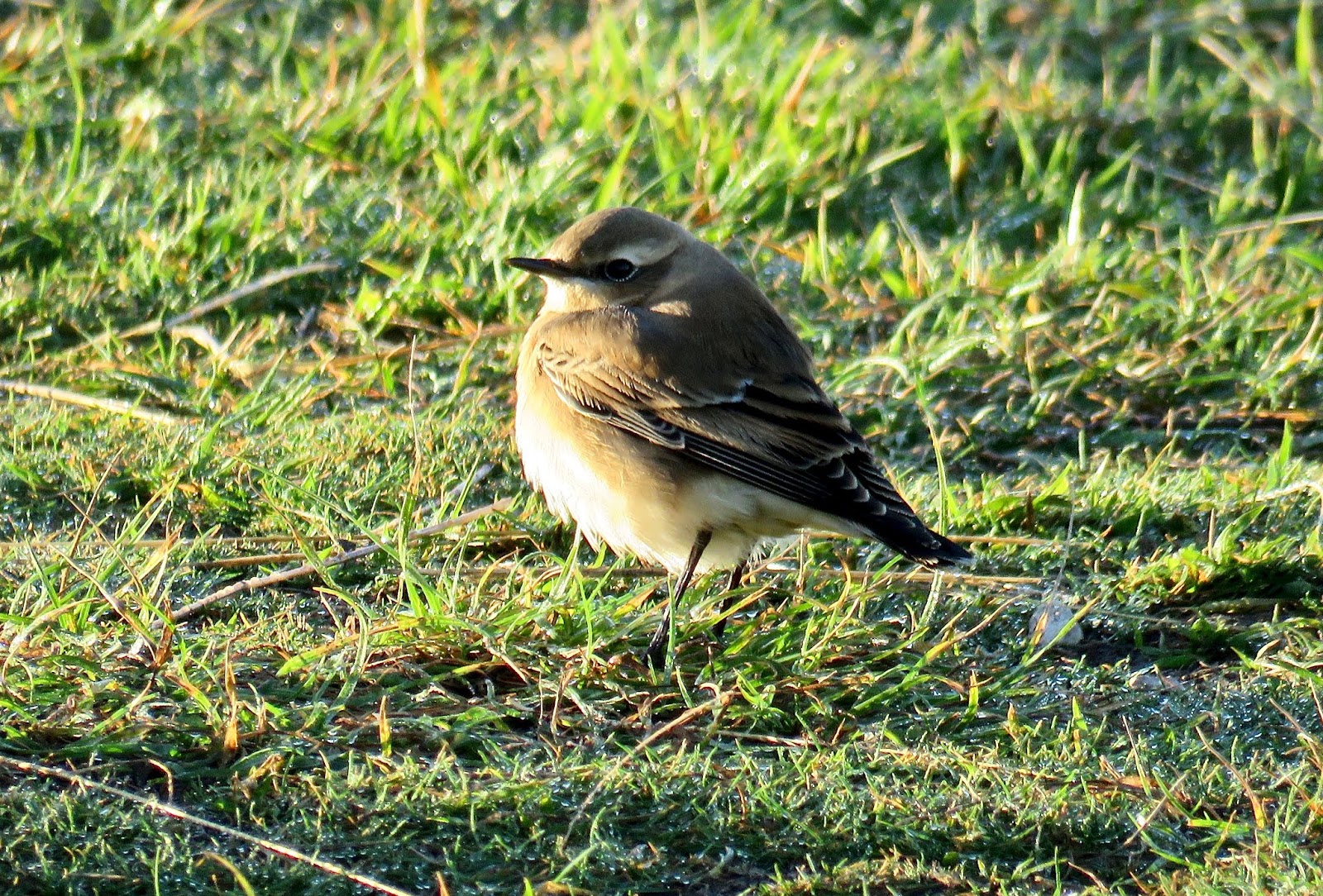
I like Wheatears. They're the best. So when the fair county of Surrey has a day when these delightful 'white-arses' are being widely observed in decent numbers I need little encouragement to get out in the field and count them. But, like all good things, they will not just appear in front of you on demand. A certain amount of toil is needed to be rewarded. I have three Wheatear hotspots close to home, but not all of them played ball. Canons Farm - no Wheatear. Priest Hill - no Wheatear. Epsom Downs - eight Wheatear! All but one on the race course itself. Seven males and a female. Mockingbird? No, as much as I can understand why many birders wanted to go and see one, give me a Wheatear any day of the week. In fact, give me several...

Summer lovin'...

Image
...happened so fast. After a few hours stomping around Epsom Downs, a male Wheatear appeared close to the grandstand, that made for a good end to the birding session. More to come in the next few days hopefully.

Kernow birds

Image
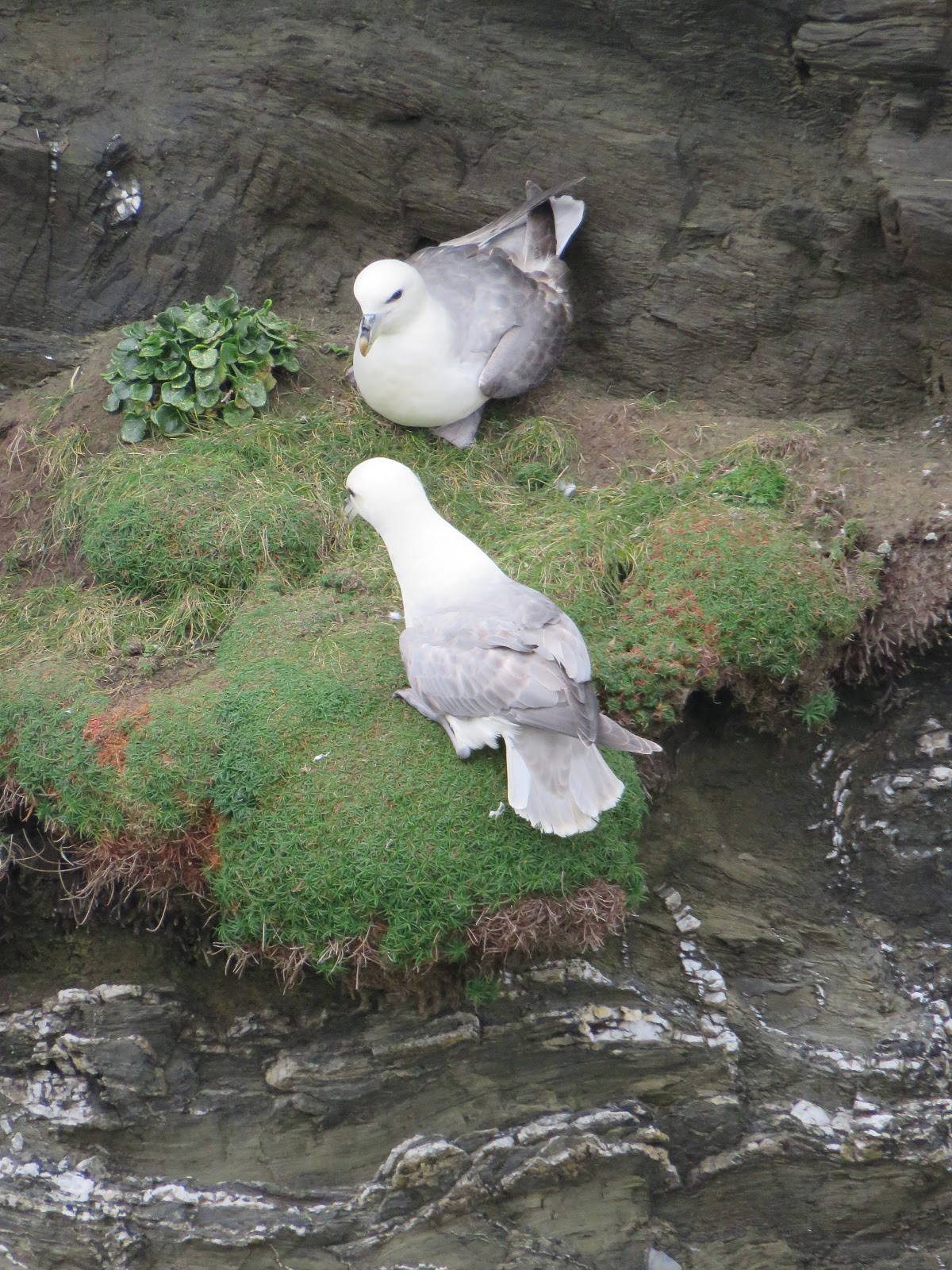
Fulmars were found along many cliff ledges Our brief spell in Cornwall is over, and although not a birding trip I did keep half an eye out. Migrant wise poor, with just a trickle of hirundines all week (mostly Swallows but with both House and Sand Martins recorded), a few Chiffchaffs and several Wheatears. Above the waves there was a constant showing of Fulmars, Gannets and Shags, with the cliff tops home to Stonechats, Ravens and the odd Peregrine. No doubt this coastal strip (from Porth to Trevose Head) has its moments, but it didn't happen while we were there. Jackdaws were always on hand for a photo-opportunity One of three Wheatears at Trevose Head, this one deciding to burst into song

The return of the ND&B Wheatear Trophy!

Image
Jono Lethbridge's award winning white-arse from 2015 IT'S BACK! After a two year break the ND&B Wheatear Trophy has been taken out of the attic, given a firm dust and loving polish, and is ready to be presented to the person who loves all things 'white-arse' above everything else. The previous winners of the trophy are: 2013 Gavin Haig 2014 Martin Casemore 2015 Jono Lethbridge 2016 Lucy@ A Natural Interlude The categories and rules are as follows: Earliest posting Whoever posts the earliest image of a 2019 UK Northern Wheatear wins this one. Blog posting only. Numbers champion (the big one!) Whoever posts the most images of Northern Wheatears between now and the end of April 2019. A photograph of five birds together will count as 5 images! Get snapping!!! No repeat images, and that means you, Peter Alfrey!! Blog posting only. Best photograph The best image of a UK Northern Wheatear in 2019 (up until the end of April), to be judged by as yet un...

Modest but productive

Image
Another visit to the 'Mole Gap' this morning, concentrating on Box Hill. Very poor return as far as vismig was concerned, with just 60 Swallows and 15 each of House Martins and Meadow Pipits (all dribbling south). A Wheatear was on the lower slope very early on, and additional back-up was provided by a Little Egret, a Red Kite, 3 Common Buzzards, 2 Sparrowhawks, a Blackcap, 3 Chiffchaffs, a Marsh Tit and 3 Ravens.

Shingle birds

Image
This Great White Egret was taking exception to a small group of Common Terns that were chasing each other and squabbling just above it. Strange to think that not that many years ago this individual would have been the subject of a nationwide twitch. And talking of 'colonisers' here's another, albeit an earlier adopter of the UK as home. Cetti's Warbler really started its northwards spread back in the 1970s, and, apart from the odd cold-weather set-back, has been expanding further north into the UK ever since. At Dungeness it is now a relatively common and widespread breeding species. The bird in the middle of this photo is the American sub-species of Black Tern. The dusky flanks and underwing do make it easy to pick out in the company of its European counterparts. This bird was present for over a week on the RSPB reserve. A modest passage of waders was enjoyed during my weeks stay, with Curlew Sandpiper, Whimbrel, Avocet, Spotted Redshank and Ruff bein...

Postcards from Cornwall

Image
Common Starling, basking in the predominant weather of our Cornish holiday - hot, dry and sunny Wall  - still extremely scarce in Surrey but easy enough to find north of Bude I was pleased to stumble across several plants of the declining 'arable weed' Field Woundwort Olearia solandri (Coastal daisy-bush), established in the sand dunes at Bude Never need an excuse to take a picture of a Wheatear - they presumably breed on the clifftops close to Bude It was good to see Bude birder Harvey Kendall (here on the right), who on this particular occasion joined me to watch a juvenile Marsh Harrier that was hunting over the lake and farmland behind the bungalow in which we were staying. I first met Harvey (and his son Ian) back in 1979 at Dungeness. We were able to reminisce and catch up over several cups of tea throughout our stay. The harrier was a Maer Lake tick for him, and one gripped back on his son!

Eight Greenlands and some small saddles

Image
Canons Farm on a still, clear morning. Little was passing overhead and if truth be told the four hours that I spent meandering across the fields and along the hedgerows were hard work - however, I really couldn't complain as there were Wheatears! Eight of them, all big, bold and brassy Greenland-types, and all bar one were males. Two of them spent a bit of time in the bizarrely named In Front George West Field whilst the rest remained faithful to Poultry Field, although all of them were wary and were never close enough to obtain anything other than purely 'record' shots. Apart from a single Grey Wagtail everything else was highly expected and I did leave a little disappointed, although whenever Wheatears are on show you cannot be totally so. A felled tree trunk that can be found alongside Lunch Wood is home to one of our most impressive species of fungi, Dryad's Saddle. At least three fruiting bodies are showing themselves (top and below) and when it reaches full...

40 years, White-arses and a Gos

Image
40 years On April 12th 1976 - 40 years ago to the very day - my 17-year old self first set foot on Dungeness and entered No. 11 RNSS, better known as Dungeness Bird Observatory. This is what I thought at the time... My first impression of Dungeness is not a favourable one. It appears an open waste of shingle, strewn with ramshackle dwellings and set against the vast nuclear power station that has squeezed perspective to such an extent that it appears two-dimensional, as if it were merely an enormous theatrical backdrop. Peering from the car making its way along the single road towards the peninsula’s point, I’m wondering what on earth I have let myself in for. I am about to join a four-day bird-watching course being held at Dungeness Bird Observatory. The focal point of our passage along to the peninsula’s snout is always the power station, dwarfing the two lighthouses that as recently as 1960 had been the tallest buildings for miles around. My attention then tur...

Wheatear Trophy update

There are just 28 days to go until the prizes are handed out at the annual North Downs and Beyond Wheatearfest! My attempts to secure the services of a celebrity to present the trophies has hit a snag, as Jeremy Clarkson has had to withdraw due to unforeseen and ongoing matters. Being a birder meant that he was prepared to carry out the Master of Ceremonies role very cheaply indeed - my budget might just about stretch to Rolf Harris (if we can secure his day release from prison, that is). At the moment there are three front runners for the big prize - of most images posted on a single blog. They are: Wanstead Birder (Jono Lethbridge) 14 Cowboy Birder (Tony Brown) - 8 Non-stop Birding (Peter Alfrey) - 7 The current holder of the title, Martin Casemore (Plodding Birder), has not been defending his title with anything but a great big dollop of apathy, as just two Wheatear images adorn his blog (although there are 564 images of the Dungeness Cattle Egrets to compensate). If I were...

The North wind doth blow

I was up and about by 05.30hrs so 'did' the moth trap in the half-light. The promise of a cloudy night hadn't materialised, so the trap was not heaving with moths - in fact, apart from a smattering of Hebrew Characters and Common Quakers there was just the single new species for the year, an Early Grey. I decided to walk up to Canons Farm, which normally takes 25 minutes. The early sun gave a weak pulse of warmth and together with the calmness made for a pleasant enough start to the day. Thoughts had foolishly turned to migrants (and by that I really mean Wheatears, hirundines and Ring Ouzels!) but the fields remained very quiet, the hedgerows were silent and the skies largely empty. Slowly, but surely, the wind started to pick up from the north, with each passing minute the temperature lowering. As if recognising such conditions, a large feeding flock of thrushes materialised, with 200 Redwing and 175 Fieldfare reminding us fools as to the real season. A lone Great Black...

White arse

Image
They're almost with us* *apparently already are in Dorset... Have you got what it takes to win a White Arse medal? (see here for details)

Pompous twat-head

Yes, I was one of those people moaning about the zillion-and-one images of Desert Wheatears that were gumming up cyberspace yesterday afternoon. It seems as if it was just me and Oscar Pistorious who didn't connect with one over the weekend. And, yes, it's me who has awarded the NDB Wheatear Trophy these past two springs in mock admiration for the blogger who had uploaded the most images of a white-arse in the month of March. So people like me had it coming - a viper-like response from one of the many Wheatear-fondlers. You can enjoy it all (including some marvellous picture) by clicking here...

Wheatear Trophy Winner 2014

Image
The North Downs and beyond Wheatear Trophy is up there in kudos with an Academy Award Oscar or the Nobel Peace Prize. Grown men have been known to cheat, steal and commit acts of violence to try and get their hands on it. The rules are simple  - which blog has unashamedly posted gratuitous images of Wheatears as the delightful little white-arses arrive on our shores. But there can only be one winner... The 2014 NDB Wheatear Trophy is awarded to..... MARTIN CASEMORE at PLODDINGBIRDER! This morning, at a lavish ceremony held at the Dungeness lifeboat station, last years winner (Gavin Haig), presented the trophy to Martin, who, as you can see from the photograph above, came dressed-up as his favourite species of bird. Two other blogs are worthy of mention in this years competition - Plover's Blog (Barney and the Bedford Plover) and Wanstead Birder (Jono Lethbridge) - both are to be commended on plastering their blogs with plenty of Wheatear action. They were beaten by a more...

It's March - it must mean Wheatears!

Birder's up and down the country are celebrating the arrival of March and with it the imminent arrival of their favourite species - Wheatear (Oenanthe whitearseii). This emblem of all things Spring should be landing along our coastal watchpoints within hours - if some haven't sneaked through already. Essex banker and Wheatear apologist Jono Lethbridge (27) said "These are my favourite birds by far. Even better than shrikes, and I bloody love shrikes, me". The 35-year old continued, "I can't wait to train my big lens onto one. I even lived in North Africa this winter to get my Wheatear fix. In all of the 44 years I've been birding I don't think I've ever been so excited!" Down in Kent, two Dungeness regulars are preparing themselves for civil war of a Wheatear kind. Paul Trodd (63) and 17-year old Martin Casemore (The Plodding Birder) have cornered the market in Wheatear photography. Last year Martin's blog showcased 578 photographs of...